. 2013 Dec 27;8(12):e83984.
doi: 10.1371/journal.pone.0083984. eCollection 2013.

Characterizing the infection-induced transcriptome of Nasonia vitripennis reveals a preponderance of taxonomically-restricted immune genes

Affiliations

Characterizing the infection-induced transcriptome of Nasonia vitripennis reveals a preponderance of taxonomically-restricted immune genes

Timothy B Sackton et al. PLoS One. .

Abstract

The innate immune system in insects consists of a conserved core signaling network and rapidly diversifying effector and recognition components, often containing a high proportion of taxonomically-restricted genes. In the absence of functional annotation, genes encoding immune system proteins can thus be difficult to identify, as homology-based approaches generally cannot detect lineage-specific genes. Here, we use RNA-seq to compare the uninfected and infection-induced transcriptome in the parasitoid wasp Nasonia vitripennis to identify genes regulated by infection. We identify 183 genes significantly up-regulated by infection and 61 genes significantly down-regulated by infection. We also produce a new homology-based immune catalog in N. vitripennis, and show that most infection-induced genes cannot be assigned an immune function from homology alone, suggesting the potential for substantial novel immune components in less well-studied systems. Finally, we show that a high proportion of these novel induced genes are taxonomically restricted, highlighting the rapid evolution of immune gene content. The combination of functional annotation using RNA-seq and homology-based annotation provides a robust method to characterize the innate immune response across a wide variety of insects, and reveals significant novel features of the Nasonia immune response.


Conflict of interest statement

Competing Interests: The authors have declared that no competing interests exist.

Figures

Figure 1
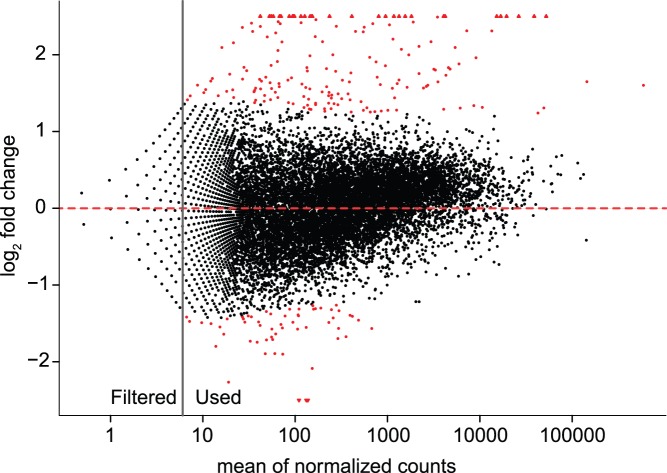
Figure 1. MA plot of differentially expressed genes between Infected and Uninfected treatments.
Points in red indicate significance at an FDR of 10%. Points with a mean counts below the dashed line were filtered prior to multiple test correction, as genes with low mean counts across conditions have little or no power to detect differential expression (see methods for more details). Triangles represent points with log2 fold change greater than 2.5 or less than −2.5.
Figure 2
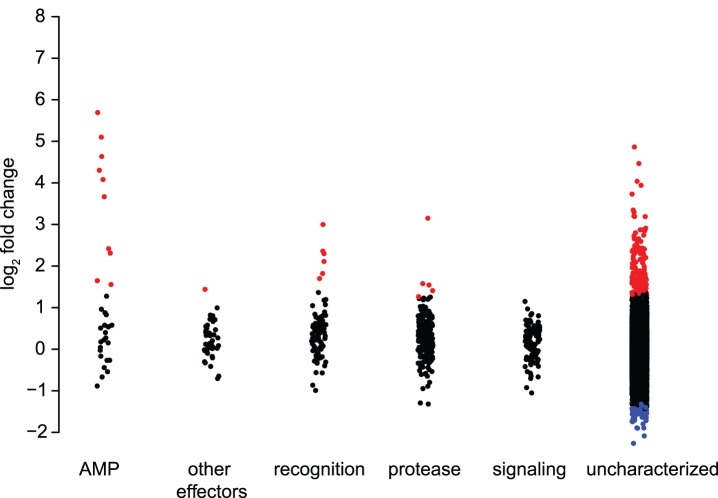
Figure 2. Fold change of immune-annotated and non-immune annotated genes after infection.
Scatterplot (with jitter of overlapping points) showing fold-change for AMPs, other effectors, recognition, signaling, proteases, and non-immune genes. Points in red represent significant up-regulation after infection, points in blue represent significant down-regulation.
Figure 3
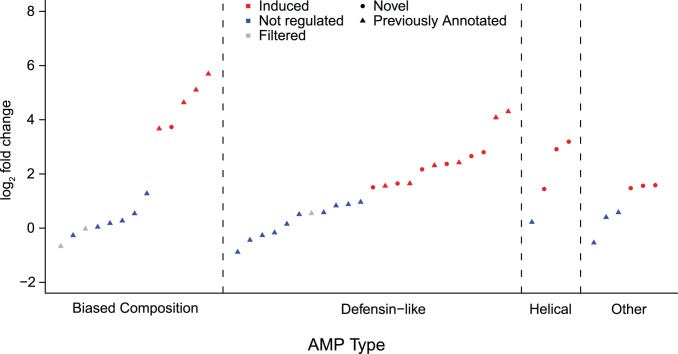
Figure 3. Induction of known and putative novel AMPs after infection.
All 34 previously identified AMPs (excluding Nasonin-7 which does not have detectable expression in our dataset), plus the 14 putative novel AMPs, are plotted on the X-axis, ordered by AMP class and degree of induction (log2 fold change, on the Y-axis). Points are colored by differential expression class, with different shapes for novel and homology-annotated genes.
Figure 4
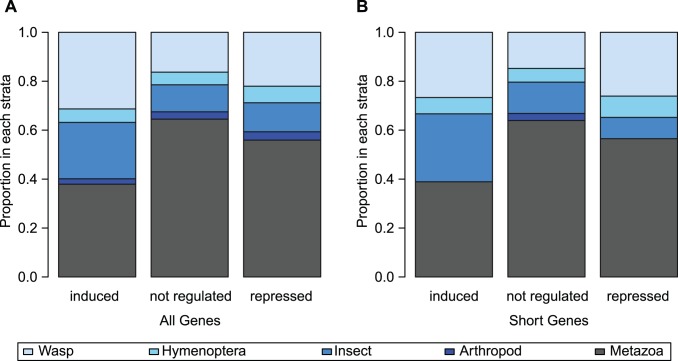
Figure 4. Phylogenetic strata for genes of different expression classes.
A) All genes, which includes all expressed genes. B) Short genes, which includes only genes encoding proteins between 134 and 456 amino acids, inclusive.
Figure 5
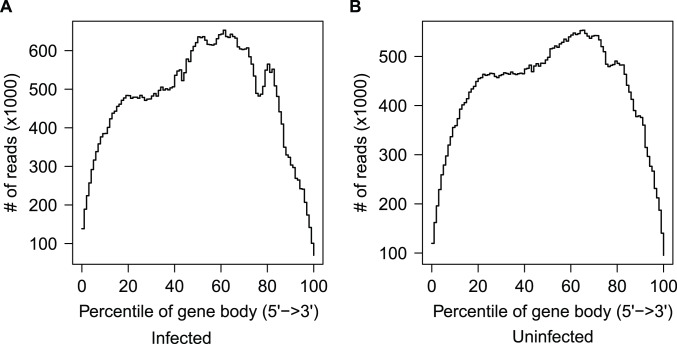
Figure 5. Distribution of read coverage along genes for the A) infected and B) uninfected library.
For each library, the distribution of reads mapped across the normalized gene body length, as calculated by RSeQC based on reads mapped to Nvit1.0 scaffolds. Each gene is divided into bins of 0.01×length and reads mapped to each bin are summed across genes.

References

    1. Hughes AL, Nei M (1988) Pattern of nucleotide substitution at major histocompatibility complex class I loci reveals overdominant selection. Nature 335: 167–170 10.1038/335167a0 - DOI - PubMed
    1. Kosiol C, Vinar T, da Fonseca RR, Hubisz MJ, Bustamante CD, et al. (2008) Patterns of positive selection in six mammalian genomes. PLoS Genet 4: e1000144 10.1371/journal.pgen.1000144 - DOI - PMC - PubMed
    1. Bulmer MS, Crozier RH (2006) Variation in positive selection in termite GNBPs and Relish. Mol Biol Evol 23: 317–326 10.1093/molbev/msj037 - DOI - PubMed
    1. Obbard DJ, Welch JJ, Kim K-W, Jiggins FM (2009) Quantifying adaptive evolution in the Drosophila immune system. PLoS Genet 5: e1000698 10.1371/journal.pgen.1000698 - DOI - PMC - PubMed
    1. Sackton TB, Lazzaro BP, Schlenke TA, Evans JD, Hultmark D, et al. (2007) Dynamic evolution of the innate immune system in Drosophila. Nat Genet 39: 1461–1468 10.1038/ng.2007.60 - DOI - PubMed

Publication types

Substances