. 2013 Nov;4(11-12):419-26.
doi: 10.1177/1947601913513950.

MAP3K1: Genomic Alterations in Cancer and Function in Promoting Cell Survival or Apoptosis

Affiliations

MAP3K1: Genomic Alterations in Cancer and Function in Promoting Cell Survival or Apoptosis

Trang T Pham et al. Genes Cancer. 2013 Nov.

Abstract

MAP3K1 is a member of the mitogen-activated protein kinase kinase kinase (MAP3K) family of serine/threonine kinases. MAP3K1 regulates JNK activation and is unique among human kinases in that it also encodes an E3 ligase domain that ubiquitylates c-Jun and ERK1/2. Full length MAP3K1 regulates cell migration and contributes to pro-survival signaling while its caspase 3-mediated cleavage generates a C-terminal kinase domain that promotes apoptosis. The critical function of MAP3K1 in cell fate decisions suggests that it may be a target for deregulation in cancer. Recent large-scale genomic studies have revealed that MAP3K1 copy number loss and somatic missense or nonsense mutations are observed in a significant number of different cancers, being most prominent in luminal breast cancer. The alteration of MAP3K1 in diverse cancer types demonstrates the importance of defining phenotypes for possible therapeutic targeting of tumor cell vulnerabilities created when MAP3K1 function is lost or gained.

Keywords: MAP3K; MEKK; apoptosis; protein kinase.


Conflict of interest statement

Declaration of Conflicting Interests: The author(s) declared no potential conflicts of interest with respect to the research, authorship, and/or publication of this article.

Figures

Figure 1.
Figure 1.
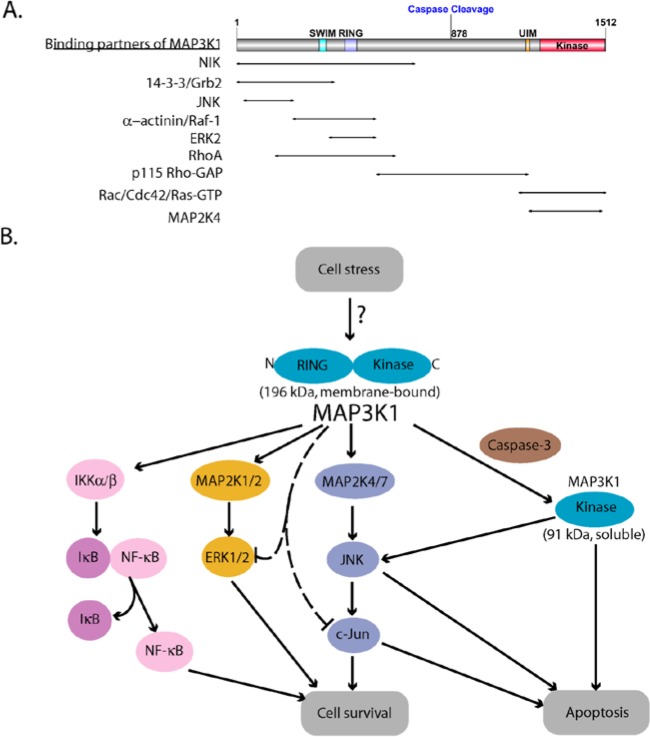
MAP3K1 domain organization and dual roles in cell survival and apoptosis. (A) Schematic structure of MAP3K1. It contains a SWIM and a RING zinc finger domain near the N-terminus and a serine/threonine kinase domain at the C-terminus. Caspase-3 cleavage occurs at the aspartate 874 of the mouse MAP3K1, which is equivalent to residue 878 of the human homolog. The protein domain structure was created using DOG 1.0 program. MAP3K1 also harbors binding sites for multiple upstream and downstream proteins indicated by the arrows. (B) MAP3K1 has a switch-like function that determines cell fate. Activation of MAP2K4/7-JNK-c-Jun, MAP2K1/2-ERK1/2, and NF-κB mediated by full length MAP3K1 promotes cell survival while caspase cleavage, which generates the soluble active kinase domain, induces apoptosis. MAP3K1 also ubiquitylates c-Jun and ERK1/2, leading to their degradation.
Figure 2.
Figure 2.
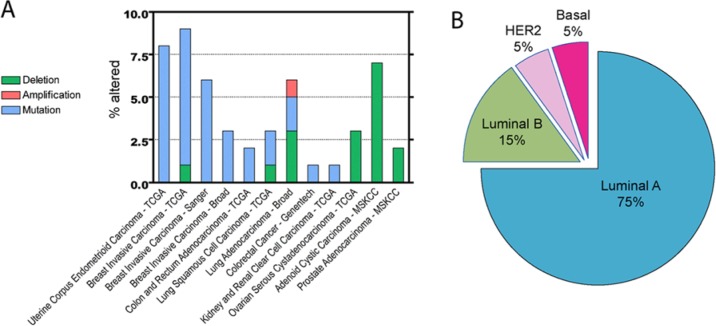
Alterations in MAP3K1 genes are observed at relatively low frequency in multiple cancers with prevalent occurrence in luminal A breast cancer. (A) Histogram illustrating the percentage of MAP3K1 alterations for each cancer study: deletion (green), amplification (red), mutation (blue). (B) Alterations of MAP3K1 in the TCGA Breast Invasive Carcinoma data set are predominant in the luminal A, followed by luminal B, breast cancer subtypes. The data were obtained and analyzed by cBioPortal (http://www.cbioportal.org/public-portal/).,
Figure 3.
Figure 3.
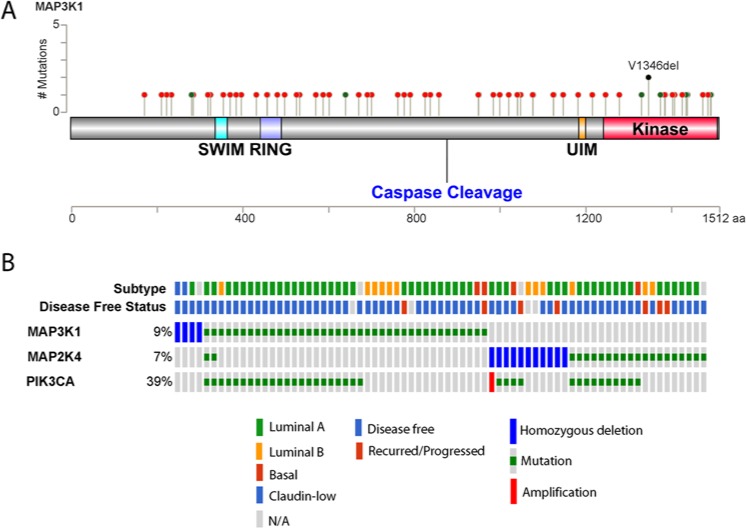
Characterization of MAP3K1 alterations in breast cancer. (A) Somatic mutations found in MAP3K1 gene by the TCGA Breast Invasive Carcinoma study are predicted to be loss-of-function. The mutations are represented by circles: nonsense, splicing mutations, frameshift deletion, and insertion (red), missense mutations (green), and inframe deletion (black). (B) MAP3K1 alterations in breast cancer are mutually exclusive with those of MAP2K4 and partially overlap with those of PIK3CA. Shown is the oncoprint of MAP3K1, MAP2K4, and PIK3CA genes, in which individual samples are represented as columns and individual genes are represented as rows. Subtype assignment and disease-free status of the patients are shown in the first 2 rows. The data were obtained and visualized by cBioPortal database using the TCGA Breast Invasive Carcinoma data set with modifications.

References

    1. Kyriakis JM, Avruch J. Mammalian mitogen-activated protein kinase signal transduction pathways activated by stress and inflammation. Physiol Rev. 2001;81:807-69 - PubMed
    1. Uhlik MT, Abell AN, Cuevas BD, Nakamura K, Johnson GL. Wiring diagrams of MAPK regulation by MEKK1, 2, and 3. Biochem Cell Biol. 2004;82:658-63 - PubMed
    1. Cuevas BD, Abell AN, Johnson GL. Role of mitogen-activated protein kinase kinase kinases in signal integration. Oncogene. 2007;26:3159-71 - PubMed
    1. Hagemann C, Blank JL. The ups and downs of MEK kinase interactions. Cell Signal. 2001;13:863-75 - PubMed
    1. Lange-Carter CA, Pleiman CM, Gardner AM, Blumer KJ, Johnson GL. A divergence in the MAP kinase regulatory network defined by MEK kinase and Raf. Science. 1993;260:315-9 - PubMed