. 2014 Aug;15(6):589-600.
doi: 10.1111/mpp.12117. Epub 2014 Feb 19.

Host perception of jasmonates promotes infection by Fusarium oxysporum formae speciales that produce isoleucine- and leucine-conjugated jasmonates

Affiliations

Host perception of jasmonates promotes infection by Fusarium oxysporum formae speciales that produce isoleucine- and leucine-conjugated jasmonates

Stephanie J Cole et al. Mol Plant Pathol. 2014 Aug.

Abstract

Three pathogenic forms, or formae speciales (f. spp.), of Fusarium oxysporum infect the roots of Arabidopsis thaliana below ground, instigating symptoms of wilt disease in leaves above ground. In previous reports, Arabidopsis mutants that are deficient in the biosynthesis of abscisic acid or salicylic acid or insensitive to ethylene or jasmonates exhibited either more or less wilt disease, than the wild-type, implicating the involvement of hormones in the normal host response to F. oxysporum. Our analysis of hormone-related mutants finds no evidence that endogenous hormones contribute to infection in roots. Mutants that are deficient in abscisic acid and insensitive to ethylene show no less infection than the wild-type, although they exhibit less disease. Whether a mutant that is insensitive to jasmonates affects infection depends on which forma specialis (f. sp.) is infecting the roots. Insensitivity to jasmonates suppresses infection by F. oxysporum f. sp. conglutinans and F. oxysporum f. sp. matthioli, which produce isoleucine- and leucine-conjugated jasmonate (JA-Ile/Leu), respectively, in culture filtrates, whereas insensitivity to jasmonates has no effect on infection by F. oxysporum f. sp. raphani, which produces no detectable JA-Ile/Leu. Furthermore, insensitivity to jasmonates has no effect on wilt disease of tomato, and the tomato pathogen F. oxysporum f. sp. lycopersici produces no detectable jasmonates. Thus, some, but not all, F. oxysporum pathogens appear to utilize jasmonates as effectors, promoting infection in roots and/or the development of symptoms in shoots. Only when the infection of roots is promoted by jasmonates is wilt disease enhanced in a mutant deficient in salicylic acid biosynthesis.

Keywords: Arabidopsis thaliana; COI1; Fusarium oxysporum; Fusarium wilt; jasmonate.


Figures

Figure 1
Figure 1
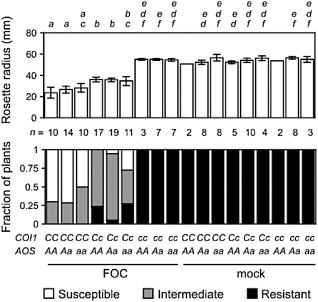
CORONATINE‐INSENSITIVE 1 (COI1) promotes wilt disease from Fusarium oxysporum f. sp. conglutinans (FOC) infection. Genotypes of FOC‐infected or mock‐infected offspring of the dihybrid COI1/coi1 ALLENE OXIDE SYNTHASE (AOX)/aos were COI1/COI1 (CC), COI1/coi1 (Cc) or coi1/coi1 (cc) and AOS/AOS (AA), AOS/aos (Aa) or aos/aos (aa). Wilt symptoms at 20 days post‐infection (dpi). Top graph, the mean radius of rosettes of n plants in millimetres. Error bars are the confidence intervals of the means (α = 0.05). Means with the same italicized letter (above) are not significantly different, according to Student's t‐test (P > 0.01). Bottom graph: fractions of n plants resistant (health index, HI| ≥ 4) or susceptible (HI < 3) or with intermediate resistance (HI ≥ 3 and HI < 4).
Figure 2
Figure 2
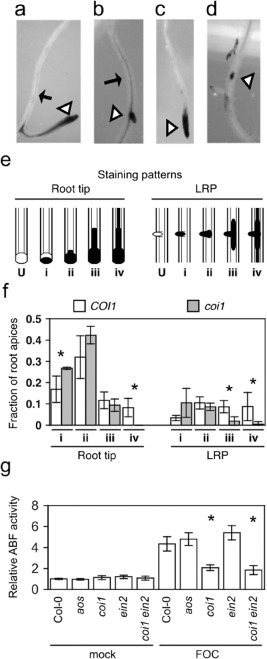
CORONATINE‐INSENSITIVE 1 (COI1) promotes infection by Fusarium oxysporum f. sp. conglutinans (FOC). Representative FOC‐infected apices (at triangles) of wild‐type (a, b) and coi1 (c, d), with 5‐bromo‐4‐chloro‐3‐indoxyl‐α‐l‐arabinofuranoside (X‐Ara) staining patterns (ii) and (iv), respectively. Arrows point to fine vascular staining. (e) Depictions of unstained root apices (U) and common patterns of X‐Ara staining (filled) at root tips and lateral root primordia (LRP): (i) partial staining of undifferentiated apices; (ii) staining throughout undifferentiated apices; (iii) broad vascular staining extending for short distances from apices; and (iv) fine, extensive vascular staining away from apices. (f) Fractions of patterns in whole‐root systems of three FOC‐infected wild‐type (COI1) and coi1 at 4–5 days post‐infection (dpi). Error bars are confidence intervals of the means (α = 0.05). Asterisks indicate that the mean values of COI1 and coi1 are different, according to Student's t‐test (α = 0.05). (g) Relative arabinofuranosidase (ABF) activity was quantified in FOC‐infected wild‐type (Col‐0, n = 5), allene oxide synthase (aos) (n = 5), coi1 (n = 4), ethylene‐insensitive 2 (ein2) (n = 5) and coi1 ein2 (n = 5) or mock‐infected plants (n = 3) at 10 dpi, and values are relative to the mean of mock‐infected Col‐0 roots. Error bars are the confidence intervals of the means, and asterisks indicate that mean values of Col‐0 and the mutant are different, according to Student's t‐test (α = 0.05).
Figure 3
Figure 3
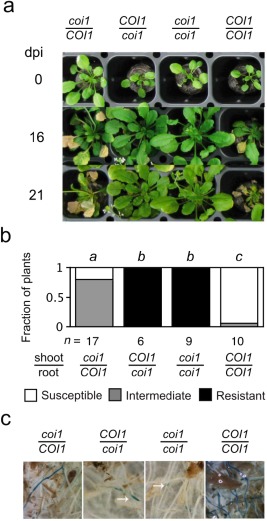
CORONATINE‐INSENSITIVE 1 (COI1) promotes symptoms in Fusarium oxysporum f. sp. conglutinans (FOC)‐infected plants. Grafted plants from scions (top) and rootstocks (bottom) that were wild‐type (COI1) or coi1 were infected with FOC. (a) Representative grafts are shown at 0, 16 and 21 days post‐infection (dpi). (b) At 16 dpi, fractions of n grafted plants were susceptible (0 ≤ health index, HI < 2), had intermediate resistance (2 ≤ HI ≤ 3) or were resistant (3 < HI ≤ 5). Grafts with the same italicized letter (above) had similar HI scores, according to Mann–Whitney U‐test (P > 0.01). (c) At 21 days, 5‐bromo‐4‐chloro‐3‐indoxyl‐α‐l‐arabinofuranoside (X‐Ara) staining in roots of grafts is shown. Note that the staining of coi1 rootstocks is restricted to the root tips (at arrows).
Figure 4
Figure 4
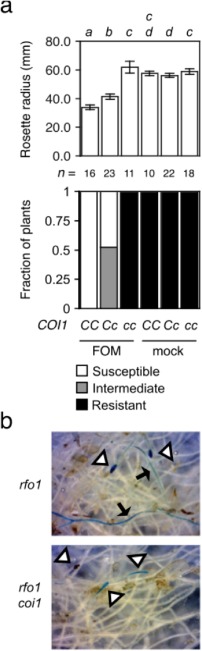
CORONATINE‐INSENSITIVE 1 (COI1) promotes infection by Fusarium oxysporum f. sp. matthioli (FOM). Genotypes of FOM‐ or mock‐infected offspring of the monohybrid double mutant resistance to F. oxysporum 1 (rfo1) COI1/coi were COI1/COI1 (CC), COI1/coi1 (Cc) or coi1/coi1 (cc). (a) Wilt symptoms at 20 days post‐infection (dpi). Top graph: the mean radius of rosettes of n plants is in millimetres. Error bars are the confidence intervals of the means (α = 0.05). Means with the same italicized letter (above) have no significant difference, according to Student's t‐test (P > 0.01). Bottom graph: fractions of n plants that were resistant (health index, HI = 5), susceptible (HI = 3) or showed intermediate resistance (HI = 4). (b) At 20 dpi, 5‐bromo‐4‐chloro‐3‐indoxyl‐α‐l‐arabinofuranoside (X‐Ara) stains root apices (at triangles) of FOM‐infected rfo1 and rfo1 coi1, and arrows point to fine vascular staining in roots of rfo1.
Figure 5
Figure 5
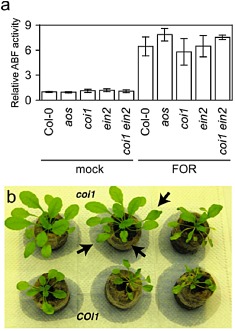
CORONATINE‐INSENSITIVE 1 (COI1) promotes symptoms in Fusarium oxysporum f. sp. raphani (FOR)‐infected plants. (a) Relative arabinofuranosidase (ABF) activity was quantified in FOR‐infected wild‐type (Col‐0), allene oxide synthase (aos), coi1, ethylene‐insensitive 2 (ein2) and coi1 ein2 or mock‐infected plants (n = 3) at 10 days post‐infection (dpi). Error bars are the confidence intervals of the means (α = 0.05). (b) Foliar symptoms, such as stunting, epinasty and darkening (anthocyanin accumulation) of leaves, in FOR‐infected wild‐type (bottom row) were suppressed in infected coi1 (top row). Note wilted leaves (at arrows) on coi1 in watered soil.
Figure 6
Figure 6
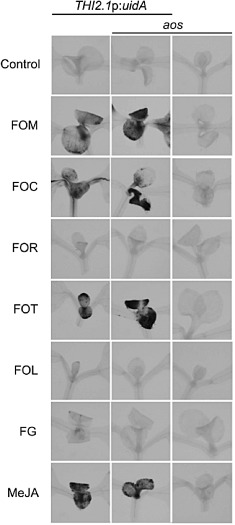
Fusarium culture filtrates induce THI2.1p:uidA. THI2.1p:uidA is induced by jasmonates in meristems and the first true leaves of young seedlings and expresses β‐glucuronidase (GUS), which hydrolyses the indigogenic substrate 5‐bromo‐4‐chloro‐3‐indoxyl‐β‐d‐glucuronic acid (XGluc) (Vignutelli et al., 1998). GUS activity in seedlings of THI2.1p:uidA (left), allene oxide synthase (aos) THI2.1p:uidA (middle) and aos (right) is stained blue by XGluc 1 day after treatment with culture filtrates of Fusarium strains, F. oxysporum f. sp. matthioli (FOM) race 2, F. oxysporum f. sp. conglutinans (FOC) race 1, F. oxysporum f. sp. raphani (FOR), F. oxysporum f. sp. tulipae (FOT), F. oxysporum f. sp. lycopersici (FOL) race 2 and F. graminearum (FG) or methyl jasmonate (MeJA). Results with FOL race 2 and race 3 (not shown) were similar.
Figure 7
Figure 7
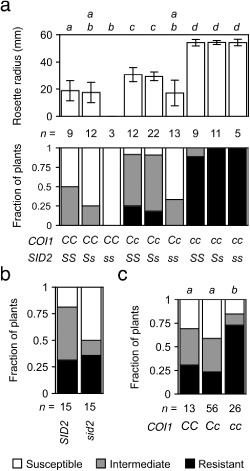
CORONATINE‐INSENSITIVE 1 (COI1)‐dependent susceptibility is independent of salicylic acid (SA). Wilt symptoms at 20 days post‐infection (dpi). (a) Fusarium oxysporum f. sp. conglutinans (FOC)‐infected offspring of the dihybrid COI1/coi1 SALICYLIC ACID INDUCTION‐DEFICIENT 2 (SID2)/sid2 were COI1/COI1 (CC), COI1/coi1 (Cc) or coi1/coi1 (cc) and SID2/SID2 (SS), SID2/sid2 (Ss) or sid2/sid2 (ss). Top graph: mean radius of rosettes of n plants in millimetres. Error bars are the confidence intervals of the means (α = 0.05). Means with the same italicized letter (above) have no significant difference, according to Student's t‐test (P > 0.01). Bottom graph of (a), and (b) and (c): fraction of n plants that were resistant (health index, HI > 3) or susceptible (HI < 2) or had intermediate resistance (2 ≤ HI ≤ 3). No symptoms were apparent in mock‐infected plants (not shown). (b) Wild‐type (SID2) and sid2 were infected with F. oxysporum f. sp. raphani (FOR). (c) FOR‐infected offspring of the monohybrid double mutant sid2 COI1/coi1 were COI1/COI1 (CC), COI1/coi1 (Cc) or coi1/coi1 (cc). Similar HI scores, according to Mann–Whitney U‐test (P > 0.01), have the same italicized letter above.
Figure 8
Figure 8
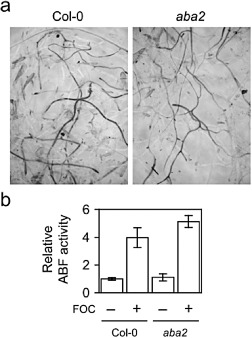
Fusarium oxysporum f. sp. conglutinans (FOC) infection in abscisic acid‐deficient 2 (aba2). (a) At 7 days post‐infection (dpi), 5‐bromo‐4‐chloro‐3‐indoxyl‐α‐l‐arabinofuranoside (X‐Ara) staining was similar in roots of FOC‐infected wild‐type (Col‐0) and aba2. (b) Relative arabinofuranosidase (ABF) activity in roots of FOC‐infected (+; n = 5) or mock‐infected (–; n = 3) plants was quantified using nitrophenyl‐α‐l‐arabinofuranoside (NP‐Ara). Fresh weights (± standard deviations) of whole‐root systems of wild‐type and aba2 were 28 (± 8) and 15 (± 3) mg, respectively. Comparison of ABF activity in infected wild‐type and aba2 using the Student's t‐test gives two‐tailed P = 0.026.
Figure 9
Figure 9
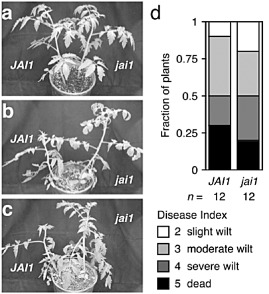
Fusarium wilt in tomato jasmonic acid‐insensitive 1 (jai1). Representative wild‐type (JAI1) and jasmonate‐insensitive jai1 plants that were mock infected (a) or infected with Fusarium oxysporum f. sp. lycopersici (FOL) race 3 (b, c) are shown at 21 days post‐infection (dpi). Lower leaves of FOL‐infected plants exhibit epinasty and premature senescence when compared with uninfected plants. (d) At 35 dpi, symptoms of FOL‐infected JAI1 (n = 12) and jai1 (n = 12) plants were scored using a disease index: healthy (0), slightly wilted (1), moderately wilted (2), severely wilted (4) and dead (5). Mock‐infected JAI1 (n = 6) and jai1 (n = 6) plants exhibited no wilt symptoms.

References

    1. Aboul‐Soud, M.A. , Yun, B.W. , Harrier, L.A. and Loake, G.J. (2004) Transformation of Fusarium oxysporum by particle bombardment and characterisation of the resulting transformants expressing a GFP transgene. Mycopathologia, 158, 475–482. - PubMed
    1. Alonso, J.M. , Hirayama, T. , Roman, G. , Nourizadeh, S. and Ecker, J.R. (1999) EIN2, a bifunctional transducer of ethylene and stress responses in Arabidopsis. Science, 284, 2148–2152. - PubMed
    1. Anderson, J.P. , Badruzsaufari, E. , Schenk, P.M. , Manners, J.M. , Desmond, O.J. , Ehlert, C. , Maclean, D.J. , Ebert, P.R. and Kazan, K. (2004) Antagonistic interaction between abscisic acid and jasmonate ethylene signaling pathways modulates defense gene expression and disease resistance in Arabidopsis. Plant Cell, 16, 3460–3479. - PMC - PubMed
    1. Beckman, C.H. (1987) The Nature of Wilt Diseases of Plants. St. Paul, MN: American Phytopathological Society.
    1. Beckman, C.H. and Roberts, E.M. (1995) On the nature and genetic basis for resistance and tolerance to Fungal wilt diseases of plants. Adv. Bot. Res. 21, 35–77.

Publication types

MeSH terms

LinkOut - more resources