


Prevalence of and associations with allergic rhinitis in children with chronic rhinosinusitis
- PMID: 24388318
- PMCID: PMC3966022
- DOI: 10.1016/j.ijporl.2013.12.006
Prevalence of and associations with allergic rhinitis in children with chronic rhinosinusitis
Abstract
Objectives: Chronic rhinosinusitis (CRS) in children has been associated with a variety of disorders including atopic disease, cystic fibrosis, immunologic disorders and ciliary dyskinesia. Although a strong association, or even cause and effect relationship, between allergic rhinitis (AR) and CRS is commonly assumed, the epidemiologic relationship between these disorders has not yet been defined in children.
Methods: A retrospective review of all children diagnosed with CRS on otolaryngology or allergy office evaluation at a large tertiary-care pediatric hospital over a ten-year period was performed. Demographic data and concomitant diagnoses of AR, cystic fibrosis, immunologic disorders and primary ciliary dyskinesia were analyzed for relationships with CRS.
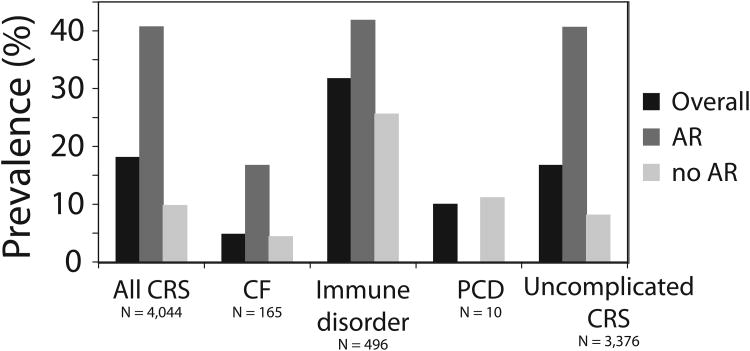
Results: A total of 4044 children with an average age of 8.9 years and a slight male predominance (53.8%) with CRS were identified. Of these children, 0.2% had primary ciliary dyskinesia, 4.1% had cystic fibrosis, 12.3% had an immunologic disorder, and 26.9% had AR. A concomitant asthma diagnosis was positively associated with a diagnosis of AR (OR=6.24, 95% CI: 5.27-7.39, P<0.001), whereas a concomitant cystic fibrosis diagnosis was negatively associated (OR=0.12, 95% CI: 0.06-0.26, P<0.001).
Conclusions: AR is more prevalent than the other comorbidities combined in children with CRS, and is independently associated with the presence of asthma. Formal allergy testing, guided by clinical history and regional allergen sensitivity prevalence, should be strongly considered in all children with CRS, in particular those with reactive airway disease.
Keywords: Allergic rhinitis; Asthma; Chronic rhinosinusitis; Hypersensitivity; Pediatrics; Sinusitis.
Copyright © 2013. Published by Elsevier Ireland Ltd.
Conflict of interest statement
Figures
References
-
- Van Crombruggen K, Zhang N, Gevaert P, et al. Pathogenesis of chronic rhinosinusitis: inflammation. J Allergy Clin Immunol. 2011 Oct;128(4):728–732. - PubMed
-
- Payne SC, Borish L, Steinke JW. Genetics and phenotyping in chronic sinusitis. J Allergy Clin Immunol. 2011 Oct;128(4):710–20. quiz 721-2. - PubMed
-
- Berger G, Kogan T, Paker M, et al. Pediatric chronic rhinosinusitis histopathology: differences and similarities with the adult form. Otolaryngol Head Neck Surg. 2011 Jan;144(1):85–90. - PubMed
-
- Wald ER, Guerra N, Byers C. Upper respiratory tract infections in young children: duration of and frequency of complications. Pediatrics. 1991 Feb;87(2):129–133. - PubMed
-
- Revai K, Dobbs LA, Nair S, et al. Incidence of acute otitis media and sinusitis complicating upper respiratory tract infection: the effect of age. Pediatrics. 2007 Jun;119(6):e1408–12. - PubMed
Publication types
MeSH terms
Grants and funding
LinkOut - more resources
Full Text Sources
Other Literature Sources
Medical
Research Materials
