


Delay discounting and task performance consistency in patients with schizophrenia
- PMID: 24388727
- PMCID: PMC4388189
- DOI: 10.1016/j.psychres.2013.11.013
Delay discounting and task performance consistency in patients with schizophrenia
Abstract
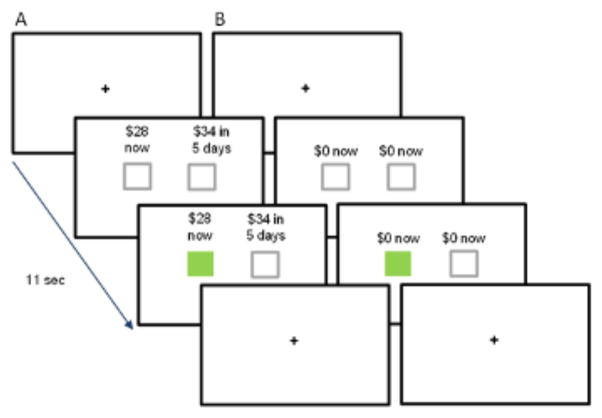
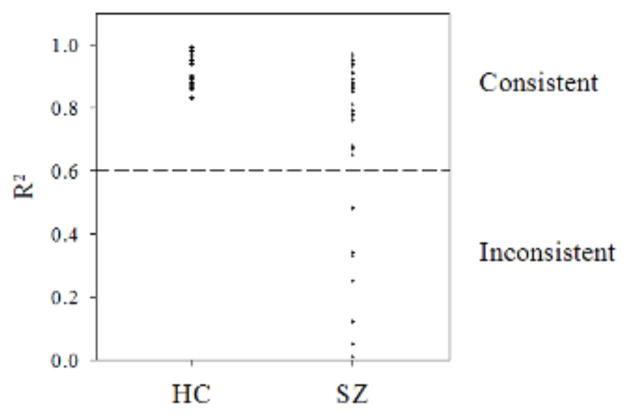
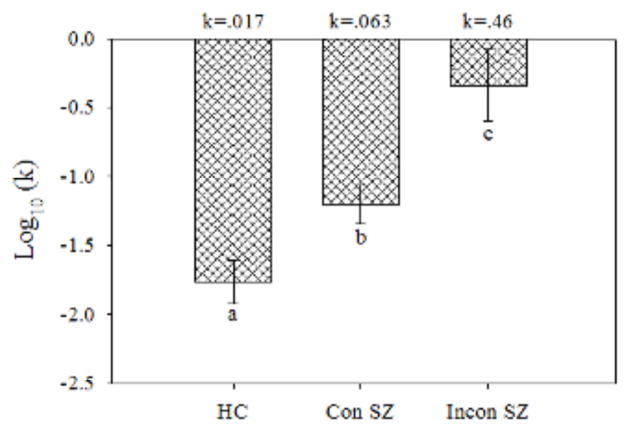
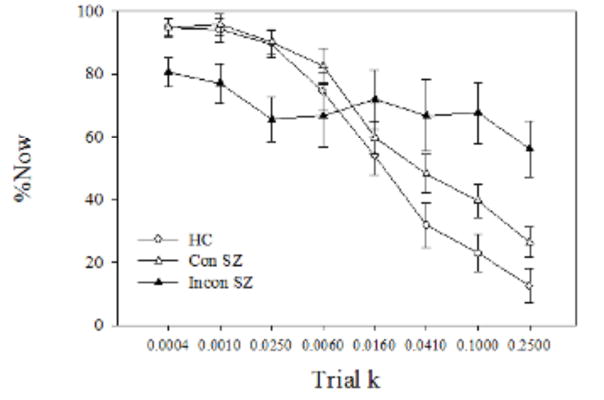
To study impaired goal-oriented behavior in schizophrenia (SZ), we used a delay discounting task, which consists of a series of choices between receiving a small immediate or larger delayed reward. Few studies of delay discounting have evaluated response consistency (R(2)), which is especially relevant in SZ because of documented inconsistency in task performance. We calculated the rate of discounting (k) and R(2) in SZ (n=35) and healthy controls (HC; n=21). Using a criterion value of R(2)>0.60 to define consistent performance allowed us to compare discounting in consistent SZ and HC, as well as in inconsistent SZ. Groups did not differ significantly in smoking. Compared to HC, consistent SZ showed greater delay discounting. Both groups exhibited similar patterns of decreasing immediate choices across trial categories, although the decrease was less for SZ. Separate analyses on smokers and non-smokers showed that this group difference was carried by the non-smokers. Inconsistent SZ discounted more than HC and consistent SZ, but their aberrant pattern of choices casts doubt on the validity of their calculated k values.
Keywords: Decision making; Executive function; Intertemporal.
© 2013 Published by Elsevier Ireland Ltd.
Figures
References
-
- American Psychiatric Association. Diagnostic and Statistical Manual of Mental Disorders: DSM-IV-TR. 4. APA; Washington, DC: 2000. revised.
-
- Ainslie G. Specious reward: a behavioral theory of impulsiveness and impulse control. Psychological Bulletin. 1975;82:463–496. - PubMed
-
- Baker F, Johnson MW, Bickel WK. Delay discounting in current and never-before cigarette smokers: similarities and differences across commodity, sign, and magnitude. Journal of Abnormal Psychology. 2003;112:382–392. - PubMed
Publication types
MeSH terms
Grants and funding
LinkOut - more resources
Full Text Sources
Other Literature Sources
