


Safety and efficacy of renal denervation as a novel treatment of ventricular tachycardia storm in patients with cardiomyopathy
- PMID: 24389229
- PMCID: PMC4253025
- DOI: 10.1016/j.hrthm.2013.12.038
Safety and efficacy of renal denervation as a novel treatment of ventricular tachycardia storm in patients with cardiomyopathy
Abstract
Background: Modulation of the autonomic nervous system has been used to treat refractory ventricular tachycardia (VT). Renal artery denervation (RDN) is under investigation for the treatment of sympathetic-driven cardiovascular diseases.
Objective: The purpose of this study was to report the largest case series to date using RDN as adjunctive therapy for refractory VT in patients with underlying cardiomyopathy.
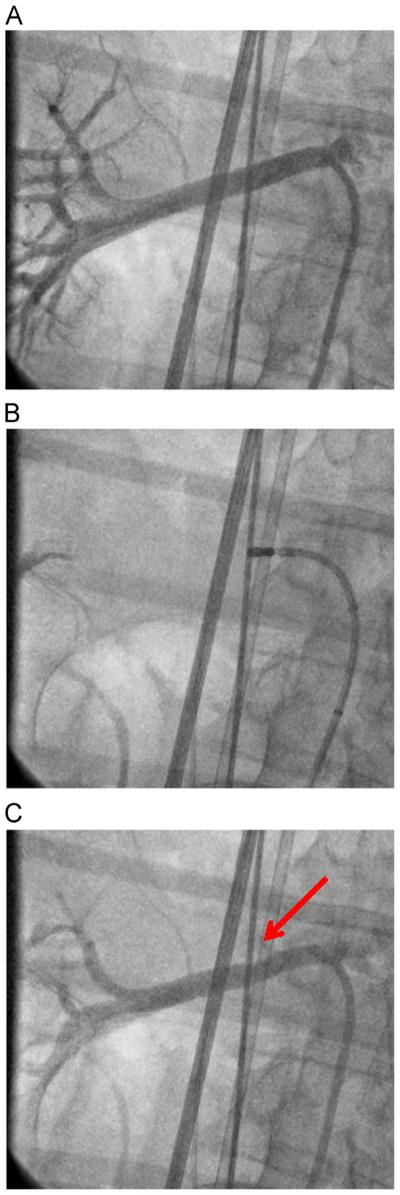
Methods: Four patients with cardiomyopathy (2 nonischemic, 2 ischemic) with recurrent VT despite maximized antiarrhythmic therapy and prior endocardial (n = 2) or endocardial/epicardial (n = 2) ablation underwent RDN ± repeat VT ablation. RDN was performed spirally along each main renal artery with either a nonirrigated (6 W at 50°C for 60 seconds) or an open irrigated ablation catheter (10-12 W for 30-60 seconds). Renal arteriography was performed before and after RDN.
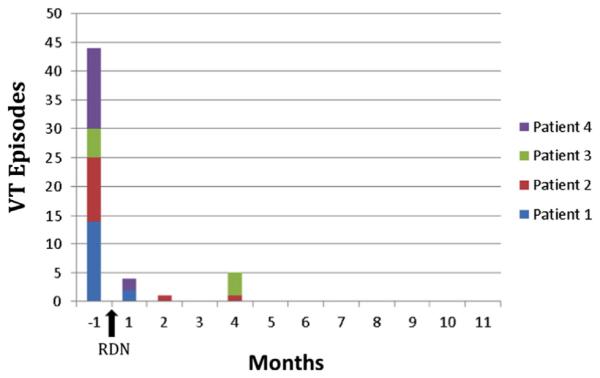
Results: RDN was well tolerated acutely and demonstrated no clinically significant complications during follow-up of 8.8 ± 2.6 months (range 5.0-11.0 months). No hemodynamic deterioration or worsening of renal function was observed. The number of VT episodes was decreased from 11.0 ± 4.2 (5.0-14.0) during the month before ablation to 0.3 ± 0.1 (0.2-0.4) per month after ablation. All VT episodes occurred in the first 4 months after ablation (2.6 ± 1.5 months). The responses to RDN were similar for ischemic and nonischemic patients.
Conclusion: This case series provides promising preliminary data on the safety and effectiveness of RDN as an adjunctive therapy in the treatment of patients with cardiomyopathy and VT resistant to standard interventions.
Keywords: Cardiomyopathy; Renal denervation; Ventricular tachycardia; Ventricular tachycardia storm.
Copyright © 2014 Heart Rhythm Society. Published by Elsevier Inc. All rights reserved.
Figures
Comment in
-
Interventional treatment of ventricular tachycardia and electrical storm: from ablation of substrate and triggers to autonomic modulation by renal denervation.Heart Rhythm. 2014 Apr;11(4):547-8. doi: 10.1016/j.hrthm.2014.01.024. Epub 2014 Jan 25. Heart Rhythm. 2014. PMID: 24469218 No abstract available.
References
-
- Moss AJ, Hall WJ, Cannom DS, et al. Improved survival with an implanted Defibrillator in patients with coronary disease at high risk for ventricular arrhythmia. Multicenter Automatic Defibrillator Implantation Trial Investigators. N Engl J Med. 1996;335:1933–1940. - PubMed
-
- Moss AJ, Zareba W, Hall WJ, et al. Prophylactic implantation of a Defibrillator in patients with myocardial infarction and reduced ejection fraction. N Engl J Med. 2002;346:877–883. - PubMed
-
- Bardy GH, Lee KL, Mark DB, et al. Amiodarone or an implantable cardioverter-Defibrillator for congestive heart failure. N Engl J Med. 2005;352:225–237. - PubMed
-
- Zipes DP, Camm AJ, Borggrefe M, et al. ACC/AHA/ESC 2006 guidelines for management of patients with ventricular arrhythmias and the prevention of sudden cardiac death: a report of the American College of Cardiology/American Heart Association Task Force and the European Society of Cardiology Committee for Practice Guidelines (Writing Committee to Develop Guidelines for Management of Patients With Ventricular Arrhythmias and the Prevention of Sudden Cardiac Death) J Am Coll Cardiol. 2006;48:e247–e346. - PubMed
-
- Stevenson WG, Wilber DJ, Natale A, et al. Irrigated radiofrequency catheter ablation guided by electroanatomic mapping for recurrent ventricular tachycardia after myocardial infarction: the Multicenter ThermoCool Ventricular Tachycardia Ablation Trial. Circulation. 2008;118:2773–2782. - PubMed
Publication types
MeSH terms
Grants and funding
LinkOut - more resources
Full Text Sources
Other Literature Sources
Medical
