. 2014 Jan 2;9(1):e84734.
doi: 10.1371/journal.pone.0084734. eCollection 2014.

The alternative role of enterobactin as an oxidative stress protector allows Escherichia coli colony development

Affiliations

The alternative role of enterobactin as an oxidative stress protector allows Escherichia coli colony development

Conrado Adler et al. PLoS One. .

Abstract

Numerous bacteria have evolved different iron uptake systems with the ability to make use of their own and heterologous siderophores. However, there is growing evidence attributing alternative roles for siderophores that might explain the potential adaptive advantages of microorganisms having multiple siderophore systems. In this work, we show the requirement of the siderophore enterobactin for Escherichia coli colony development in minimal media. We observed that a strain impaired in enterobactin production (entE mutant) was unable to form colonies on M9 agar medium meanwhile its growth was normal on LB agar medium. Given that, neither iron nor citrate supplementation restored colony growth, the role of enterobactin as an iron uptake-facilitator would not explain its requirement for colony development. The absence of colony development was reverted either by addition of enterobactin, the reducing agent ascorbic acid or by incubating in anaerobic culture conditions with no additives. Then, we associated the enterobactin requirement for colony development with its ability to reduce oxidative stress, which we found to be higher in media where the colony development was impaired (M9) compared with media where the strain was able to form colonies (LB). Since oxyR and soxS mutants (two major stress response regulators) formed colonies in M9 agar medium, we hypothesize that enterobactin could be an important piece in the oxidative stress response repertoire, particularly required in the context of colony formation. In addition, we show that enterobactin has to be hydrolyzed after reaching the cell cytoplasm in order to enable colony development. By favoring iron release, hydrolysis of the enterobactin-iron complex, not only would assure covering iron needs, but would also provide the cell with a molecule with exposed hydroxyl groups (hydrolyzed enterobactin). This molecule would be able to scavenge radicals and therefore reduce oxidative stress.


Conflict of interest statement

Competing Interests: The authors have declared that no competing interests exist.

Figures

Figure 1
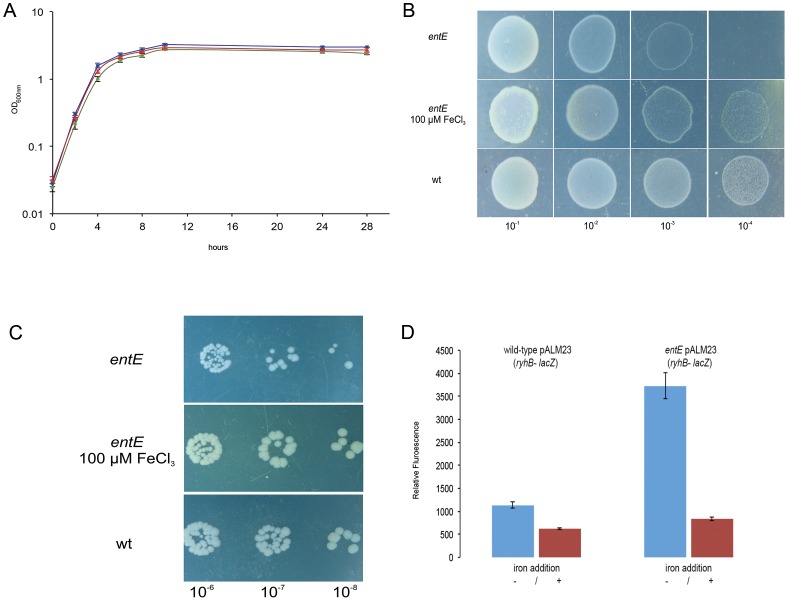
Figure 1. Growth of E. coli wild-type (wt) and entE strains in liquid and solid media.
A) Liquid aerated minimal M9 medium cultures of wild-type strain (blue squares), entE strain (green circles) and entE strain in the same media but supplemented with 100 µM FeCl3 (red triangles). Growth (OD600) was determined at the indicated times. B) Lawn growth of wt and entE E. coli strains on M9A. A stationary phase culture of entE E. coli strain was serially diluted (10−1 to 10−4) and an aliquot of these dilutions was applied on M9A or M9A supplemented with 100 µM FeCl3. As control, the same dilutions of a wt strain overnight culture were applied on M9A medium. Lawn growth was compared at 8 hours of incubation. C) Colony growth of wt and entE E. coli on LBA. A stationary phase culture of entE E. coli strain was serially diluted and an aliquot of dilutions 10−6 to 10−8 were applied on LBA or LBA supplemented with 100 µM FeCl3. As control, the same dilutions of an overnight culture of the wt strain were applied on LBA medium. After overnight incubation, colonies sizes were compared. D) Activity of the rhyB promoter estimated by β-galactosidase activity as an indirect measure of the intracellular iron content (The higher the promoter expression, the lower the iron content [48]). Both wild-type strain and entE mutant respond to iron addition. The plasmid pALM23 carries the ryhB- lacZ fusion.
Figure 2
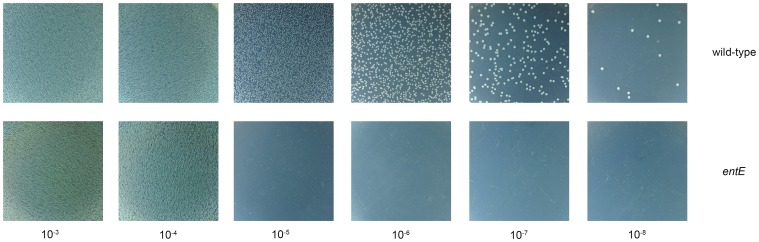
Figure 2. Observed type of growth of entE and wild-type strains in M9A after plating and overnight incubation of serial dilutions obtained from stationary phase cultures.
Representative pictures show the characteristic leap from lawn growth (10−4 dilution) to absence of colonies (10−5 dilution) for the entE strain in M9A.
Figure 3
Figure 3. Growth of E. coli wild-type and entE mutant streaked in M9A.
Wild-type strain growth in aerobic conditions (A) and entE mutant growth in aerobic (B) or anaerobic conditions (C).
Figure 4
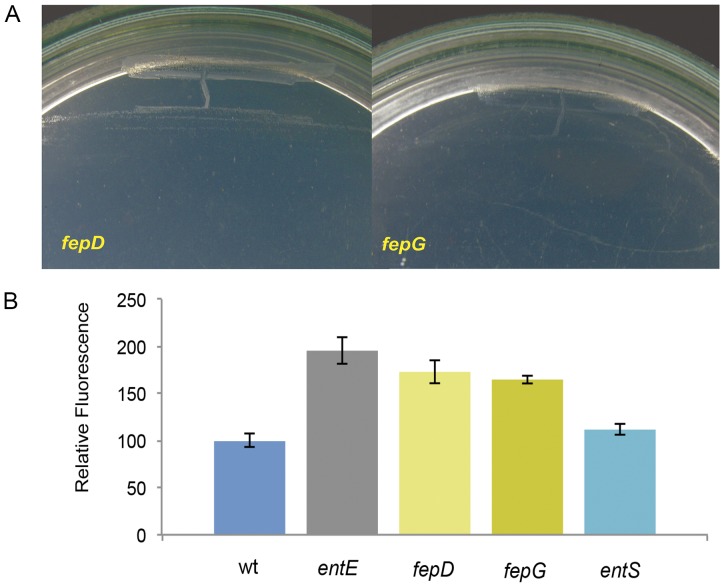
Figure 4. A) Type of growth of E. coli fepD and fepG mutants streaked in M9A and incubated overnight in aerobic conditions. B) Levels of reactive oxygen species in E. coli wild-type and fepD, fepG, entS and entE mutants grown in M9 medium. Quantitation of ROS levels was done using the DCFA-DA probe. Fluorescence intensities are relative to that of the control. Control: wt grown in M9 medium. Error bars = SD, n = 3.
Figure 5
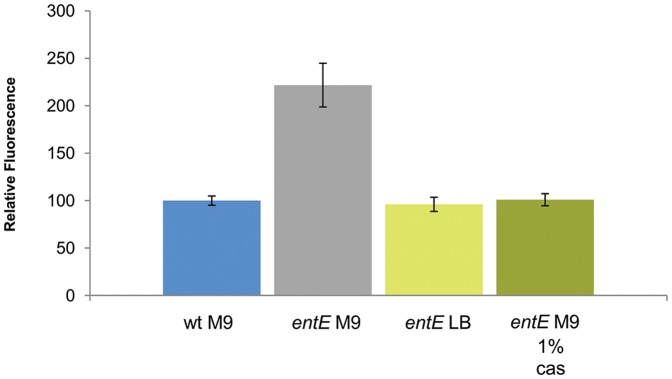
Figure 5. Reactive oxygen species levels in E. coli entE mutant grown in different culture media.
Quantitation of ROS levels was done using the DCFA-DA probe. Fluorescence intensities are relative to that of the control. Control: wild-type strain grown in M9 medium; entE M9: indicates cells grown in M9 medium, entE LB: indicates cells grown in LB medium, entE M9 1% cas: indicates cells grown in M9 medium supplemented with 1% casamino acids. Error bars = SD, n = 3.
Figure 6
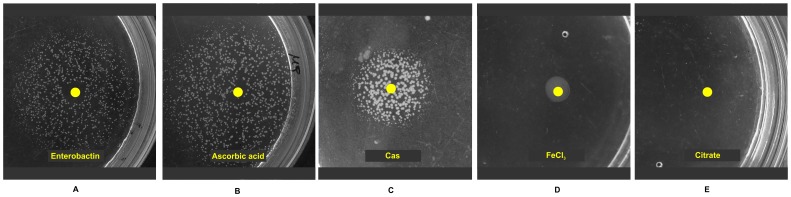
Figure 6. Colonies resume growth upon enterobactin, ascorbic acid or casamino acids (cas) addition.
In plates in which no growth was obtained after overnight incubation (10−5 dilutions), 1 µL of 1 µM enterobactin (A), 5 µL of 1 mM ascorbic acid (B), 5 µL of 2% casamino acids (C), 10 µL of 1 mM FeCl3 (D) or 10 µL of 1 mM sodium citrate (E) were spotted. After a second overnight incubation, a size gradient of colonies was clearly observed around the spots containing enterobactin (A), ascorbic acid (B) and casamino acids (C). However, no growth was observed with FeCl3 (D) or citrate (E).
Figure 7
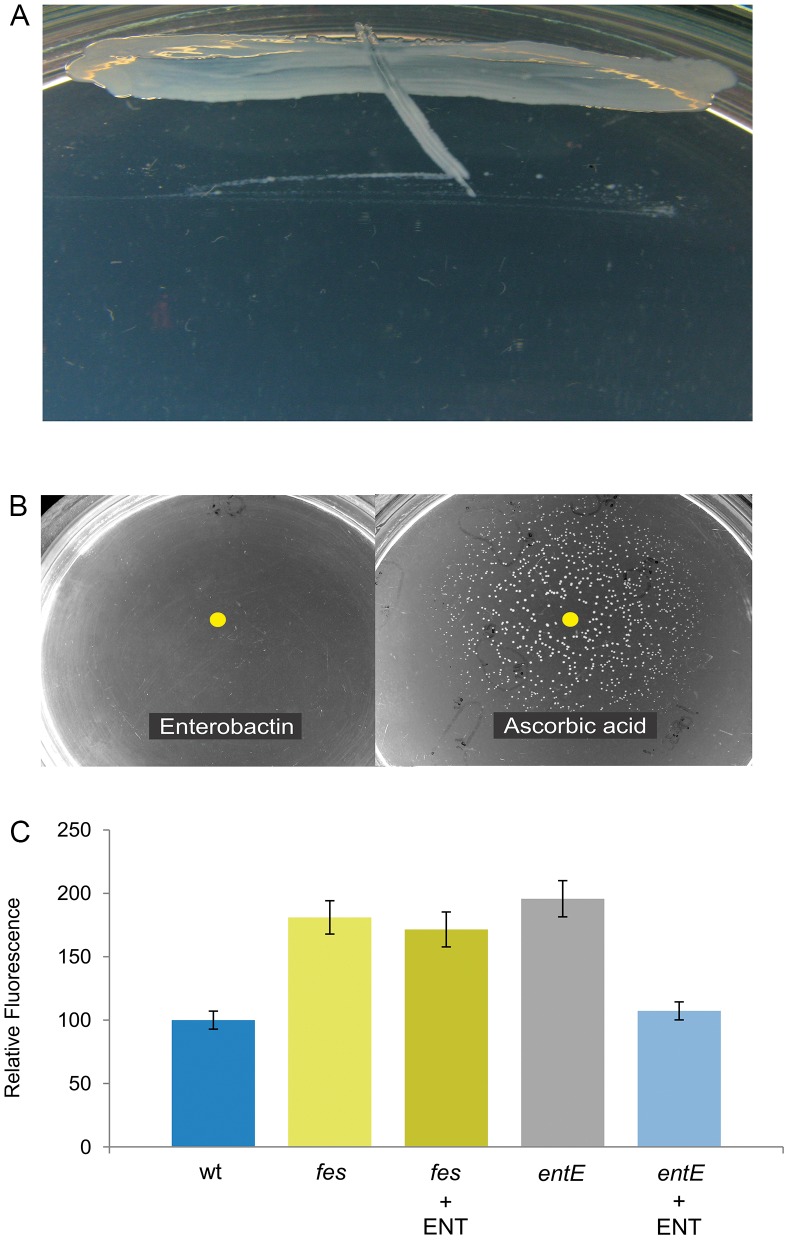
Figure 7. A) Type of growth of E. coli fes mutant streaked in M9A and incubated overnight in aerobic conditions. B) No colony development was observed when a 10−5 dilution of a fes mutant stationary phase culture was incubated overnight. Then, 1 µL of pure enterobactin (1 µM) or 5 µL ascorbic acid (1 mM) were spotted on the medium surface and reincubated overnight. It can be observed that ascorbic acid restores colony growth of fes mutant meanwhile enterobactin does not. C) Reactive oxygen species levels in E. coli fes and entE mutants grown in M9 medium. Quantitation of ROS levels using the DCFA-DA probe. Fluorescence intensities are relative to that of the control. Control: wt strain grown in M9 medium; +ENT: indicates addition of 1 µM enterobactin. Error bars = SD, n = 3.

References

    1. Andrews SC, Robinson AK, Rodriguez-Quinones F (2003) Bacterial iron homeostasis. FEMS Microbiol Rev 27: 215–237. - PubMed
    1. Guerinot ML, Yi Y (1994) Iron: Nutritious, Noxious, and Not Readily Available. Plant Physiol 104: 815–820. - PMC - PubMed
    1. Wandersman C, Delepelaire P (2004) Bacterial iron sources: from siderophores to hemophores. Annu Rev Microbiol 58: 611–647. - PubMed
    1. Hider RC, Kong X (2010) Chemistry and biology of siderophores. Nat Prod Rep 27: 637–657. - PubMed
    1. Neilands JB (1982) Microbial envelope proteins related to iron. Annu Rev Microbiol 36: 285–309. - PubMed

Publication types

LinkOut - more resources