. 2013:2013:527418.
doi: 10.1155/2013/527418. Epub 2013 Dec 12.

Biodistribution and molecular studies on orally administered nanoparticle-AON complexes encapsulated with alginate aiming at inducing dystrophin rescue in mdx mice

Affiliations

Biodistribution and molecular studies on orally administered nanoparticle-AON complexes encapsulated with alginate aiming at inducing dystrophin rescue in mdx mice

Maria Sofia Falzarano et al. Biomed Res Int. 2013.

Abstract

We have previously demonstrated that intraperitoneal injections of 2'-O-methyl-phosphorothioate (2'OMePS) antisense oligoribonucleotides adsorbed onto a cationic core-shell nanoparticles (NPs), termed ZM2, provoke dystrophin restoration in the muscles of mdx mice. The aim of the present work was to evaluate the oral route as an alternative way of administration for ZM2-antisense oligoribonucleotides complexes. The biodistribution and elimination of nanoparticles were evaluated after single and multiple oral doses of IR-dye conjugated nanoparticles. Labeled nanoparticles were tracked in vivo as well as in tissue cryosections, urines and feces by Odyssey infrared imaging system, and revealed a permanence in the intestine and abdominal lymph nodes for 72 hours to 7 days before being eliminated. We subsequently tested alginate-free and alginate-encapsulated ZM2-antisense oligoribonucleotides (AON) complexes orally administered 2 and 3 times per week, respectively, in mdx mice for a total of 12 weeks. Treatment with alginate ZM2-AON induced a slight dystrophin rescue in diaphragm and intestine smooth muscles, while no dystrophin was detected in alginate-free ZM2-AON treated mice. These data encourage further experiments on oral administration testing of NP and AON complexes, possibly translatable in oligoribonucleotides-mediated molecular therapies.


Figures
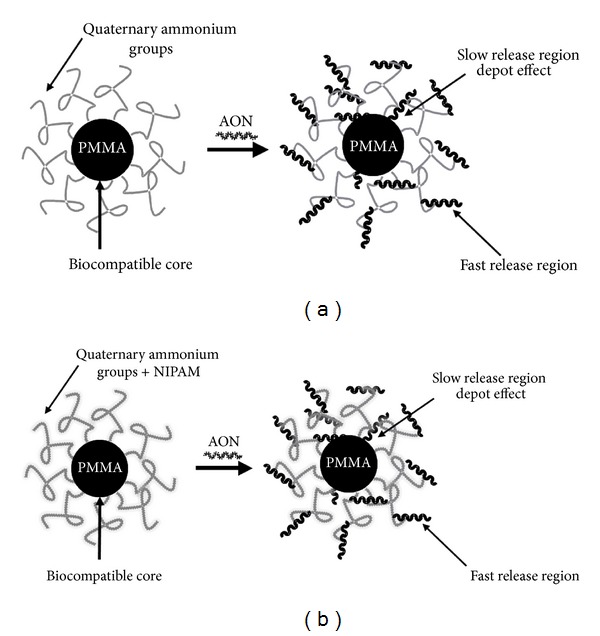
Figure 1
Figure 1
Nanoparticles characteristics. Representation of the interactions between antisense oligoribonucleotide (M23D AON) and quaternary ammonium groups on the surface of T1 (a) and ZM2 (b) nanoparticles.
Figure 2
Figure 2
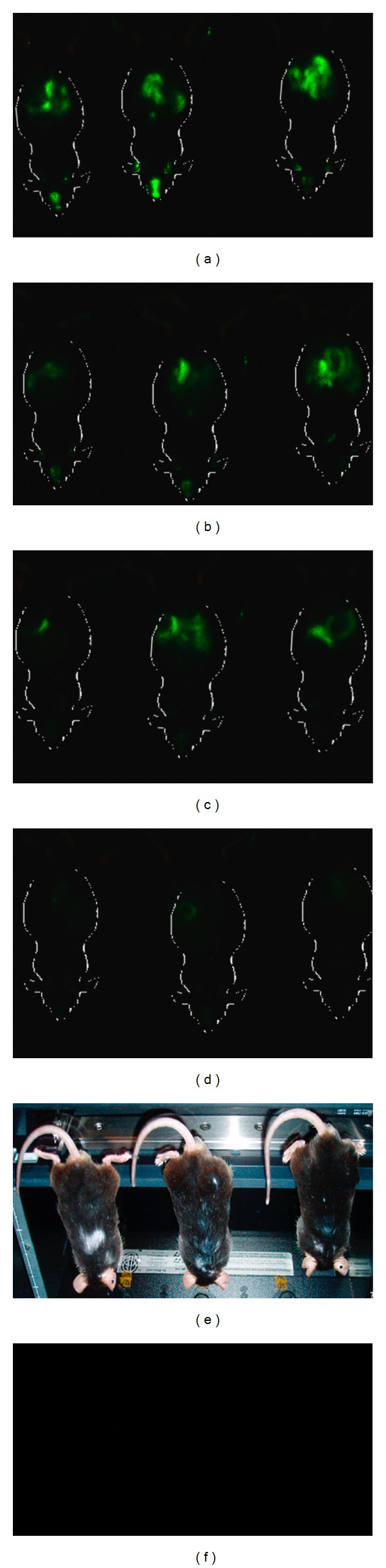
Biodistribution of ZM4-IR-dye. Three mice (1, 2, 3) were analyzed at 12 (a), 24 (b), 48 (c), and 72 (d) hours post ZM4-IR single administration. Fluorescence was visualized using the Odyssey Infrared Imaging System. Green fluorescence represents the IR signal (~800 nm) associated to the nanoparticle. The signal appears localized to the abdominal region (intestine) of the mouse. (e) Mice located on the mouse pod of the Odyssey scanner. (f) The image shows the absence of fluorescence signal in mdx untreated mice.
Figure 3
Figure 3
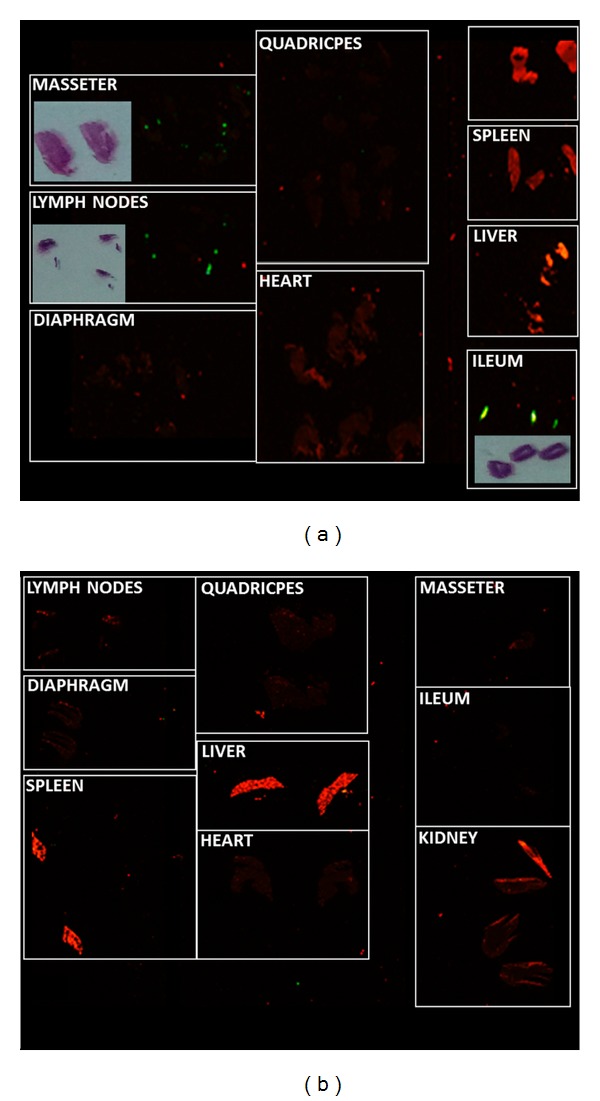
Odyssey analysis of organ/muscle cryosections (20 μm) from ZM4-IR multiple-dose administered mice 7 days (a) and 1 month (b) after last treatment. Green fluorescence represents IR-dye signal (~800 nm) associated to the nanoparticle; red represents tissue autofluorescence at ~700 nm. The signal is evident in abdominal lymph nodes, ileum, and masseter muscle at 7 days and absent at 1 month. Hematoxylin-Eosin (HE) staining of the same cryosections is presented next to IR positive sections to clarify the position on the slide.
Figure 4
Figure 4
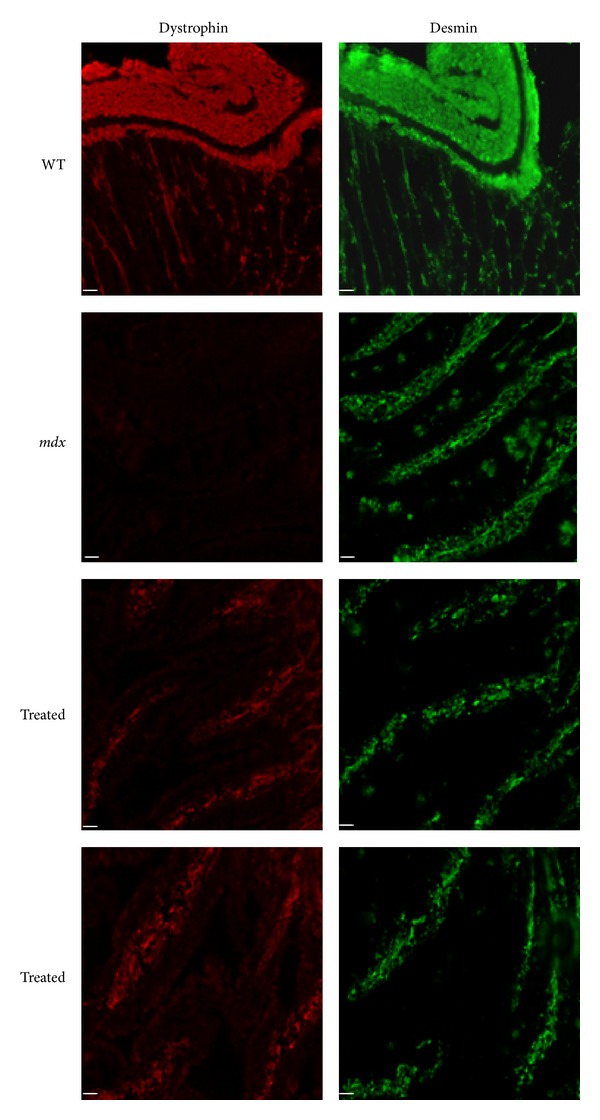
Immunofluorescence analysis of intestinal smooth muscle of wild type (WT), untreated (mdx) and alginate-ZM2-M23D orally treated (Treated) mdx mice. The sections of small intestine were labeled with antidystrophin antibody. Serial sections of intestine were labeled with a polyclonal antibody for desmin (green). All samples were observed with a Nikon Eclipse 80i fluorescence microscope. Dystrophin (red) is clearly visible in the intestinal smooth muscle of WT mice, absent in untreated mdx, and rescued in treated mdx mice. (Scale bar = 50 μm).
Figure 5
Figure 5
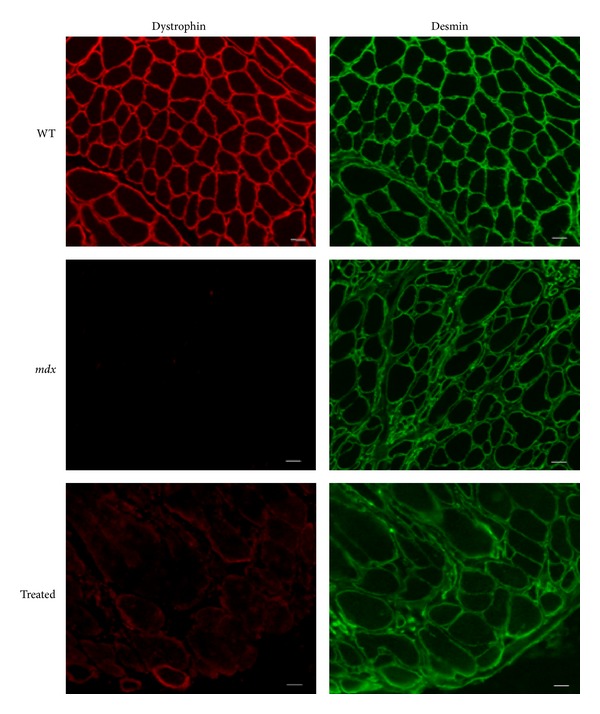
Immunofluorescence analysis of dystrophin protein in the diaphragm of wild type (WT), untreated (mdx), and alginate-ZM2-M23D orally treated (treated) mdx mice. The sections were labeled with antidystrophin antibody (red signal) and double-labeled with a rat monoclonal antibody for laminin-2 (green). Dystrophin traces are visible in diaphragm from alginate ZM2-M23D oral treated mice. No dystrophin labeling was detected at the sarcolemma in mice untreated or treated with ZM2-AON mdx. (Scale bar = 50 μm).
Figure 6
Figure 6
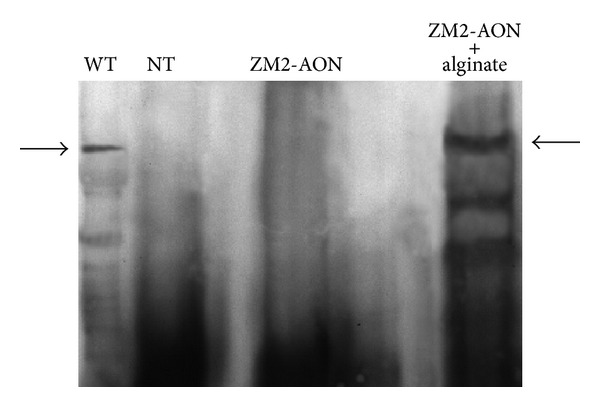
Immunoblotting of dystrophin in the intestine of untreated mdx mice (NT), ZM2-AON treated mice, and alginate-coated ZM2-AON treated mice. Intestine from WT mice were used as positive controls. For WT samples, the total protein loaded was 1/10 (15 μg) of the quantity used in the other lanes (150 μg). Quantitation performed by densitometric analysis of autoradiographic bands followed by normalization with the quantity of total protein loaded on the gels showed 31 ± 1.5% (P = 0.0003) of dystrophin recovery in the intestine from alginate ZM2-AON-treated mice compared to WT mice. The arrows show the bands of dystrophin (427 kD).

References

    1. van Deutekom JC, Janson AA, Ginjaar IB, et al. Local dystrophin restoration with antisense oligonucleotide PRO051. The New England Journal of Medicine. 2007;357(26):2677–2686. - PubMed
    1. Wilton SD, Fletcher S. Exon skipping and Duchenne muscular dystrophy: hope, hype and how feasible? Neurology India. 2008;56(3):254–262. - PubMed
    1. van Ommen GJ, van Deutekom J, Aartsma-Rus A. The therapeutic potential of antisense-mediated exon skipping. Current Opinion in Molecular Therapeutics. 2008;10(2):140–149. - PubMed
    1. Goemans NM, Tulinius M, van den Akker JT, et al. Systemic administration of PRO051 in Duchenne’s muscular dystrophy. The New England Journal of Medicine. 2011;364(16):1513–1522. - PubMed
    1. Cirak S, Arechavala-Gomeza V, Guglieri M, et al. Exon skipping and dystrophin restoration in patients with Duchenne muscular dystrophy after systemic phosphorodiamidate morpholino oligomer treatment: an open-label, phase 2, dose-escalation study. The Lancet. 2011;378(9791):595–605. - PMC - PubMed

Publication types