


Expanding Anfinsen's principle: contributions of synonymous codon selection to rational protein design
- PMID: 24392935
- PMCID: PMC3959793
- DOI: 10.1021/ja411302m
Expanding Anfinsen's principle: contributions of synonymous codon selection to rational protein design
Abstract
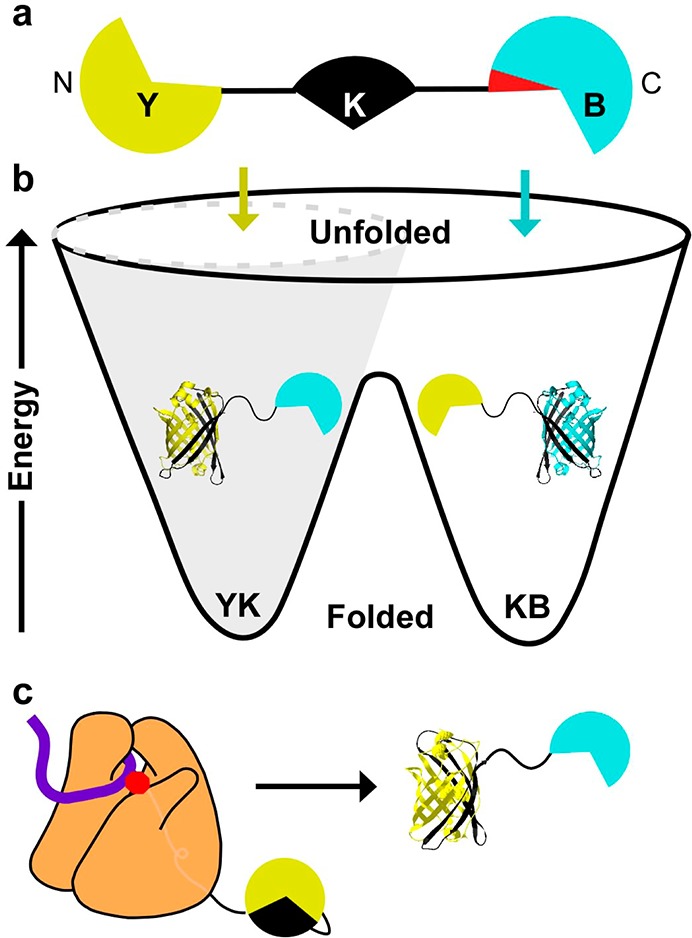
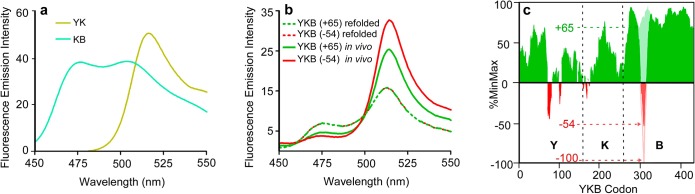
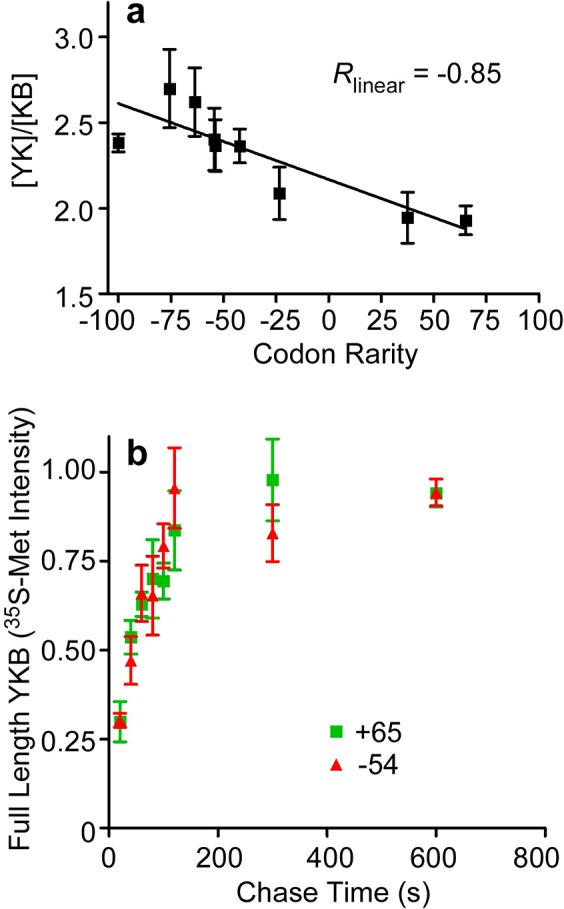
Anfinsen's principle asserts that all information required to specify the structure of a protein is encoded in its amino acid sequence. However, during protein synthesis by the ribosome, the N-terminus of the nascent chain can begin to fold before the C-terminus is available. We tested whether this cotranslational folding can alter the folded structure of an encoded protein in vivo, versus the structure formed when refolded in vitro. We designed a fluorescent protein consisting of three half-domains, where the N- and C-terminal half-domains compete with each other to interact with the central half-domain. The outcome of this competition determines the fluorescence properties of the resulting folded structure. Upon refolding after chemical denaturation, this protein produced equimolar amounts of the N- and C-terminal folded structures, respectively. In contrast, translation in Escherichia coli resulted in a 2-fold enhancement in the formation of the N-terminal folded structure. Rare synonymous codon substitutions at the 5' end of the C-terminal half-domain further increased selection for the N-terminal folded structure. These results demonstrate that the rate at which a nascent protein emerges from the ribosome can specify the folded structure of a protein.
Figures
Comment in
-
Protein folding: When ribosomes pick the structure.Nat Chem. 2014 May;6(5):378-9. doi: 10.1038/nchem.1926. Nat Chem. 2014. PMID: 24755584 No abstract available.
References
Publication types
MeSH terms
Substances
Grants and funding
LinkOut - more resources
Full Text Sources
Other Literature Sources
