. 2014 Jan 22;136(3):858-61.
doi: 10.1021/ja411302m. Epub 2014 Jan 13.

Expanding Anfinsen's principle: contributions of synonymous codon selection to rational protein design

Affiliations

Expanding Anfinsen's principle: contributions of synonymous codon selection to rational protein design

Ian M Sander et al. J Am Chem Soc. .

Abstract

Anfinsen's principle asserts that all information required to specify the structure of a protein is encoded in its amino acid sequence. However, during protein synthesis by the ribosome, the N-terminus of the nascent chain can begin to fold before the C-terminus is available. We tested whether this cotranslational folding can alter the folded structure of an encoded protein in vivo, versus the structure formed when refolded in vitro. We designed a fluorescent protein consisting of three half-domains, where the N- and C-terminal half-domains compete with each other to interact with the central half-domain. The outcome of this competition determines the fluorescence properties of the resulting folded structure. Upon refolding after chemical denaturation, this protein produced equimolar amounts of the N- and C-terminal folded structures, respectively. In contrast, translation in Escherichia coli resulted in a 2-fold enhancement in the formation of the N-terminal folded structure. Rare synonymous codon substitutions at the 5' end of the C-terminal half-domain further increased selection for the N-terminal folded structure. These results demonstrate that the rate at which a nascent protein emerges from the ribosome can specify the folded structure of a protein.


Figures
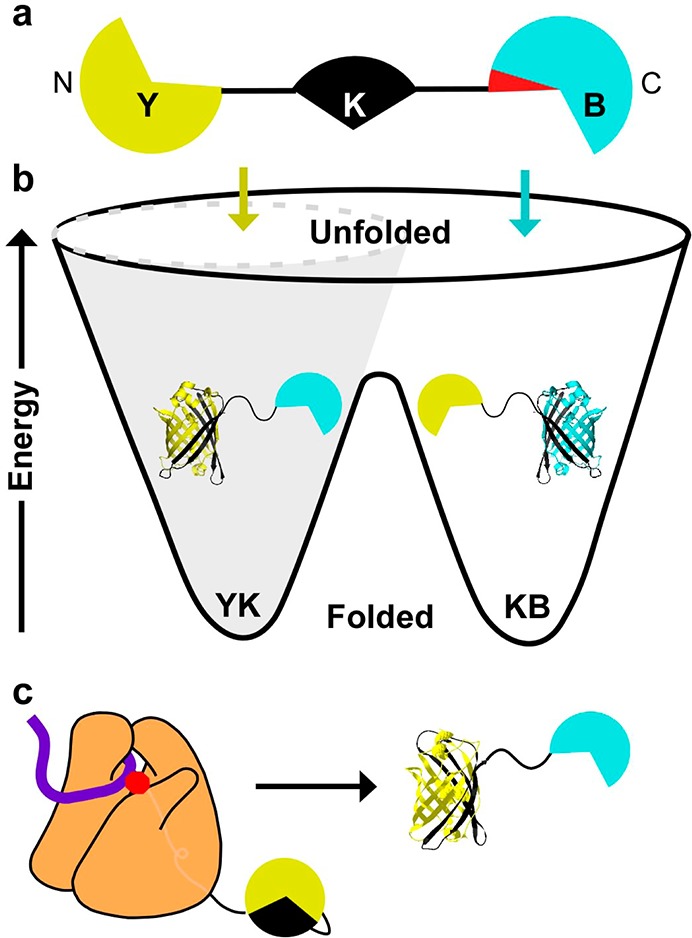
Figure 1
Figure 1
Experimental design for kinetically controlled folding. (a) Schematic of YKB, which consists of three half-domains connected by flexible (AGQ)5 linkers (black lines). The Y (yellow) and B (blue) half-domains compete to form a mutually exclusive kinetically trapped folded domain with the central K (black) half-domain. The red wedge indicates the location of synonymous codon substitutions (see text). (b) Energy landscapes for proteins that fold under kinetic control have multiple deep minima, representing alternative folded structures, separated by large barriers. The conformations of the unfolded protein and early folding intermediates (colored arrows) determine the final folded state of the protein. Forces that constrict the unfolded ensemble (gray cone) can bias folding toward one structure. (c) During translation of the nascent chain by the ribosome (orange), folding cannot be initiated from the untranslated C-terminus, which restricts the ensemble of unfolded states and leads to the preferential formation of one folded structure.
Figure 2
Figure 2
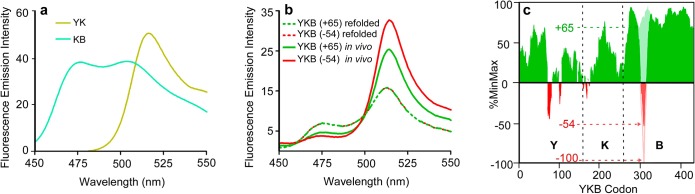
Translation alters YKB folded structure. (a) Fluorescence emission spectra of intact E. coli expressing the control fluorescent protein constructs YK (yellow) or KB (cyan). (b) Fluorescence emission spectra of intact E. coli expressing YKB constructs with common or rare codon usage (green versus red solid lines) versus the same YKB constructs folded in vitro upon dilution from a chemical denaturant (dashed lines). Numbers in parentheses correspond to synonymous codon usage; larger positive numbers correspond to more common codons. (c) E. coli MG1655 relative codon usage for codons encoding three representative YKB synonymous mutants: (+65) (light green), (−54) (red), and (−100) (pink line).
Figure 3
Figure 3
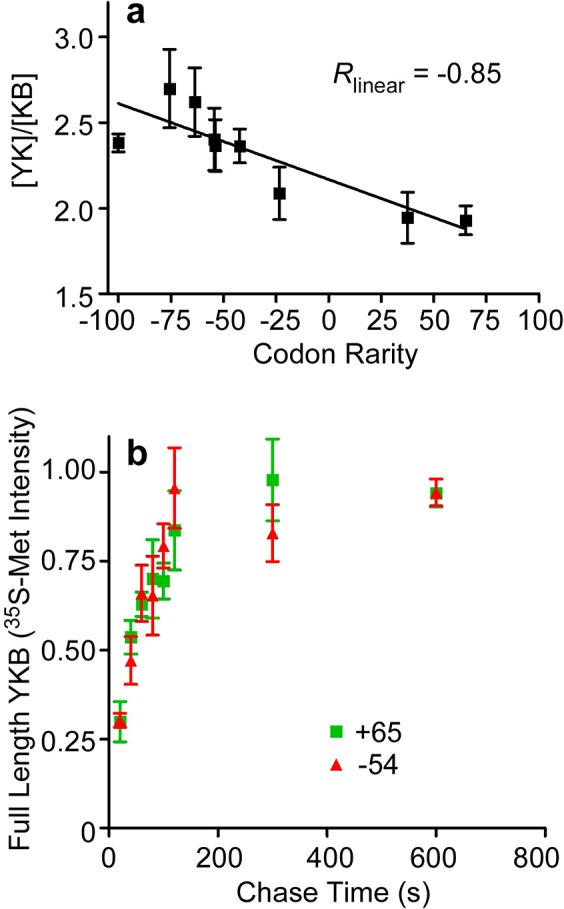
YKB synonymous codon substitutions predictably alter N-terminal versus C-terminal folding competition. (a) [YK]/[KB] molar ratios for synonymous mutants with altered codon usage, calculated as in Figure 2b. Error bars represent SEM of five measurements. (b) Pulse chase measurement of translation rate for YKB (+65) (green) versus (−54) (red). Error bars represent SEM of three measurements.

Comment in

References

    1. Anfinsen C. B. Science 1973, 181, 223–230. - PubMed
    1. Braselmann E.; Chaney J. L.; Clark P. L. Trends Biochem. Sci. 2013, 38, 337–344. - PMC - PubMed
    1. Clarke T. F.; Clark P. L. PLoS One 2008, 3, e3412. - PMC - PubMed
    1. Baker D.; Agard D. A. Biochemistry 1994, 33, 7505–7509. - PubMed
    1. Bryan P. N.; Orban J. Curr. Opin. Struct. Biol. 2010, 20, 482–488. - PMC - PubMed

Publication types