


Prevalence of hepatitis C in a Swiss sample of men who have sex with men: whom to screen for HCV infection?
- PMID: 24393532
- PMCID: PMC3890510
- DOI: 10.1186/1471-2458-14-3
Prevalence of hepatitis C in a Swiss sample of men who have sex with men: whom to screen for HCV infection?
Abstract
Background: While the numbers of hepatitis-C-virus (HCV) infections among men who have sex with men (MSM) who are co-infected with the human immunodeficiency virus (HIV) are on the rise, with vast evidence for sexual transmission of HCV in this population, concerns have also been raised regarding sexual HCV-transmission among MSM without HIV infection. Therefore, the aim of this study was to estimate the prevalence of hepatitis C among MSM without HIV diagnosis in Zurich (Switzerland).
Methods: Participants were recruited from a gay health centre and various locations such as dark rooms, saunas and cruising areas in Zurich. Participants self-completed a questionnaire assessing known and suspected risk factors for HCV-infection, and provided a blood sample for detection of past (antibodies) and present (core antigen, RNA) infections with HCV.
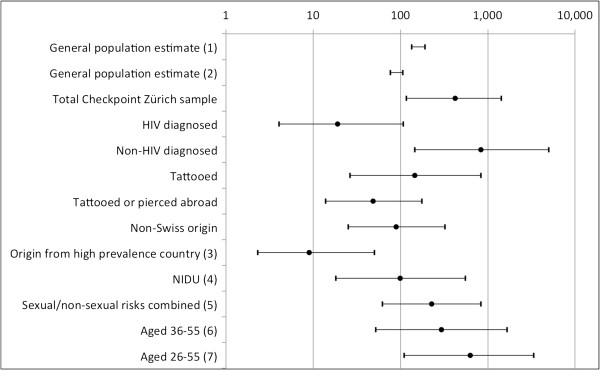
Results: In total, 840 MSM aged 17-79 (median: 33 years) underwent HCV-testing and completed the questionnaire, among whom 19 reported living with HIV. Overall, seven tested positive for HCV-antibodies, and two were also positive for HCV core antigen and HCV-RNA-these two were immigrants, one from a country where HCV is endemic. None of the seven were aware of their infection. The seroprevalence of hepatitis C among the 821 non-HIV-diagnosed MSM was 0.37% (95%-CI: 0.12-1.69%), and one man harboured replicating virus (0.12%; 0.02-0.69%), resulting in a number needed to test of 821 to detect one active infection. Significant univariable associations of lifetime HCV-infection were found with known HIV-diagnosis (OR=72.7), being tattooed (OR=10.4), non-injection use of cocaine/amphetamines (OR=8.8), and non-Swiss origin (OR=8.5). For MSM without HIV-diagnosis, the only variable marginally associated with positive HCV-serostatus was being tattooed (OR=8.3). No significant associations were observed with reported injection drug use, unprotected anal intercourse, sexual practices that may lead to mucosal trauma, or proxy measures for group sex and lesion-prone STIs.
Conclusions: Our findings suggest that in Switzerland, hepatitis C among MSM without diagnosed HIV is not more prevalent than in the general population. We found no evidence of elevated rates of sexual transmission of HCV among MSM without HIV-infection. Therefore, we currently see no reason for promoting HCV-testing among all MSM in Switzerland.
Figures
References
-
- Swiss Federal Office of Public Health. Notifications of infectious disease. Bulletin. 2013;27:448. German.
-
- Cornberg M, Razavi HA, Alberti A, Bernasconi E, Buti M, Cooper C, Dalgard O, Dillion JF, Flisiak R, Forns X. et al. A systematic review of hepatitis C virus epidemiology in Europe, Canada and Israel. Liver Int. 2011;31(Suppl 2):30–60. - PubMed
Publication types
MeSH terms
LinkOut - more resources
Full Text Sources
Other Literature Sources
Medical
Miscellaneous
