


Serum and plasma neutrophil gelatinase associated lipocalin (NGAL) levels are not equivalent in patients admitted to intensive care
- PMID: 24395189
- PMCID: PMC6807606
- DOI: 10.1002/jcla.21662
Serum and plasma neutrophil gelatinase associated lipocalin (NGAL) levels are not equivalent in patients admitted to intensive care
Abstract
Background: Neutrophil gelatinase associated lipocalin (NGAL) is proposed as a biomarker of acute kidney injury (AKI). NGAL has been studied in a range of body fluids including serum and EDTA plasma. The aim of the present study was to establish relationship between serum NGAL concentrations and EDTA plasma NGAL concentrations in patients admitted to intensive care units (ICUs) and whether these determinations are directly comparable in this setting.
Methods: NGAL was measured in 40 paired samples of serum and EDTA plasma from 25 patients admitted to intensive care with a commercial particle-enhanced turbidimetric immunoassay (The NGAL Test™, BioPorto Diagnostics A/S, Gentofte, Denmark) on a Roche Hitachi 917 (Roche-Hitachi, Inc., Tokyo, Japan) analyzer.
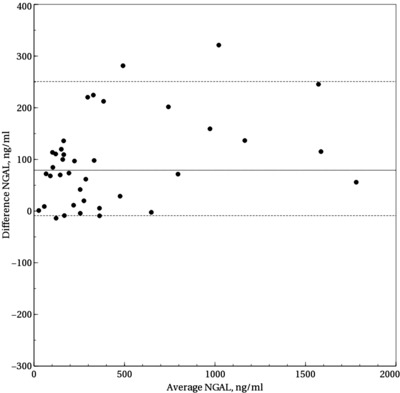
Results: Serum NGAL concentrations ranged from 26.8 to 1,808 ng/ml (median 281 ng/ml, interquartile range (IQR) 453 ng/ml). EDTA plasma NGAL concentrations ranged from 25.7 to 1,752 ng/ml (median 225 ng/ml, IQR 352 ng/ml). The difference in NGAL concentrations in paired serum and EDTA plasma samples (serum- plasma) ranged from -13.8 to 321 ng/ml (median 79 ng/ml, IQR 116 ng/ml; difference from zero, P < 0.0001, Wilcoxon's signed rank test). Although serum and EDTA plasma values were correlated (Spearman's r = 0.95, P < 0.0001), Deming regression analysis showed a slope of 1.1 that was not significantly different from unity (95% confidence interval (CI) 1.0-1.1) and a highly significant intercept of 67.9 ng/ml with a wide confidence interval (95% CI 29.8-106).
Conclusion: NGAL concentration values measured in serum and EDTA plasma cannot be directly compared and should not be used as equivalents in studies of patients admitted to intensive care.
Keywords: acute kidney injury; biomarkers; critical illness; neutrophil gelatinase-associated lipocalin (NGAL); plasma; serum.
© 2014 Wiley Periodicals, Inc.
Figures
References
-
- Clerico A, Galli C, Fortunato A, et al. Neutrophil gelatinase‐associated lipocalin (NGAL) as biomarker of acute kidney injury: A review of the laboratory characteristics and clinical evidences. Clin Chem Lab Med 2012;50:1505–1517. - PubMed
-
- Kjeldsen L, Johnsen AH, Sengeløv H, et al. Isolation and primary structure of NGAL, a novel protein associated with human neutrophil gelatinase. J Biol Chem 1993;268:10425–10432. - PubMed
-
- Kjeldsen L, Bainton DF, Sengeløv H, et al. Identification of neutrophil gelatinase‐associated lipocalin as a novel matrix protein of specific granules in human neutrophils. Blood 1994;83:799–807. - PubMed
-
- Kjeldsen L, Cowland JB, Borregaard N. Human neutrophil gelatinase‐associated lipocalin and homologous proteins in rat and mouse. Biochim Biophys Acta 2000;1482:272–283. - PubMed
-
- Haase M, Bellomo R, Devarajan P, et al. Accuracy of neutrophil gelatinase‐associated lipocalin (NGAL) in diagnosis and prognosis in acute kidney injury: A systematic review and meta‐analysis. Am J Kidney Dis 2009;54:1012–1024. - PubMed
MeSH terms
Substances
LinkOut - more resources
Full Text Sources
Other Literature Sources
Medical
Miscellaneous
