


Novel parameters of extended complete blood cell count under fluorescence flow cytometry in patients with sepsis
- PMID: 24395719
- PMCID: PMC6807461
- DOI: 10.1002/jcla.21656
Novel parameters of extended complete blood cell count under fluorescence flow cytometry in patients with sepsis
Abstract
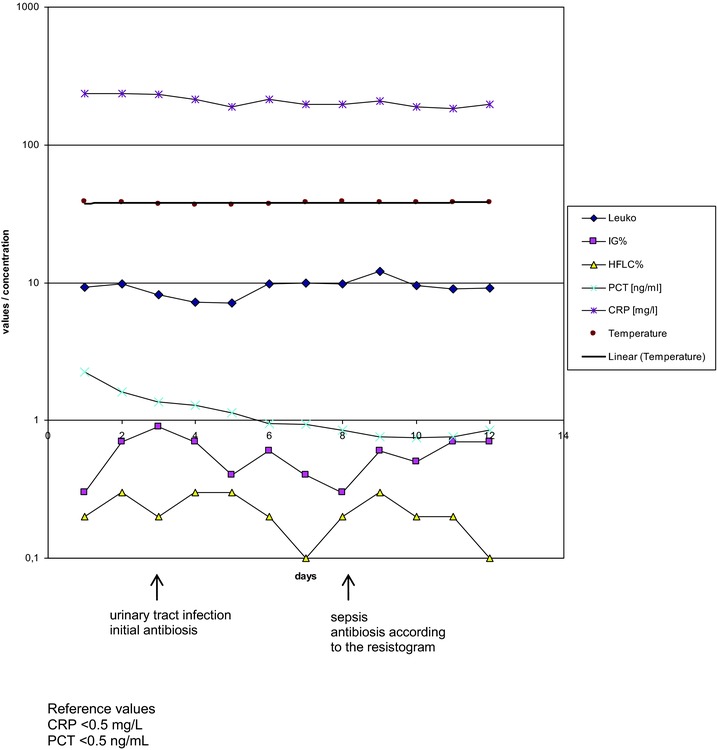
Background: We first describe a patient who developed urosepsis from an ordinary urinary tract infection. In this case, the new hematological parameters of immature leukocytes, that is, the high-fluorescence lymphocyte cell (HFLC) and immature granulocyte (IG) counts peaked early, whereas the established infection parameters, that is, C-reactive protein (CRP) and total white blood cell count showed less dynamic regarding infection and therapy.
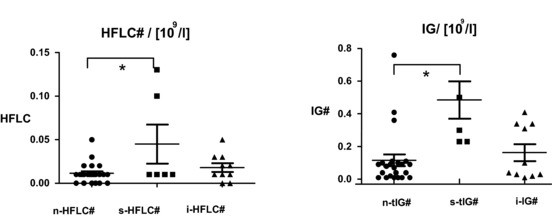
Methods: To investigate this phenomenon in greater detail, the novel parameters HFLC and IG counts are investigated retrospectively in a cohort of 38 patients who were admitted to the anesthesia intensive care unit. Three groups of patients have been analyzed and compared: patients without signs of infection, patients with limited infections, and patients with sepsis. Data were collected with a Sysmex XE-5000 hematological analyzer.
Results: In patients (n = 22) without any signs of infection, both values are very low. In patients with limited local infections (n = 10), moderate elevations of the IG and HFLC counts are seen. In patients with sepsis (n = 6), the IG and HFLC counts are significantly higher.
Conclusion: The total IG count seems to be useful for distinguishing a septic patient from a nonseptic (P < 0.004). Hematological parameters have the advantage of being measured easily during routine blood cell analysis.
Keywords: anesthesiology; flow cytometry; hematology.
© 2014 Wiley Periodicals, Inc.
Figures
References
-
- Alberti C, Brun‐Buisson C, Goodman SV, et al. European Sepsis Group influence of systemic inflammatory response syndrome and sepsis on outcome of critically ill infected patients. Am J Respir Crit Care Med 2003;168(1):77–84. - PubMed
-
- Ansari‐Lari M, Kickler T, Borowitz M. Immature granulocyte measurement using the Sysmex XE‐2100. Relationship to infection and sepsis. Am J Clin Pathol 2003;120(5):795–799. - PubMed
-
- Nahm C, Choi J, Lee J. Delta neutrophil index in automated immature granulocyte counts for assessing disease severity of patients with sepsis. Ann Clin Lab Sci 2008;38(3):241–246. - PubMed
-
- Schottmüller H, Bingold K. Die Septische Erkrankung Handbuch der Inneren Medizin. 22. Auflage (Bd. Part 1, 2). Springer Verlag; 1937. p 776–778.
-
- Schottmüller H. Über Wesen und Therapie der Sepsis. D. Kongress f. Inner. Medizin, Wiesbaden, Voss; 1914. p 1–10.
MeSH terms
LinkOut - more resources
Full Text Sources
Other Literature Sources
Medical
Research Materials
Miscellaneous
