. 2014 Jan 21;111(3):1072-7.
doi: 10.1073/pnas.1318685111. Epub 2014 Jan 6.

Inflammasome-independent IL-1β mediates autoinflammatory disease in Pstpip2-deficient mice

Affiliations

Inflammasome-independent IL-1β mediates autoinflammatory disease in Pstpip2-deficient mice

Suzanne L Cassel et al. Proc Natl Acad Sci U S A. .

Abstract

Chronic recurrent multifocal osteomyelitis (CRMO) is a human autoinflammatory disorder that primarily affects bone. Missense mutation (L98P) of proline-serine-threonine phosphatase-interacting protein 2 (Pstpip2) in mice leads to a disease that is phenotypically similar to CRMO called chronic multifocal osteomyelitis (cmo). Here we show that deficiency of IL-1RI in cmo mice resulted in a significant reduction in the time to onset of disease as well as the degree of bone pathology. Additionally, the proinflammatory cytokine IL-1β, but not IL-1α, played a critical role in the pathology observed in cmo mice. In contrast, disease in cmo mice was found to be independent of the nucleotide-binding domain, leucine-rich repeat-containing family, pyrin domain-containing 3 (NLRP3) inflammasome as well as caspase-1. Neutrophils, but not bone marrow-derived macrophages, from cmo mice secreted increased IL-1β in response to ATP, silica, and Pseudomonas aeruginosa compared with neutrophils from WT mice. This aberrant neutrophil response was sensitive to inhibition by serine protease inhibitors. These results demonstrate an inflammasome-independent role for IL-1β in disease progression of cmo and implicate neutrophils and neutrophil serine proteases in disease pathogenesis. These data provide a rationale for directly targeting IL-1RI or IL-1β as a therapeutic strategy in CRMO.

Keywords: chronic osteomyelitis; innate immunity.


Conflict of interest statement

The authors declare no conflict of interest.

Figures
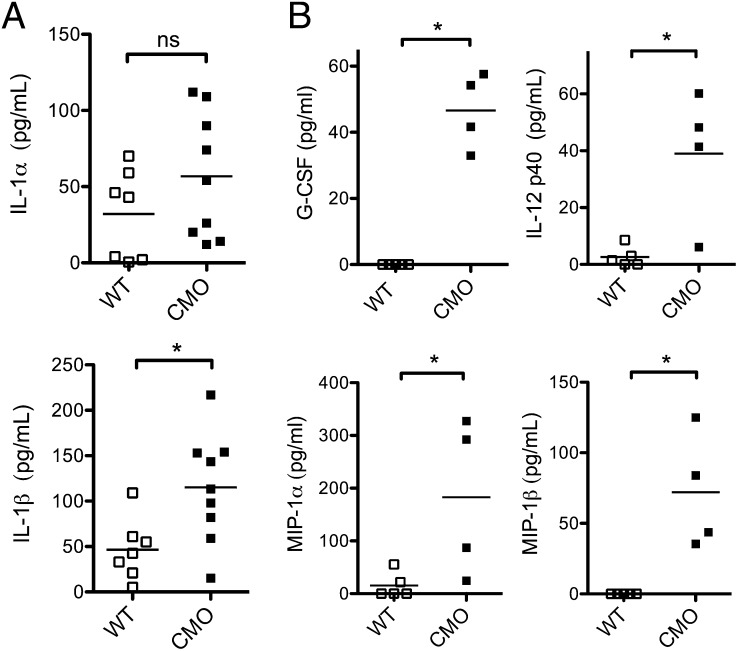
Fig. 1.
Fig. 1.
cmo mice have elevated proinflammatory cytokines in vivo. (A) Tail homogenates from WT (n = 7) or cmo mice (n = 9) were assessed for IL-1α and IL-1β via ELISA. (B) Tail homogenates from WT (n = 5) or cmo mice (n = 4) were assessed for the indicated cytokines via multiplex assay. ns, not significant, *P < 0.05 by two-tailed Mann-Whitney test.
Fig. 2.
Fig. 2.
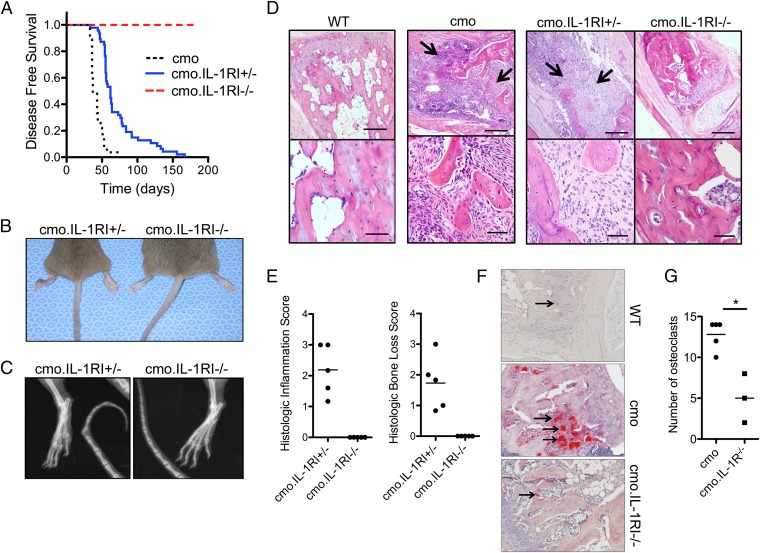
IL-1Rl–deficient mice are protected from developing cmo pathology. (A) Kaplan-Meier disease-free survival curves for cmo (n = 27), cmo.IL-1RI+/− (n = 48), and cmo.IL-1RI−I− (n = 49) mice. Test of equality over the three groups (log–rank P < 0.0001; Bonferroni-adjusted pairwise survival curve comparisons, each P < 0.0005). (B and C) Representative tail kinks and foot deformities in a 3-mo-old cmo.IL-1RI+/− mouse in comparison with a littermate cmo.IL-1RI−/− mouse by gross (B) and radiological (C) examination. (D) Representative fixed decalcified tail bone from WT, cmo, cmo.IL-1RI+/−, and cmo.IL-1RI−/− sectioned and stained with H&E. In the cmo and cmo.IL-1RI+/− sections there is loss of trabecular and cortical bone, with fibrosis and infiltration of macrophages, lymphocytes, and neutrophils (arrows). In contrast, the section from the cmo.IL-1RI−/− mouse shows normal bone with no inflammation. (Scale bars, Upper, 200 μm; Lower, 50 μm.) (E) Histological scoring for severity of inflammation and bone loss was performed on tail bones from cmo mice lacking IL-1Rl compared with heterozygous controls (n = 5 per group). (F) Histologic sections of tail vertebrae from WT, cmo, and cmo.IL-1RI−/− mice stained for TRAP, a marker for osteoclasts (arrows). (G) Number of osteoclasts per 400× field per mouse was scored using lmageJ software (n = 5 for cmo, n = 3 for cmo.IL-1RI−I−). *P = 0.033 by two-tailed Mann-Whitney test.
Fig. 3.
Fig. 3.
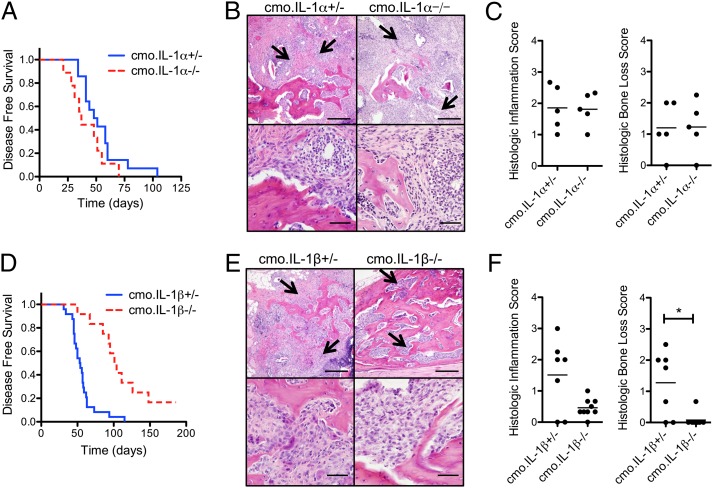
Mice deficient in IL-1β, but not IL-1α, are protected from developing cmo disease. (A) Kaplan-Meier disease-free survival curves for cmo.IL-1α+/− (n = 14) and cmo.IL-1α−I− (n = 9); P = 0.12 by log–rank test. (B) Representative fixed decalcified tail bone sections from cmo.IL-1α+/− and cmo.IL-1α−/− mice stained with H&E. Images are representative of the most severe lesions observed in each genotype. Loss of trabecular and cortical bone with fibrosis and infiltration of macrophages, lymphocytes, and neutrophils is indicated by arrows. (Scale bars, Upper, 200 μm; Lower, 50 μm.) (C) Histological scoring for severity of bone loss and inflammation was performed on tails from cmo.IL-1α+/− and cmo.IL-1α−/− mice. (D) Kaplan-Meier disease-free survival curves for cmo.IL-1β+/− (n = 24) and cmo.IL1β−/− (n = 12); P < 0.0001 by log–rank test. (E) Representative fixed decalcified tail bone sections from cmo.IL-1β+/− and cmo.IL-1β−/− mice stained with H&E as described above. (F) Histological scoring for severity of bone loss and inflammation on tails from cmo.IL-1β+/− and cmo.IL-1β−/−; *P = 0.0125 by two-tailed Mann-Whitney test.
Fig. 4.
Fig. 4.
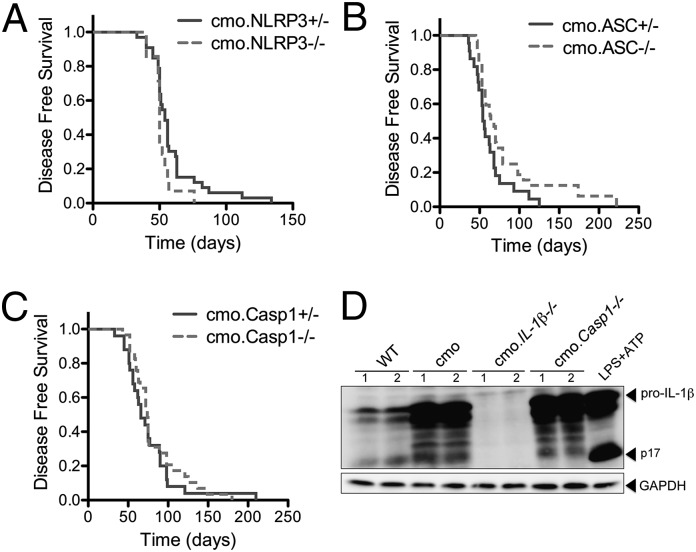
Disease in the cmo mouse is inflammasome independent. (A) Kaplan-Meier disease curves for cmo.NLRP3+/− (n = 25) and cmo.NLRP3−/− (n = 14); log–rank test P = 0.03. (B) Disease-free survival curve for cmo.ASC+/− (n = 22) and cmo.ASC−/− (n = 29); log–rank test P = 0.16. (C) Disease-free survival curve for cmo.Casp1+/− (n = 25) and cmo.Casp1−/− (n = 28); log–rank test P = 0.32. (D) Hind paw homogenates from WT, cmo, cmo.IL1β−/−, and cmo.Casp1−/− mice were immunoblotted for IL-1β and GAPDH. A positive control from LPS-primed BMDMs stimulated with ATP (LPS+ATP) is included to demonstrate caspase-1–mediated IL-1β cleavage. Each lane represents an individual mouse.
Fig. 5.
Fig. 5.
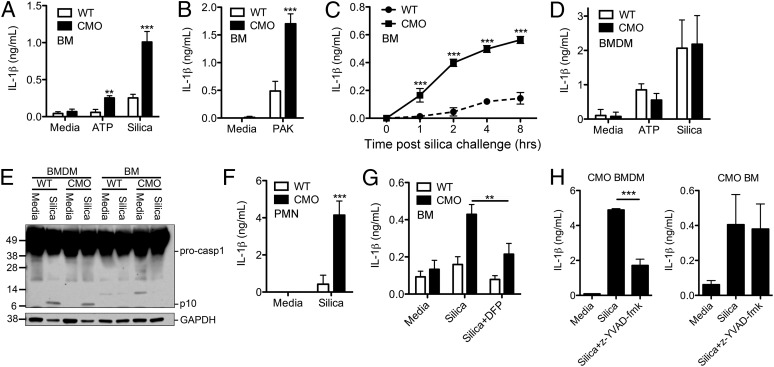
Neutrophils from cmo mice produce elevated IL-1β in vitro. (A–C) BM cells from WT or cmo mice were LPS-primed and then stimulated with either ATP (5 mM), silica (50 μg/cm2), or P. aeruginosa PAK strain at a multiplicity of infection of 1:1; culture supernatants were collected 5 h later, or at the indicated time, and IL-1β release measured by ELISA. (D) BMDMs from WT and cmo mice were LPS-primed, followed by stimulation with either ATP or silica for 6 h, after which supernatants were assessed for IL-1β via ELISA. (E) Lysates from LPS-primed WT or cmo BMDMs and BM cells stimulated with silica for 5 h were immunoblotted with antibodies against the p10 subunit of caspase-1 and GAPDH. (F) Neutrophils (PMN) from WT and cmo mice were isolated by Percoll gradient centrifugation, LPS-primed, and stimulated with silica for 5 h; IL-1β secretion into culture supernatants was determined by ELISA. (G) BM cells from WT or cmo mice were LPS-primed, pretreated for 20 min with the serine protease inhibitor DFP, and then challenged with silica. Supernatants were collected 5 h later and were assessed for IL-1β via ELISA. (H) BMDMs and BM from cmo mice were LPS-primed, pretreated with the caspase-1 inhibitor z-YVAD-fmk (10 μM) for 30 min, and then challenged with silica. Supernatants were collected 5 h later and assessed for IL-1β via ELISA. Determinations were performed in triplicate and expressed as the mean ± SD (B–D, F–H); results are representative of two (B, E, G, and H) and three (C, D, and F) separate experiments. Data represent the mean ± SEM of four separate experiments (A). **P < 0.01, ***P < 0.001 by two-way ANOVA with a Bonferroni posttest (A–D, F). **P < 0.01 by Student t test (G), ***P < 0.001 by one-way ANOVA (H).

References

    1. Ferguson PJ, Sandu M. Current understanding of the pathogenesis and management of chronic recurrent multifocal osteomyelitis. Curr Rheumatol Rep. 2012;14(2):130–141. - PMC - PubMed
    1. Ferguson PJ, El-Shanti HI. Autoinflammatory bone disorders. Curr Opin Rheumatol. 2007;19(5):492–498. - PubMed
    1. Aksentijevich I, et al. An autoinflammatory disease with deficiency of the interleukin-1-receptor antagonist. N Engl J Med. 2009;360(23):2426–2437. - PMC - PubMed
    1. Herlin T, et al. Efficacy of anti-IL-1 treatment in Majeed syndrome. Ann Rheum Dis. 2013;72(3):410–413. - PMC - PubMed
    1. Majeed HA, Al-Tarawna M, El-Shanti H, Kamel B, Al-Khalaileh F. The syndrome of chronic recurrent multifocal osteomyelitis and congenital dyserythropoietic anaemia. Report of a new family and a review. Eur J Pediatr. 2001;160(12):705–710. - PubMed

Publication types

MeSH terms

Supplementary concepts

LinkOut - more resources