


Percutaneous coronary intervention in patients with anomalous origin of coronary artery presenting with acute coronary syndrome: A case series
- PMID: 24396264
- PMCID: PMC3849285
- DOI: 10.1016/j.jcdr.2013.08.004
Percutaneous coronary intervention in patients with anomalous origin of coronary artery presenting with acute coronary syndrome: A case series
Abstract
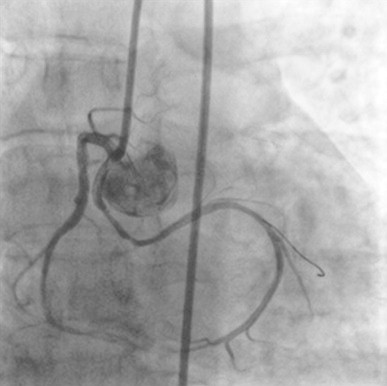
Coronary artery anomalies are found in 0.6%-1.5% of patients undergoing diagnostic coronary angiogram. Intervention in these patients poses a particular technical challenge secondary to the aberrancies in the vessel origin and course. From March 2011 to February 2013, 13 cases with complex coronary artery anomalies were observed among 2482 patients undergoing CAG (0.52%) at our cath lab. Only three patients had severe stenosis in the anomalous artery sufficient to require an intervention and had presented with myocardial infarction. PCI was performed successfully in these 3 patients two of which had anomalous left circumflex artery and the other having an anomalous right coronary artery.
Keywords: Acute coronary syndrome; Anomalous coronary artery; Coronary angiogram; Percutaneous coronary intervention.
Figures


References
-
- Yamanaka O., Hobbs R.E. Coronary artery anomalies in 126,595 patients undergoing coronary arteriography. Cathet Cardiovasc Diagn. 1990;21:28–40. - PubMed
-
- Catanoso A., Rizzini A.L., Cacucci M., Valentini P., Inama G. Coronary angioplasty of anomalous coronary arteries. G Ital Cardiol (Rome) 2010;11(suppl 1):72S–77S. - PubMed
-
- West N.E., McKenna C.J., Ormerod O. Percutaneous coronary intervention with stent deployment in anomalously-arising left circumflex coronary arteries. Catheter Cardiovasc Interv. 2006;68:882–890. - PubMed
-
- Ugalde H., Muñoz M., Ugalde D., García S. Primary angioplasty for acute myocardial infarction with an anomalous origin of right coronary artery: report of one case. Rev Med Chil. 2012;140:88–92. - PubMed
LinkOut - more resources
Full Text Sources
Other Literature Sources
Miscellaneous