


Effect of functional lumbar stabilization exercises on pain, disability, and kinesiophobia in women with menstrual low back pain: a preliminary trial
- PMID: 24396316
- PMCID: PMC3838710
- DOI: 10.1016/j.jcm.2013.08.005
Effect of functional lumbar stabilization exercises on pain, disability, and kinesiophobia in women with menstrual low back pain: a preliminary trial
Abstract
Objective: The purpose of this preliminary study was to investigate the effect of functional lumbar stabilization exercises on pain, disability, and kinesiophobia in women with menstrual low back pain (LBP).
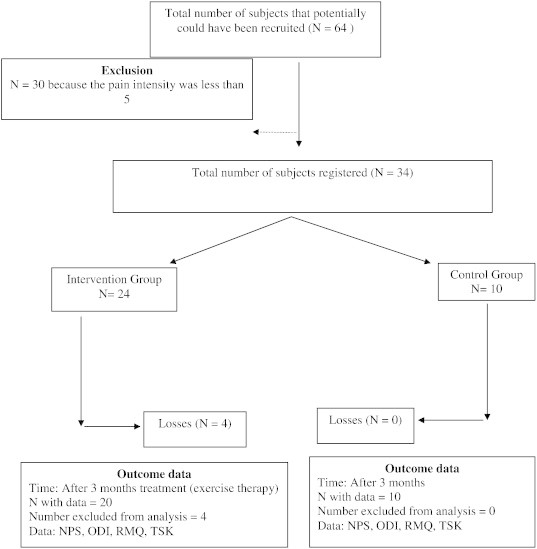
Methods: Thirty women with menstrual LBP participated in the study. Subjects were assigned to a control group (n = 10, mean age = 25.1 ± 4.7 years) and an intervention group (n = 20, mean age = 21.7±2.4 years). Treatment for the intervention group consisted of functional lumbar stabilization exercises, 10 repetitions each, 3 times a day, for 3 consecutive months. The women in the control group received no exercise and performed their regular activity daily living. Pain intensity using a Numeric Pain Scale (NPS), Oswestry Disability Index (ODI), Roland-Morris Questionnaire (RMQ), and Tampa Scale of Kinesiophobia (TSK) was collected at baseline and at the end of 3 months in both groups.
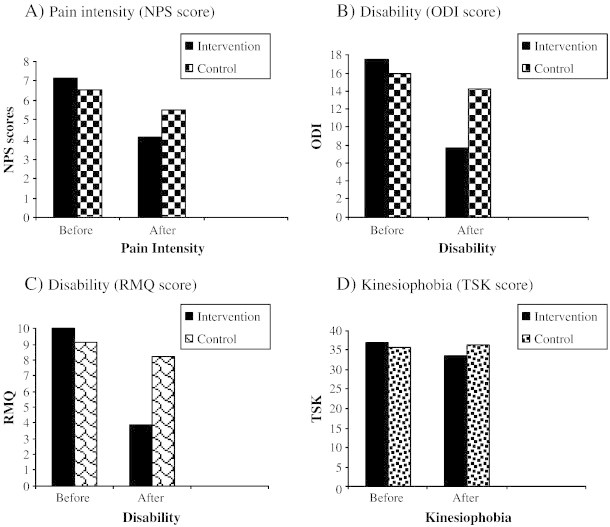
Results: Statistical analysis (paired t test) revealed a significant decrease in NPS, ODI, RMQ, and TSK after treatment in the intervention group. No significant difference in NPS, ODI, RMQ, or TSK was found between pre- and postmeasurement scores in the control group. In the analysis of covariance, controlling for pretest scores, a significant difference was found between the 2 groups in the postmeasurement score of NPS (P = .01), ODI (P < .001), RMQ (P = .002), and TSK (P = .04).
Conclusion: Lumbar stabilization exercises were shown to improve pain, disability, and kinesiophobia during menstrual LBP for subjects who participated in this preliminary study compared to those who did not receive the intervention.
Keywords: Disability; Exercise; Low back pain; Menstruation; Pain.
Figures
References
-
- Lentz G.M. Primary and secondary dysmenorrhea, premenstrual syndrome, and premenstrual dysphoric disorder: etiology, diagnosis, management. In: Katz V.L., Lentz G.M., Lobo R.A., Gershenson D.M., editors. Comprehensive gynecology. 5th ed. Mosby Elsevier; Philadelphia, Pa: 2007. chap 36.
-
- Svensson H.O., Andersson G.B., Hagstad A., Jansson P.O. The relationship of low-back pain to pregnancy and gynecologic factors. Spine. 1990;15:371–375. - PubMed
-
- Smith D.R., Mihashi M., Adachi Y. Menstrual disorders and their influence on low back pain among Japanese nurses. Ind Health. 2009;47:301–312. - PubMed
-
- Wijnhoven H.A., de Vet H.C., Smit H.A., Picavet H.S. Hormonal and reproductive factors are associated with chronic low back pain and chronic upper extremity pain in women—the MORGEN study. Spine. 2006;31:1496–1502. - PubMed
-
- Malmqvist S., Kjaermann I., Andersen K., Økland I., Brønnick K., Larsen J.P. Prevalence of low back and pelvic pain during pregnancy in a Norwegian population. J Manipulative Physiol Ther. 2012;35(4):272–278. - PubMed
LinkOut - more resources
Full Text Sources
Other Literature Sources
Miscellaneous
