


Tcea3 regulates the vascular differentiation potential of mouse embryonic stem cells
- PMID: 24397209
- PMCID: PMC8750336
- DOI: 10.3727/105221613x13776146743343
Tcea3 regulates the vascular differentiation potential of mouse embryonic stem cells
Abstract
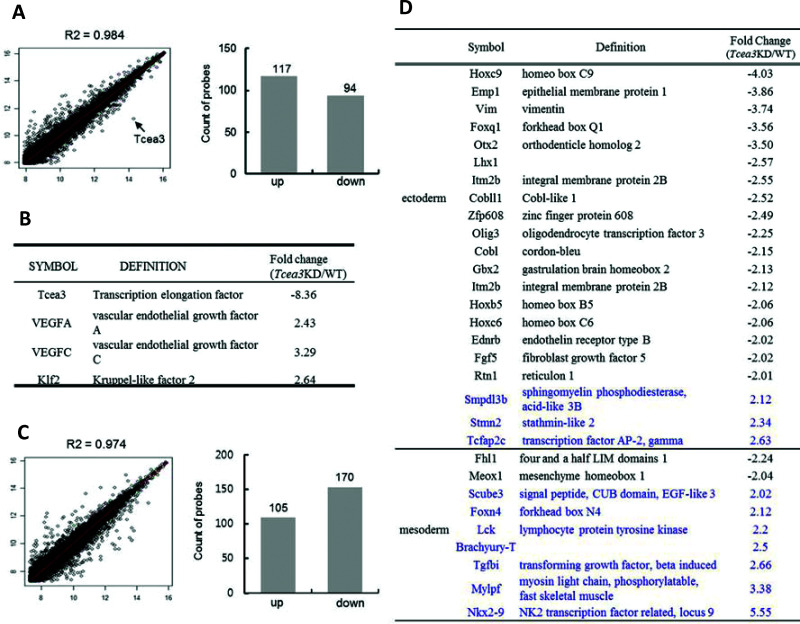
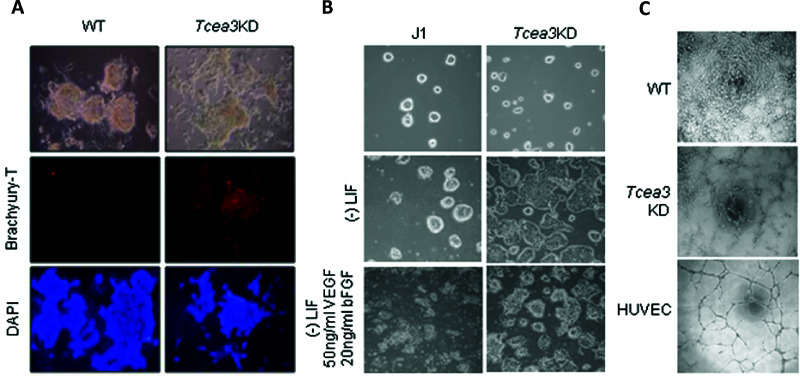
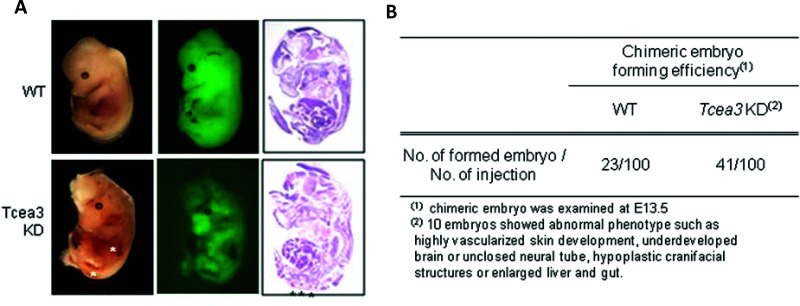
Tcea3 is present in high concentrations in mouse embryonic stem cells (mESCs) and functions to activate Lefly1, a negative regulator of Nodal signaling. The Nodal pathway has numerous biological activities, including mesoderm induction and patterning in early embryogenesis. Here, we demonstrate that the suppression of Tcea3 in mESCs shifts the cells from pluripotency into enhanced mesoderm development. Vascular endothelial growth factor A (VEGFA) and VEGFC, major transcription factors that regulate vasculogenesis, are activated in Tcea3 knocked down (Tcea3 KD) mESCs. Moreover, differentiating Tcea3 KD mESCs have perturbed gene expression profiles with suppressed ectoderm and activated mesoderm lineage markers. Most early differentiating Tcea3 KD cells expressed Brachyury-T, a mesoderm marker, whereas control cells did not express the gene. Finally, development of chimeric embryos that included Tcea3 KD mESCs was perturbed.
Figures
References
-
- Evans MJ, Kaufman MH. Establishment in culture of pluripotential cells from mouse embryos. Nature 1981; 292(5819):154–156. - PubMed
-
- Rossant J. Stem cells and early lineage development. Cell 2008, 132(4):527–531. - PubMed
-
- Pera MF, Tam PP. Extrinsic regulation of pluripotent stem cells. Nature 2010; 465(7299):713–720. - PubMed
-
- Watabe T, Miyazono K. Roles of TGF-beta family signaling in stem cell renewal and differentiation. Cell Res 2009; 19(1):103–115. - PubMed
-
- Fei T, Zhu S, Xia K, Zhang J, Li Z, Han JD, et al. Smad2 mediates Activin/Nodal signaling in mesendoderm differentiation of mouse embryonic stem cells. Cell Res 2010; 20(12):1306–1318. - PubMed
Publication types
MeSH terms
Substances
LinkOut - more resources
Full Text Sources
Other Literature Sources
Molecular Biology Databases