


Anti-hepatitis C virus compounds obtained from Glycyrrhiza uralensis and other Glycyrrhiza species
- PMID: 24397541
- PMCID: PMC7168410
- DOI: 10.1111/1348-0421.12127
Anti-hepatitis C virus compounds obtained from Glycyrrhiza uralensis and other Glycyrrhiza species
Abstract
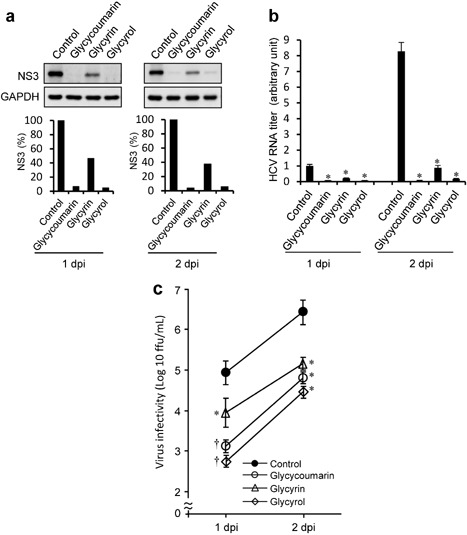
Development of complementary and/or alternative drugs for treatment of hepatitis C virus (HCV) infection is still much needed from clinical and economic points of view. Antiviral substances obtained from medicinal plants are potentially good targets to study. Glycyrrhiza uralensis and G. glabra have been commonly used in both traditional and modern medicine. In this study, extracts of G. uralensis roots and their components were examined for anti-HCV activity using an HCV cell culture system. It was found that a methanol extract of G. uralensis roots and its chloroform fraction possess anti-HCV activity with 50%-inhibitory concentrations (IC(50)) of 20.0 and 8.0 μg/mL, respectively. Through bioactivity-guided purification and structural analysis, glycycoumarin, glycyrin, glycyrol and liquiritigenin were isolated and identified as anti-HCV compounds, their IC(50) being 8.8, 7.2, 4.6 and 16.4 μg/mL, respectively. However, glycyrrhizin, the major constituent of G. uralensis, and its monoammonium salt, showed only marginal anti-HCV activity. It was also found that licochalcone A and glabridin, known to be exclusive constituents of G. inflata and G. glabra, respectively, did have anti-HCV activity, their IC(50) being 2.5 and 6.2 μg/mL, respectively. Another chalcone, isoliquiritigenin, also showed anti-HCV activity, with an IC(50) of 3.7 μg/mL. Time-of-addition analysis revealed that all Glycyrrhiza-derived anti-HCV compounds tested in this study act at the post-entry step. In conclusion, the present results suggest that glycycoumarin, glycyrin, glycyrol and liquiritigenin isolated from G. uralensis, as well as isoliquiritigenin, licochalcone A and glabridin, would be good candidates for seed compounds to develop antivirals against HCV.
Keywords: antiviral substance; coumarin; hepatitis C virus.
© 2014 The Societies and Wiley Publishing Asia Pty Ltd.
Figures
References
-
- Gottwein J.M., Scheel T.K., Jensen T.B., Lademann J.B., Prentoe J.C., Knudsen M.L., Hoegh A.M., Bukh J. ( 2009) Development and characterization of hepatitis C virus genotype 1–7 cell culture systems: role of CD81 and scavenger receptor class B type I and effect of antiviral drugs. Hepatology 49: 364–77. - PubMed
-
- Moradpour D., Penin F., Rice C.M. ( 2007) Replication of hepatitis C virus. Nat Rev Microbiol 5: 453–6. - PubMed
-
- Arzumanyan A., Reis H.M., Feitelson M.A. ( 2013) Pathogenic mechanisms in HBV‐ and HCV‐associated hepatocellular carcinoma. Nat Rev Cancer 13: 123–35. - PubMed
Publication types
MeSH terms
Substances
LinkOut - more resources
Full Text Sources
Other Literature Sources
Medical
