


Free-roaming kissing bugs, vectors of Chagas disease, feed often on humans in the Southwest
- PMID: 24398362
- PMCID: PMC4096837
- DOI: 10.1016/j.amjmed.2013.12.017
Free-roaming kissing bugs, vectors of Chagas disease, feed often on humans in the Southwest
Abstract
Background: Kissing bugs, vectors of Trypanosoma cruzi, the parasite that causes Chagas disease, are common in the desert Southwest. After a dispersal flight in summer, adult kissing bugs occasionally gain access to houses where they remain feeding on humans and pets. How often wild, free-roaming kissing bugs feed on humans outside their homes has not been studied. This is important because contact of kissing bugs with humans is one means of gauging the risk for acquisition of Chagas disease.
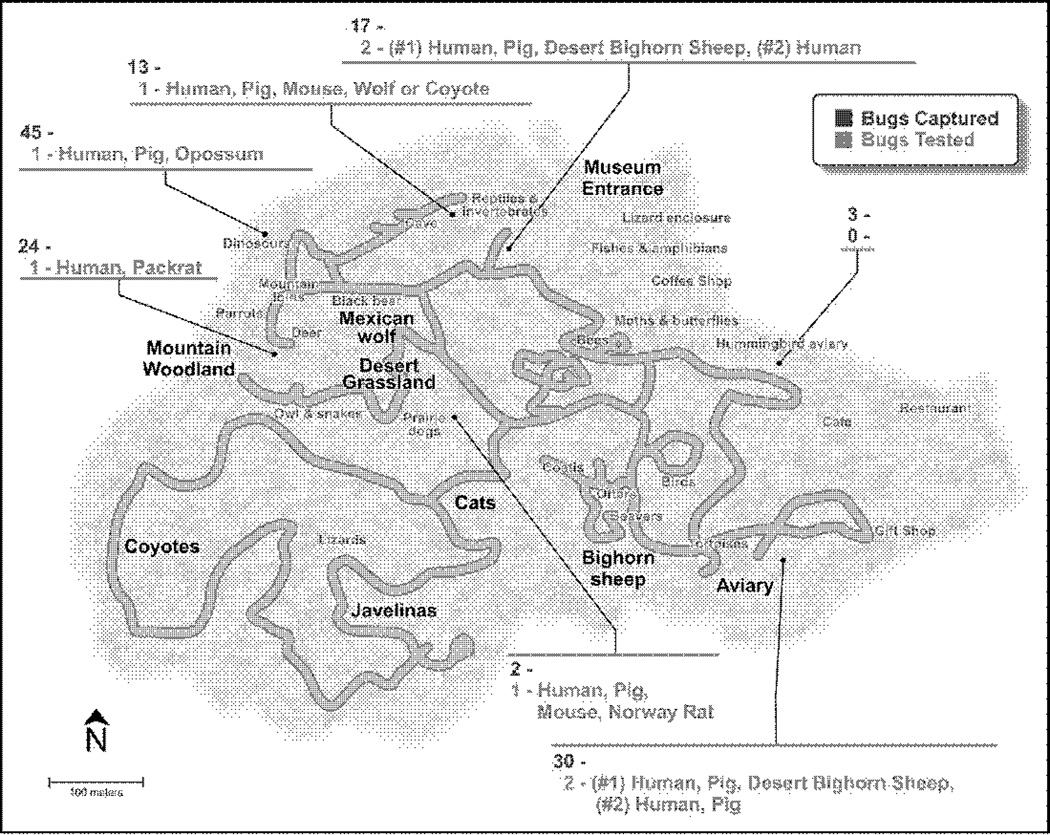
Methods: We captured kissing bugs in a zoological park near Tucson, Arizona, where many potential vertebrate hosts are on display, as well as being visited by more than 300,000 humans annually. Cloacal contents of the bugs were investigated for sources of blood meals and infection with T. cruzi.
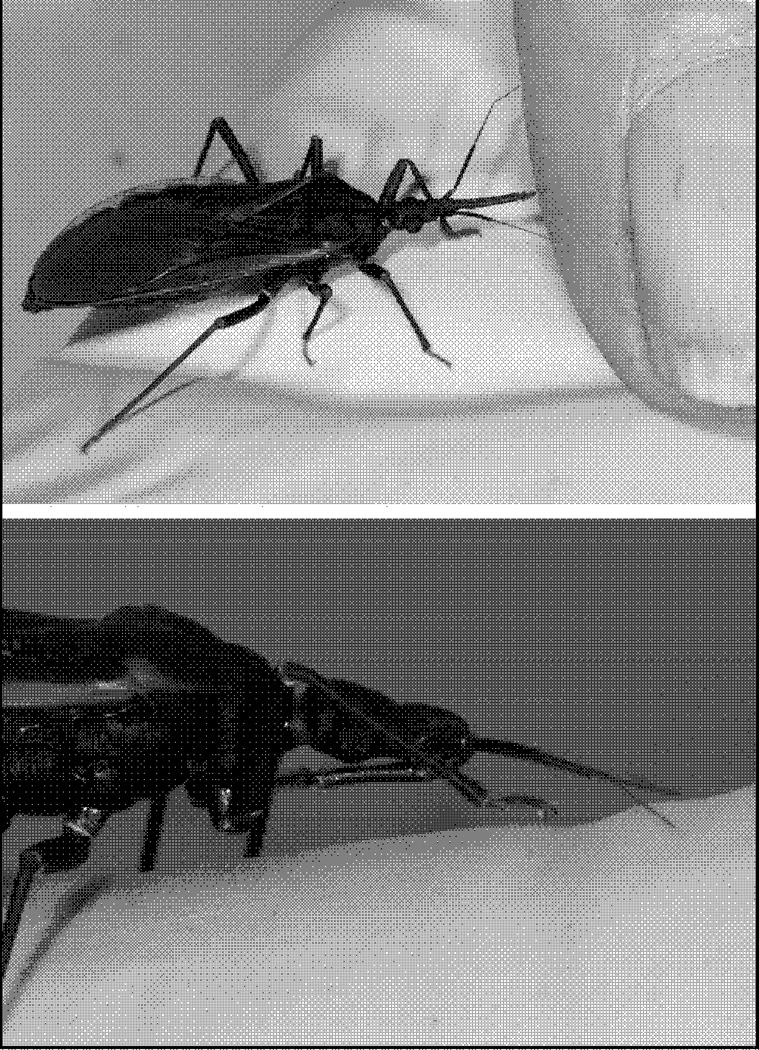
Results: Eight of 134 captured bugs were randomly selected and investigated. All 8 (100%) had human blood in their cloacae, and 7 of 8 (88%) had fed on various vertebrates on display or feral in the park. Three bugs (38%) were infected with T. cruzi. Three specimens of the largest species of kissing bug in the United States (Triatoma recurva) were captured in a cave and walking on a road; 2 of 3 (67%) had fed on humans. No T. recurva harbored T. cruzi.
Conclusions: This study establishes that free-roaming kissing bugs, given the opportunity, frequently feed on humans outside the confines of their homes in the desert Southwest and that some harbored T. cruzi. This could represent a hitherto unrecognized potential for transmission of Chagas disease in the United States.
Keywords: Chagas disease; Kissing bugs; Triatominae; Trypanosoma cruzi.
Copyright © 2014 Elsevier Inc. All rights reserved.
Conflict of interest statement
Figures
References
-
- Zeledon R, Beard C, Pinto Diaz J, Leiby D, Dorn P, Coura J. An Appraisal of the Status of Chagas Disease in the United States. Amsterdam: Elsevier; 2012.
-
- Click Lambert R, Kolivras K, Resler L, Brewster C, Paulson S. The potential for emergence of Chagas disease in the United States. Geospat Health. 2008;2:227–239. - PubMed
-
- Klotz J, Dorn P, Logan J, et al. “Kissing bugs”: potential disease vectors and cause of anaphylaxis. Clin Infect Dis. 2010;50:1629–1634. - PubMed
Publication types
MeSH terms
Grants and funding
LinkOut - more resources
Full Text Sources
Other Literature Sources
Medical
