The presence of female conveners correlates with a higher proportion of female speakers at scientific symposia
- PMID: 24399856
- PMCID: PMC3884059
- DOI: 10.1128/mBio.00846-13
The presence of female conveners correlates with a higher proportion of female speakers at scientific symposia
Abstract
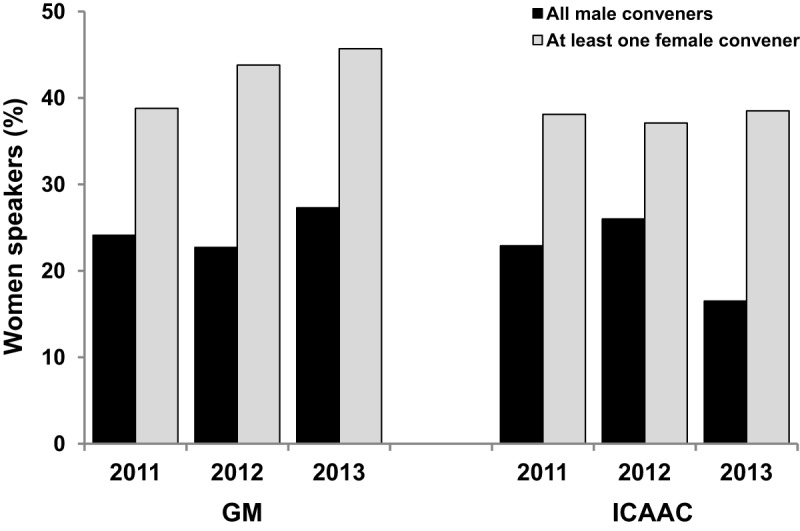
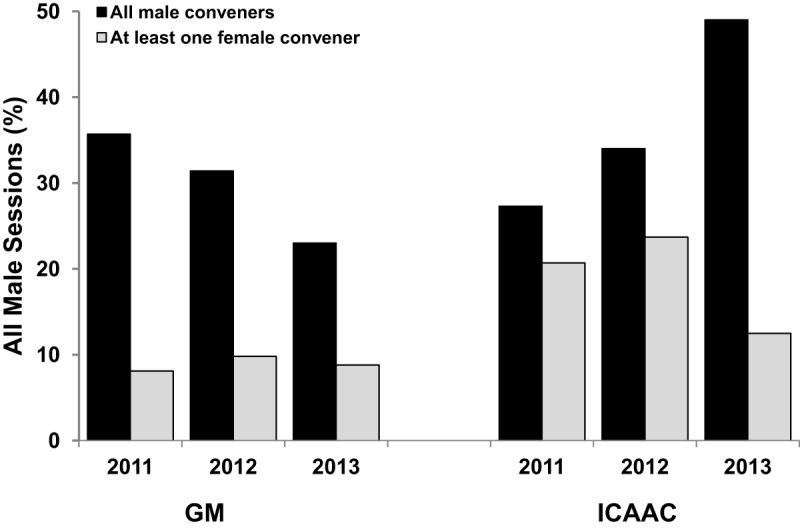
We investigated the hypothesis that the gender of conveners at scientific meetings influenced the gender distribution of invited speakers. Analysis of 460 symposia involving 1,845 speakers in two large meetings sponsored by the American Society for Microbiology revealed that having at least one woman member of the convening team correlated with a significantly higher proportion of invited female speakers and reduced the likelihood of an all-male symposium roster. Our results suggest that inclusion of more women as conveners may increase the proportion of women among invited speakers at scientific meetings.
Importance: The proportion of women entering scientific careers has increased substantially, but women remain underrepresented in academic ranks. Participation in meetings as a speaker is a factor of great importance for academic advancement. We found that having a woman as a convener greatly increased women's participation in symposia, suggesting that one mechanism for achieving gender balance at scientific meetings is to involve more women as conveners.
Figures
References
-
- Pell AN. 1996. Fixing the leaky pipeline: women scientists in academia. J. Anim. Sci. 74:2843–2848 - PubMed
-
- Schroeder J, Dugdale HL, Radersma R, Hinsch M, Buehler DM, Saul J, Porter L, Liker A, De Cauwer I, Johnson PJ, Santure AW, Griffin AS, Bolund E, Ross L, Webb TJ, Feulner PG, Winney I, Szulkin M, Komdeur J, Versteegh MA, Hemelrijk CK, Svensson EI, Edwards H, Karlsson M, West SA, Barrett EL, Richardson DS, van den Brink V, Wimpenny JH, Ellwood SA, Rees M, Matson KD, Charmantier A, Dos Remedios N, Schneider NA, Teplitsky C, Laurance WF, Butlin RK, Horrocks NP. 2013. Fewer invited talks by women in evolutionary biology symposia. J. Evol. Biol. 26:2063–2069 - PMC - PubMed
MeSH terms
LinkOut - more resources
Full Text Sources
Other Literature Sources