


Bile resistance mechanisms in Lactobacillus and Bifidobacterium
- PMID: 24399996
- PMCID: PMC3872040
- DOI: 10.3389/fmicb.2013.00396
Bile resistance mechanisms in Lactobacillus and Bifidobacterium
Abstract
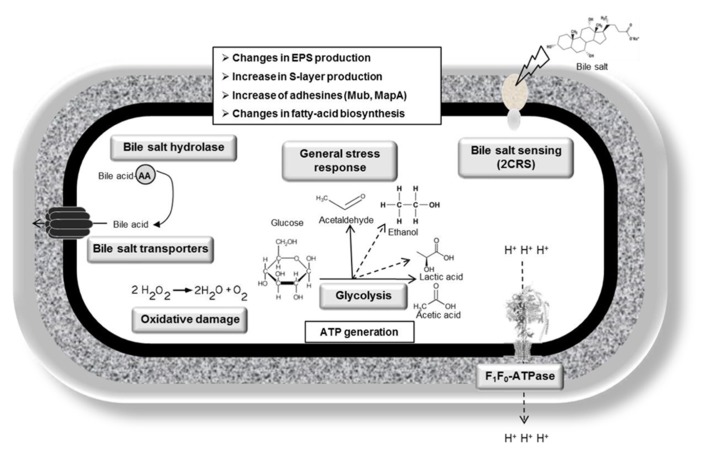
Probiotics are live microorganisms which when administered in adequate amounts confer a health benefit on the host. Most of the probiotic bacteria currently available in the market belong to the genera Lactobacillus and Bifidobacterium, and specific health-promoting activities, such as treatment of diarrhea or amelioration of gastrointestinal discomfort, have been attributed to them. In order to be able to survive the gastrointestinal transit and transiently colonize our gut, these bacteria must be able to counteract the deleterious action of bile salts, which are the main components of bile. Bile salts are detergent-like biological substances synthesized in the liver from cholesterol. Host enzymes conjugate the newly synthesized free bile acids in the liver with the amino acids glycine or taurine, generating conjugated bile salts. These compounds are stored in the gall bladder and they are released into the duodenum during digestion to perform their physiological function, which is the solubilization of fat coming from diet. These bile salts possess strong antimicrobial activity, since they are able to disorganize the structure of the cell membrane, as well as trigger DNA damage. This means that bacteria inhabiting our intestinal tract must have intrinsic resistance mechanisms to cope with bile salts. To do that, Lactobacillus and Bifidobacterium display a variety of proteins devoted to the efflux of bile salts or protons, to modify sugar metabolism or to prevent protein misfolding. In this manuscript, we review and discuss specific bile resistance mechanisms, as well as the processes responsible for the adaptation of bifidobacteria and lactobacilli to bile.
Keywords: Bifidobacterium; Lactobacillus; bile adaptation; bile detoxification; bile resistance.
Figures
References
-
- Bron P. A., Marco M., Hoffer S. M., Van Mullekom E., De Vos W. M., Kleerebezem M. (2004). Genetic characterization of the bile salt response in Lactobacillus plantarum and analysis of responsive promoters in vitro and in situ in the gastrointestinal tract. J. Bacteriol. 186 7829–7835 10.1128/JB.186.23.7829-7835.2004 - DOI - PMC - PubMed
LinkOut - more resources
Full Text Sources
Other Literature Sources
