


Excess body mass is associated with T cell differentiation indicative of immune ageing in children
- PMID: 24401077
- PMCID: PMC3992037
- DOI: 10.1111/cei.12267
Excess body mass is associated with T cell differentiation indicative of immune ageing in children
Abstract
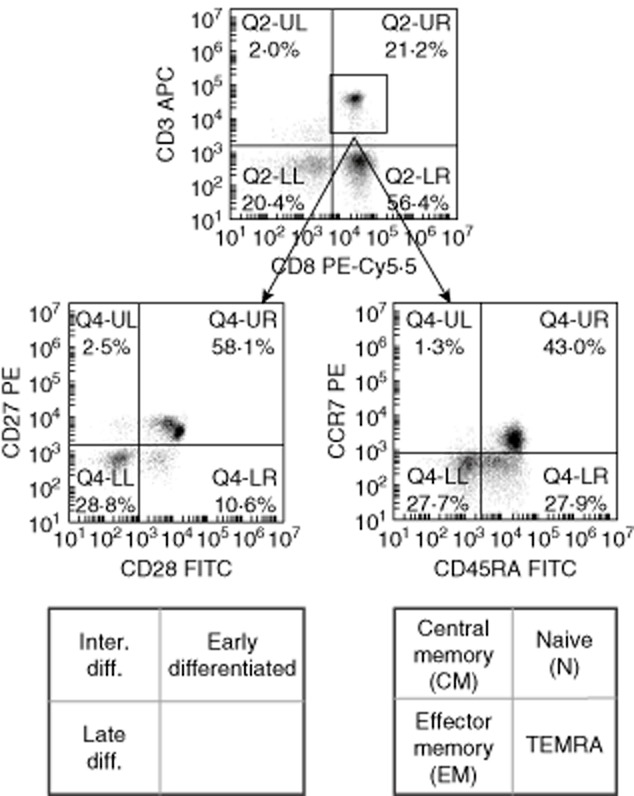
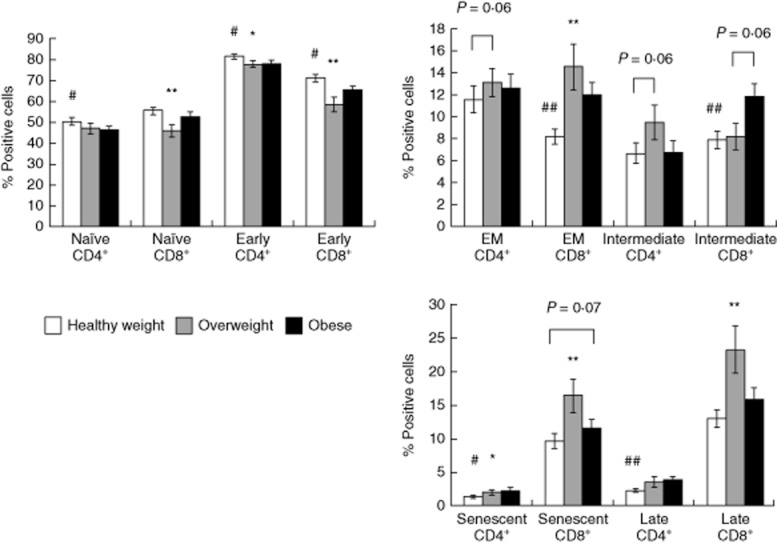
Obesity has been associated with accelerated biological ageing and immunosenescence. As the prevalence of childhood obesity is increasing, we wanted to determine if associations between obesity and immunosenescence would manifest in children. We studied 123 Mexican American adolescents aged 10-14 (mean 12·3 ± 0·7) years, with body weights ranging from 30·1 to 115·2 kg (mean 52·5 ± 14·5 kg). Blood samples were obtained to determine proportions of naive, central memory (CM), effector memory (EM), senescent and early, intermediate and highly differentiated subsets of CD4(+) and CD8(+) T cells. Overweight and obese children had significantly lowered proportions of early CD8(+) T cells (B = -11·55 and -5·51%, respectively) compared to healthy weight. Overweight children also had more EM (B = +7·53%), late (B = +8·90%) and senescent (B = +4·86%) CD8(+) T cells than healthy weight children, while obese children had more intermediate CD8(+) (B = +4·59%), EM CD8(+) (B = +5·49%), late CD4(+) (B = +2·01%) and senescent CD4(+) (B = +0·98%) T cells compared to healthy weight children. These findings withstood adjustment for potentially confounding variables, including age, gender and latent cytomegalovirus and Epstein-Barr virus infections. We conclude that excess body mass, even in adolescence, may accelerate immunosenescence and predispose children to increased risks of incurring immune-related health problems in adulthood.
Keywords: adolescents; herpes viruses; immunosenescence; obesity; overweight.
© 2014 British Society for Immunology.
Figures
References
-
- American Diabetes Association. Type 2 diabetes in children and adolescents. Diabetes Care. 2000;23:381–389. - PubMed
-
- van Emmerik NM, Renders CM, van de Veer M, et al. High cardiovascular risk in severely obese young children and adolescents. Arch Dis Child. 2012;97:818–821. - PubMed
-
- Cook S, Weitzman M, Auinger P, Nguyen M, Dietz WH. Prevalence of a metabolic syndrome phenotype in adolescents: findings from the third National Health and Nutrition Examination Survey, 1988–1994. Arch Pediatr Adolesc Med. 2003;157:821–827. - PubMed
-
- Freedman DS, Khan LK, Serdula MK, Dietz WH, Srinivasan SR, Berenson GS. The relation of childhood BMI to adult adiposity: the Bogalusa Heart Study. Pediatrics. 2005;115:22–27. - PubMed
MeSH terms
LinkOut - more resources
Full Text Sources
Other Literature Sources
Medical
Research Materials
