


Index-based dietary patterns and risk of head and neck cancer in a large prospective study
- PMID: 24401718
- PMCID: PMC3927689
- DOI: 10.3945/ajcn.113.073163
Index-based dietary patterns and risk of head and neck cancer in a large prospective study
Abstract
Background: Head and neck cancer (HNC) is the seventh most common cancer worldwide. Although diet has been proposed to play an important role in HNC, few associations with diet have been convincing other than alcohol intake. Studies of dietary patterns that examine overall diets may provide broader insight than studies of individual foods. Little is known about the association between dietary patterns and risk of HNC.
Objective: We prospectively evaluated the association between 2 index-based dietary patterns [ie, the Healthy Eating Index-2005 (HEI-2005) and alternate Mediterranean Diet Score (aMED)] and risk of head and neck squamous cell carcinoma.
Design: We included 494,967 participants from the NIH-AARP Diet and Health study (1995-2006). HRs (95% CIs) were estimated by using Cox regression. Scores for the HEI-2005 and aMED were calculated on the basis of diet assessed by using a baseline food-frequency questionnaire. Higher scores reflected adherence to dietary recommendations for healthy eating. Our main outcome was the incidence of HNC, including cancer of the larynx, oral cavity, and orohypopharynx.
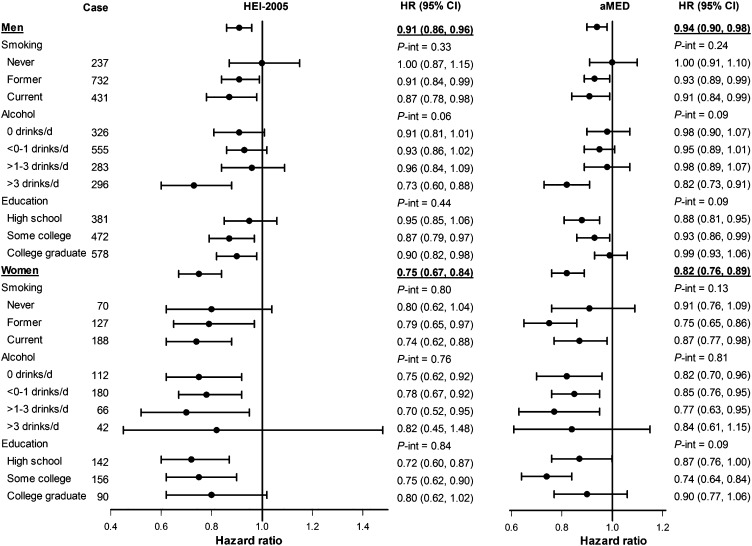
Results: A total of 1868 HNC cases were identified during follow-up. Higher HEI-2005 scores were associated with reduced risk of HNC in men [HR: 0.74 (95% CI: 0.61, 0.89) for highest compared with lowest quintiles; P-trend = 0.0008] and women [HR: 0.48; 95% CI: 0.33, 0.70; P-trend < 0.0001]. High aMED scores were also associated with lower HNC risk in men (HR: 0.80; 95% CI: 0.64, 1.01; P-trend = 0.002) and women (HR: 0.42; 95% CI: 0.24, 0.74; P-trend < 0.0001). Associations were similar among subsites. We did not find significant interactions between smoking and alcohol intake and each index on HNC risk.
Conclusions: HEI-2005 and aMED scores were associated inversely with risk of HNC. Large interventional studies are required to assess the causality before conveying definite public health messages.
Trial registration: ClinicalTrials.gov NCT00340015.
Figures
References
-
- Jemal A, Bray F, Center MM, Ferlay J, Ward E, Forman D. Global cancer statistics. CA Cancer J Clin 2011;61:69–90. - PubMed
-
- Siegel R, Naishadham D, Jemal A. Cancer statistics, 2013. CA Cancer J Clin 2013;63:11–30. - PubMed
-
- Sturgis EM, Wei Q, Spitz MR. Descriptive epidemiology and risk factors for head and neck cancer. Semin Oncol 2004;31:726–33. - PubMed
-
- Hashibe M, Brennan P, Benhamou S, Castellsague X, Chen C, Curado MP, Dal Maso L, Daudt AW, Fabianova E, Fernandez L, et al. Alcohol drinking in never users of tobacco, cigarette smoking in never drinkers, and the risk of head and neck cancer: pooled analysis in the International Head and Neck Cancer Epidemiology Consortium. J Natl Cancer Inst 2007;99:777–89 (Published erratum appears in J Natl Cancer Inst 2008;100:225.) - PubMed
-
- Freedman ND, Abnet CC, Leitzmann MF, Hollenbeck AR, Schatzkin A. Prospective investigation of the cigarette smoking-head and neck cancer association by sex. Cancer 2007;110:1593–601. - PubMed
Publication types
MeSH terms
Associated data
LinkOut - more resources
Full Text Sources
Other Literature Sources
Medical
