. 2014 Mar;6(3):322-34.
doi: 10.1002/emmm.201303000. Epub 2014 Jan 8.

Telomerase governs immunomodulatory properties of mesenchymal stem cells by regulating FAS ligand expression

Affiliations

Telomerase governs immunomodulatory properties of mesenchymal stem cells by regulating FAS ligand expression

Chider Chen et al. EMBO Mol Med. 2014 Mar.

Abstract

Bone marrow mesenchymal stem cells (BMMSCs) are capable of differentiating into multiple cell types and regulating immune cell response. However, the mechanisms that govern the immunomodulatory properties of BMMSCs are still not fully elucidated. Here we show that telomerase-deficient BMMSCs lose their capacity to inhibit T cells and ameliorate the disease phenotype in systemic sclerosis mice. Restoration of telomerase activity by telomerase reverse transcriptase (TERT) transfection in TERT(-/-) BMMSCs rescues their immunomodulatory functions. Mechanistically, we reveal that TERT, combined with β-catenin and BRG1, serves as a transcriptional complex, which binds the FAS ligand (FASL) promoter to upregulate FASL expression, leading to an elevated immunomodulatory function. To test the translational value of these findings in the context of potential clinical therapy, we used aspirin treatment to upregulate telomerase activity in BMMSCs, and found a significant improvement in the immunomodulatory capacity of BMMSCs. Taken together, these findings identify a previously unrecognized role of TERT in improving the immunomodulatory capacity of BMMSCs, suggesting that aspirin treatment is a practical approach to significantly reduce cell dosage in BMMSC-based immunotherapies.


Figures
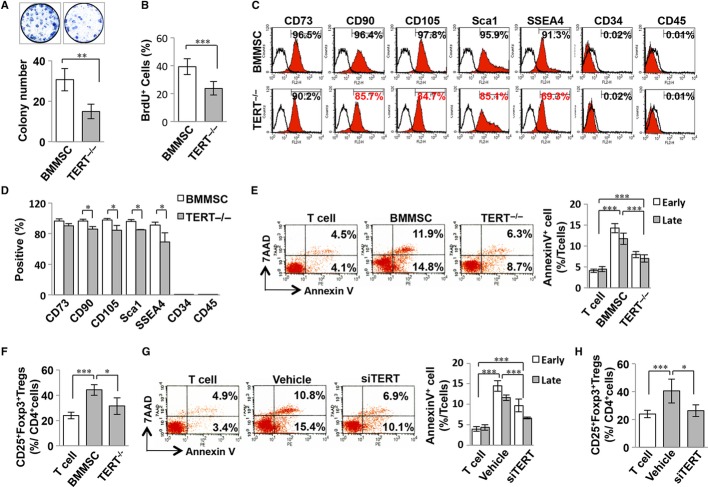
Figure 1
Figure 1
Telomerase reverse transcriptase (TERT) contributes to Bone marrow mesenchymal stem cell (BMMSC)-mediated immunomodulation. A TERT/ BMMSCs showed reduced single colony-forming ability. (Student's t-test, n = 5 in each group, **< 0.01). Error bars present the s.d. of the mean values. B BrdU labeling was performed to show reduced proliferative capacity of TERT/ BMMSCs (Student's t-test, n = 5 in each group, ***< 0.005). Error bars present the s.d. of the mean values. C–D FACS analysis showed downregulated expression levels of BMMSC surface markers in TERT/ BMMSCs (Student's t-test, n = 5 in each group, *< 0.005). Error bars present the s.d. of the mean values. E In vitro coculture system showed a significantly decreased capacity of TERT/ BMMSCs to induce AnnexinV+7AAD and AnnexinV+7AAD+ double positive apoptotic T cells compared to regular (WT) BMMSCs (One-way ANOVA, Bonferroni, n = 5 in each group, ***< 0.005). Error bars present the s.d. of the mean values. F Treg induction assay indicated a significantly decreased capacity of TERT/ BMMSCs to upregulate Treg levels in comparison with WT BMMSCs (One-way ANOVA, Bonferroni, n = 5 in each group, ***< 0.005, *< 0.05). Error bars present the s.d. of the mean values. G In vitro coculture system showed a decreased capacity of TERT knockdown BMMSCs by siRNA to induce AnnexinV+7AAD and AnnexinV+7AAD+ double positive apoptotic T cells BMMSCs (One-way ANOVA, Bonferroni, n = 5 in each group, ***< 0.005). Error bars present the s.d. of the mean values. H Treg induction assay was performed to show a significantly decreased capacity of TERT knockdown BMMSCs to upregulate the level of Tregs in comparison with WT BMMSCs (One-way ANOVA, Bonferroni, n = 5 in each group, ***< 0.005, *< 0.05). Error bars present the s.d. of the mean values. Vehicle: scrambled siRNA-treated BMMSCs.
Figure 2
Figure 2
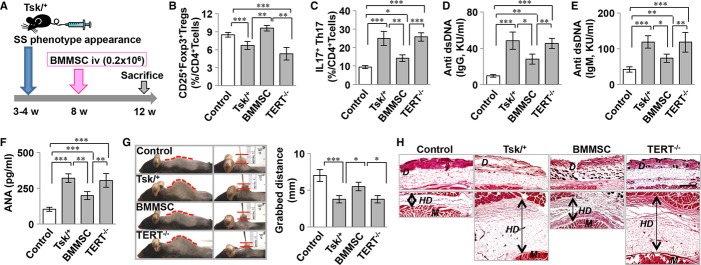
Telomerase reverse transcriptase (TERT) is required for Bone marrow mesenchymal stem cell (BMMSC)-mediated amelioration of disease phenotype in systemic sclerosis mice. A Schema showing BMMSC transplantation (MSCT) for treating systemic sclerosis (SS) tight skin (Tsk/+) mice. B FACS analysis showed that the Treg level was significantly decreased in Tsk/+ mice compared to Fbn1+/+ control littermates. After MSCT, the Treg level was significantly elevated, whereas TERT/ MSCT failed to upregulate the Treg level in Tsk/+ mice. C FACS analysis showed that CD4+IL17+ Th17 cells were significantly increased in Tsk/+ mice compared to control littermates. WT MSCT, but not TERT/ MSCT, was able to significantly reduce the Th17 level in Tsk/+ mice. D–F ELISA assays showed that Tsk/+ mice had elevated levels of anti-double strand DNA antibodies IgG (D), IgM (E) and antinuclear antibody (ANA, F) when compared to control littermates. WT MSCT reduced the levels of anti-double strand DNA antibodies IgG (d), IgM (e) and ANA (f). In contrast, TERT/ MSCT failed to reduce the levels of anti-double strand DNA antibodies IgG (d), IgM (e) and ANA (f). G Tsk/+ mice showed a tight skin phenotype. Grabbed skin distance measurement showed that WT BMMSC, but not TERT/ BMMSC, transplantation significantly improved the tight skin phenotype. H Histological examination identified that hyperdermal thickness was significantly increased in Tsk/+ mice compared to control littermates. WT BMMSC, but not TERT/ BMMSC, transplantation improved hyperdermal thickness in Tsk/+ mice. Scale Bar, 100 μm. D: Dermal, M: Muscle, and HD: Hyperdermal. Data information: Error bars represent the s.d. from the mean values (One-way ANOVA, Bonferroni, n = 6 in each group, ***< 0.005, **< 0.01, *< 0.05).
Figure 3
Figure 3
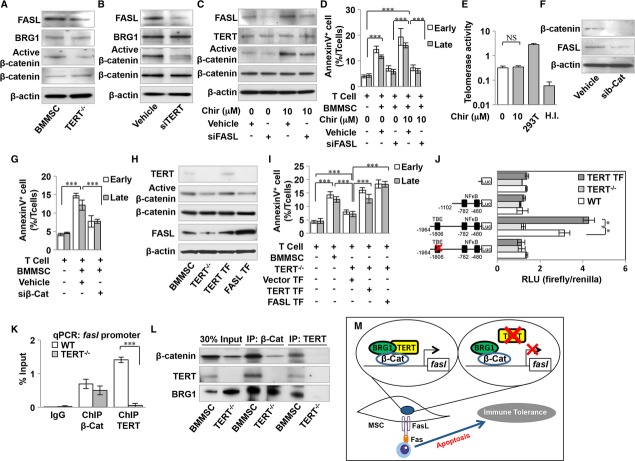
Telomerase reverse transcriptase (TERT) serves as a transcriptional modulator to regulate FASL expression in Bone marrow mesenchymal stem cells (BMMSCs). A–B Western blot analysis showed decreased levels of FASL and active β-catenin, but not BRG1, in TERT/ BMMSCs (A) and tert knockdown BMMSCs by siRNA (B) compared to TERT+/+ (WT) BMMSCs. C β-catenin activator (Chir, 10 μM) treatment elevated levels of active β-catenin and FASL in WT BMMSCs. fasl knockdown BMMSCs by siRNA showed a decreased level of FASL expression, but not active β-catenin. D In vitro coculture system showed β-catenin activator (Chir)-treated BMMSCs had increased capacity to induce AnnexinV+7AAD and AnnexinV+7AAD+ double positive apoptotic T cells compared to control group. fasl siRNA treatment could reduce Chir-elevated T cell apoptosis in the co-culture system. E Telomerase activity in Chir-treated BMMSCs showed no significant difference from the untreated group. 293T cells were used as a positive control, and heat-inactivated (H.I.) samples were used as a negative control. F Western blot analysis showed decreased expression levels of β-catenin and FASL in β-catenin knockdown BMMSCs by siRNA. G β-catenin knockdown BMMSCs by siRNA showed decreased capacity to induce AnnexinV+7AAD and AnnexinV+7AAD+ double positive apoptotic T cells compared to the control siRNA group. H Western blot showed that TERT/ BMMSCs decreased expression levels of TERT, active β-catenin, and FASL. Tert transfection (TERT TF) rescued the expression levels of TERT, active β-catenin, and FASL, assessed by Western blot, while fasl transfection (FASL TF) only rescued FASL expression, but not that of TERT or β-catenin, in TERT/ BMMSCs. I In vitro coculture system showed a decreased capacity of TERT/ BMMSCs to induce AnnexinV+7AAD and AnnexinV+7AAD+ double positive apoptotic T cells when compared to the control group, whereas transfection of both tert and fasl rescued the capacity to induce AnnexinV+7AAD and AnnexinV+7AAD+ double positive apoptotic T cells. J fasl promoter-luciferase fusions were examined in WT, TERT/ and TERT TF BMMSCs. Promoter activity was expressed as relative light units (RLU) normalized to the activity of co-transfected Renilla luciferase. The activity of 2 kb promoter-luciferase fusion was significantly elevated compared to 1.1 kb fusion in WT BMMSCs and TERT TF BMMSCs when compared to TERT/ BMMSCs. The activity of TBE-specific site-mutated promoters was markedly decreased in WT BMMSCs and TERT TF BMMSCs. K Chromatin immunoprecipitation (ChIP)-qPCR assay showed enrichment of direct association of β-catenin on the fasl promoter in WT and TERT/ BMMSCs, while the enrichment of direct association of TERT on the fasl promoter was only found in WT BMMSCs. L ChIP-Western blot assays showed direct association of TERT, β-catenin and BRG1 on the fasl promoter in WT BMMSCs, but only direct association of β-catenin and BRG1 on the fasl promoter in TERT/ BMMSCs. M Schematic diagram indicates that TERT, as a transcriptional modulator in a complex with β-catenin and BRG1, mediates FASL expression in BMMSC-induced immunoregulation. Vehicle: scrambled siRNA-treated BMMSCs. Data information: Error bars represent the s.d. from the mean values (One-way ANOVA, Bonferroni, n = 3 in each group, ***< 0.005, *< 0.05). Source data are available for this figure.
Figure 4
Figure 4
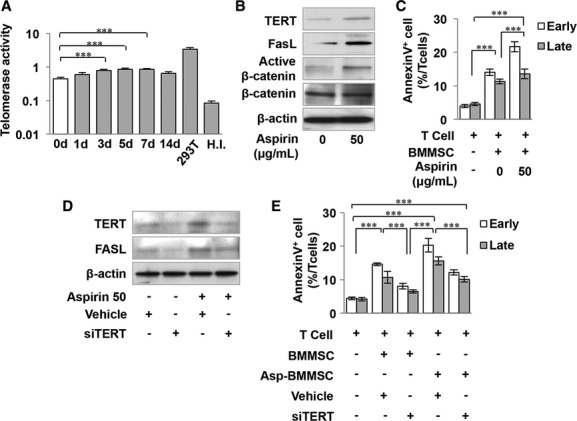
Aspirin pretreatment increases immunomodulation of Bone marrow mesenchymal stem cells (BMMSCs) through Telomerase reverse transcriptase (TERT) activation.
  1. TRAP-ELISA assays showed that Aspirin-pretreated (50 μg/ml) BMMSCs exhibited increased telomerase activity from day 3 to day 7 compared to the untreated group. 293T cells were used as a positive control, and heat-inactivated (H.I.) samples were used as negative control.

  2. Western blot analysis showed elevated levels of TERT, FASL, and active β-catenin expression in aspirin-pretreated BMMSCs.

  3. In vitro coculture system showed that Aspirin-pretreated BMMSCs exhibited increased capacity to induce AnnexinV+7AAD and AnnexinV+7AAD+ double positive apoptotic T cells compared to the untreated group.

  4. Western blot analysis showed that aspirin pretreatment elevated levels of TERT and FASL expression in BMMSCs, which could be blocked by TERT siRNA treatment.

  5. In vitro coculture system showed that aspirin-pretreated BMMSCs exhibited increased capacity to induce AnnexinV+7AAD and AnnexinV+7AAD+ double positive apoptotic T cells, which could be diminished by TERT siRNA treatment. Vehicle: scrambled siRNA-treated BMMSCs.
Data information: Error bars represent the s.d. from the mean values (One-way ANOVA, Bonferroni, n = 3 in each group, ***< 0.005). Source data are available for this figure.
Figure 5
Figure 5
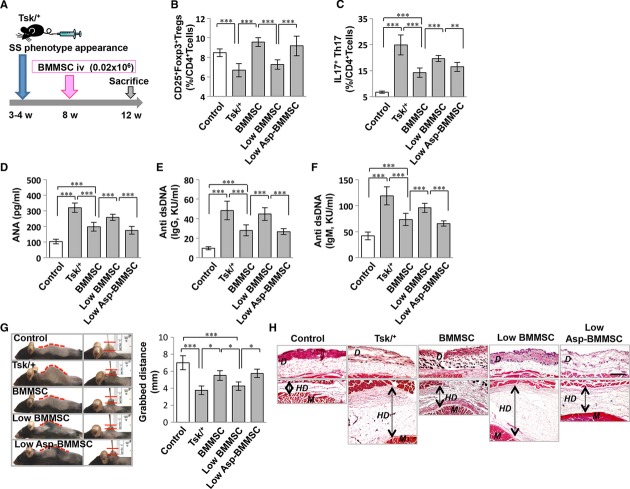
Aspirin-pretreated BMMSCs show increased capacity to ameliorate systemic sclerosis phenotypes.. A Schema showing procedure for using aspirin-pretreated BMMSC transplantation (Asp-MSCT) to treat systemic sclerosis (SS) tight skin (Tsk/+) mice. B FACS analysis showed that the Treg level was significantly decreased in Tsk/+ mice compared to control littermates. After MSCT, the Treg level was significantly elevated. Using ten times less BMMSCs during MSCT (Low-BMMSC) failed to increase the Treg level, while Low-Asp-BMMSC significantly elevated the Treg level in Tsk/+ mice. C FACS analysis showed that CD4+IL17+ Th17 cells were significantly increased in Tsk/+ mice compared to control littermates. After MSCT, the Th17 level was significantly reduced. Low-BMMSC failed to diminish Th17 level, while Low-Asp-BMMSC significantly reduced the Th17 level in Tsk/+ mice. D–F ELISA assays showed that Tsk/+ mice had elevated levels of antinuclear antibody (ANA, D) and anti-double strand DNA antibodies IgG (E) and IgM (F) when compared to control littermates. MSCT reduced the levels of ANA (d) and anti-double strand DNA antibodies IgG (e) and IgM (f). Low-BMMSC failed to diminish the levels of ANA (D) and anti-double strand DNA antibodies IgG (E) and IgM (F), while Low-Asp-BMMSC significantly reduced the levels of ANA (D) and anti-double strand DNA antibodies IgG (E) and IgM (F) in Tsk/+ mice. G Tsk/+ mice showed tight skin phenotype compared to control littermates. MSCT significantly improved skin phenotype in terms of grabbed skin distance in Tsk/+ mice. Grabbed skin distance measurement showed that Low-BMMSC failed to ameliorate tight skin phenotypes, while Low-Asp-BMMSC significantly improved skin phenotypes in Tsk/+ mice. H Hyperdermal thickness was significantly increased in Tsk/+ mice compared to control littermates. MSCT improved hyperdermal thickness in Tsk/+ mice. Histological examination identified that Low-BMMSC failed to diminish hyperdermal thickness, while Low-Asp-BMMSC significantly reduced hyperdermal thickness in Tsk/+ mice. Scale Bar, 100 μm. D: Dermal, M: Muscle, and HD: Hyperdermal. Data information: Error bars represent the s.d. from the mean values (One-way ANOVA, Bonferroni, n = 6 in each group, ***< 0.005, **< 0.01, *< 0.05).

References

    1. Aggarwal S, Pittenger MF. Human mesenchymal stem cells modulate allogeneic immune cell responses. Blood. 2005;105:1815–1822. - PubMed
    1. Akiyama K, Chen C, Wang D, Xu X, Qu C, Yamaza T, Cai T, Chen W, Sun L, Shi S. Mesenchymal stem cell-induced immunoregulation involves Fas Ligand/Fas-mediated T cell apoptosis. Cell Stem Cell. 2012;10:544–555. - PMC - PubMed
    1. Batten P, Sarathchandra P, Antoniw JW, Tay SS, Lowdell MW, Taylor PM, Yacoub MH. Human mesenchymal stem cells induce T cell anergy and downregulate T cell allo-responses via the TH2 pathway: relevance to tissue engineering human heart valves. Tissue Eng. 2006;12:2263–2273. - PubMed
    1. Battula VL, Treml S, Bareiss PM, Gieseke F, Roelofs H, Zwart P, Muller I, Schewe B, Skutella T, Fibbe WE, et al. Isolation of functionally distinct mesenchymal stem cell subsets using antibodies against CD56, CD271, and mesenchymal stem cell antigen-1. Haematologica. 2009;94:173–184. - PMC - PubMed
    1. Bonab MM, Alimoghaddam K, Talebian F, Ghaffari SH, Ghavamzadeh A, Nikbin B. Aging of mesenchymal stem cell in vitro. BMC Cell Biol. 2006;7:14. - PMC - PubMed

Publication types

MeSH terms