


Role of the lateral parabrachial nucleus in the control of sodium appetite
- PMID: 24401989
- PMCID: PMC3921312
- DOI: 10.1152/ajpregu.00251.2012
Role of the lateral parabrachial nucleus in the control of sodium appetite
Abstract
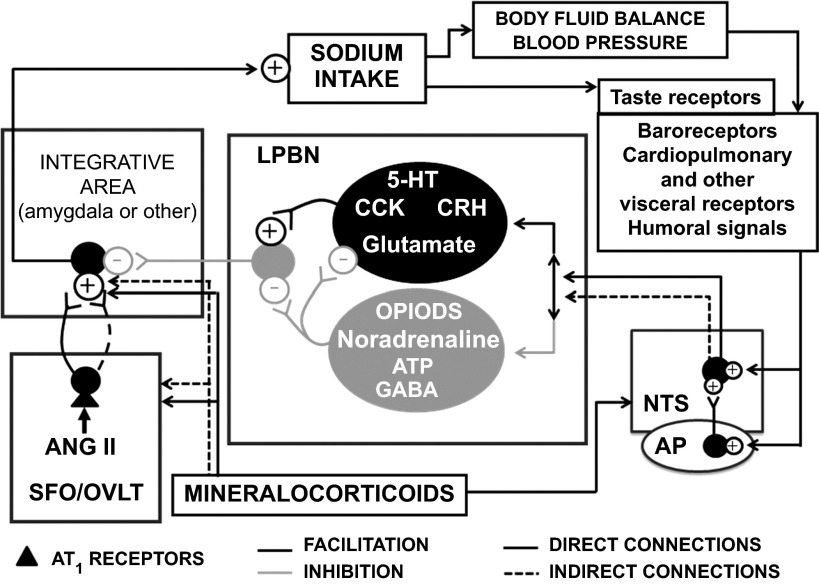
In states of sodium deficiency many animals seek and consume salty solutions to restore body fluid homeostasis. These behaviors reflect the presence of sodium appetite that is a manifestation of a pattern of central nervous system (CNS) activity with facilitatory and inhibitory components that are affected by several neurohumoral factors. The primary focus of this review is on one structure in this central system, the lateral parabrachial nucleus (LPBN). However, before turning to a more detailed discussion of the LPBN, a brief overview of body fluid balance-related body-to-brain signaling and the identification of the primary CNS structures and humoral factors involved in the control of sodium appetite is necessary. Angiotensin II, mineralocorticoids, and extracellular osmotic changes act on forebrain areas to facilitate sodium appetite and thirst. In the hindbrain, the LPBN functions as a key integrative node with an ascending output that exerts inhibitory influences on forebrain regions. A nonspecific or general deactivation of LPBN-associated inhibition by GABA or opioid agonists produces NaCl intake in euhydrated rats without any other treatment. Selective LPBN manipulation of other neurotransmitter systems [e.g., serotonin, cholecystokinin (CCK), corticotrophin-releasing factor (CRF), glutamate, ATP, or norepinephrine] greatly enhances NaCl intake when accompanied by additional treatments that induce either thirst or sodium appetite. The LPBN interacts with key forebrain areas that include the subfornical organ and central amygdala to determine sodium intake. To summarize, a model of LPBN inhibitory actions on forebrain facilitatory components for the control of sodium appetite is presented in this review.
Keywords: angiotensin; electrolyte balance; sodium intake; thirst.
Figures
References
-
- Almeida RL, David RB, Constancio J, Fracasso JF, Menani JV, DeLucaJr LA. Inhibition of sodium appetite by lipopolysaccharide: involvement of α2-adrenoceptors. Am J Physiol Regul Integr Comp Physiol 301: R185–R192, 2011 - PubMed
-
- Andrade CAF, Barbosa SP, De Luca LA, Jr, Menani JV. Activation of α2-adrenergic receptors into the lateral parabrachial nucleus enhances NaCl intake in rats. Neuroscience 129: 25–34, 2004 - PubMed
-
- Andrade-Franzé GM, Andrade CA, De Luca LA, Jr, De Paula PM, Colombari DS, Menani JV. Lesions in the central amygdala impair sodium intake induced by the blockade of the lateral parabrachial nucleus. Brain Res 1332: 57–64, 2010 - PubMed
-
- Andrade-Franzé GM, Andrade CA, De Luca LA, Jr, De Paula PM, Menani JV. Lateral parabrachial nucleus and central amygdala in the control of sodium intake. Neuroscience 165: 633–641, 2010 - PubMed
-
- Antunes-Rodrigues J, De Castro M, Elias LK, Valença MM, McCann SM. Neuroendocrine control of body fluid metabolism. Physiol Rev 84: 169–208, 2004 - PubMed
Publication types
MeSH terms
Substances
Grants and funding
LinkOut - more resources
Full Text Sources
Other Literature Sources
Medical
