


Recreational water-associated disease outbreaks--United States, 2009-2010
- PMID: 24402466
- PMCID: PMC5779330
Recreational water-associated disease outbreaks--United States, 2009-2010
Erratum in
- MMWR Morb Mortal Wkly Rep. 2014 Jan 31;63(4):82
Abstract
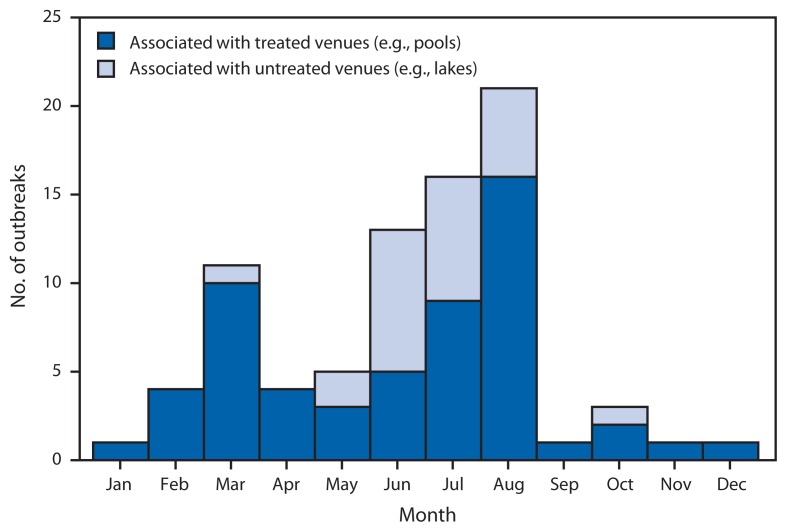
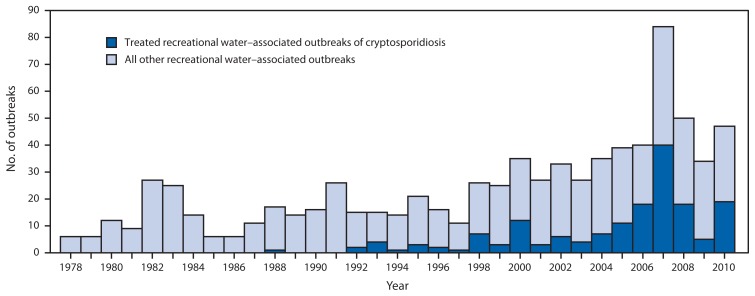
Recreational water-associated disease outbreaks result from exposure to infectious pathogens or chemical agents in treated recreational water venues (e.g., pools and hot tubs or spas) or untreated recreational water venues (e.g., lakes and oceans). For 2009-2010, the most recent years for which finalized data are available, public health officials from 28 states and Puerto Rico electronically reported 81 recreational water-associated disease outbreaks to CDC's Waterborne Disease and Outbreak Surveillance System (WBDOSS) via the National Outbreak Reporting System (NORS). This report summarizes the characteristics of those outbreaks. Among the 57 outbreaks associated with treated recreational water, 24 (42%) were caused by Cryptosporidium. Among the 24 outbreaks associated with untreated recreational water, 11 (46%) were confirmed or suspected to have been caused by cyanobacterial toxins. In total, the 81 outbreaks resulted in at least 1,326 cases of illness and 62 hospitalizations; no deaths were reported. Laboratory and environmental data, in addition to epidemiologic data, can be used to direct and optimize the prevention and control of recreational water-associated disease outbreaks.
Figures
References
-
- CDC. Surveillance for waterborne disease outbreaks and other health events associated with recreational water—United States, 2007–2008. MMWR. 2011;60(SS-12) - PubMed
-
- CDC. Communitywide cryptosporidiosis outbreak—Utah, 2007. MMWR. 2008;57:989–93. - PubMed
-
- Cantey PT, Kurian AK, Jefferson D, et al. Outbreak of cryptosporidiosis associated with a man-made chlorinated lake—Tarrant County, Texas, 2008. J Environ Health. 2012;75:14–9. - PubMed
-
- CDC. Cryptosporidiosis outbreak response and evaluation. Atlanta, GA: US Department of Health and Human Services; 2009. Available at http://www.cdc.gov/parasites/crypto/resources/core_guidelines.pdf.
-
- Hudnell HK, Backer LC, Anderson J, Dionysiou DD. United States of America: historical review and current policy addressing cyanobacteria. In: Chorus I, editor. Current approaches to cyanotoxin risk assessment, risk management and regulations in different countries. Dessau, Germany: Federal Environment Agency (Umweltbundesamt); 2012. pp. 137–47.
MeSH terms
LinkOut - more resources
Full Text Sources
Medical
