


Humans rely on the same rules to assess emotional valence and intensity in conspecific and dog vocalizations
- PMID: 24402716
- PMCID: PMC3917336
- DOI: 10.1098/rsbl.2013.0926
Humans rely on the same rules to assess emotional valence and intensity in conspecific and dog vocalizations
Abstract
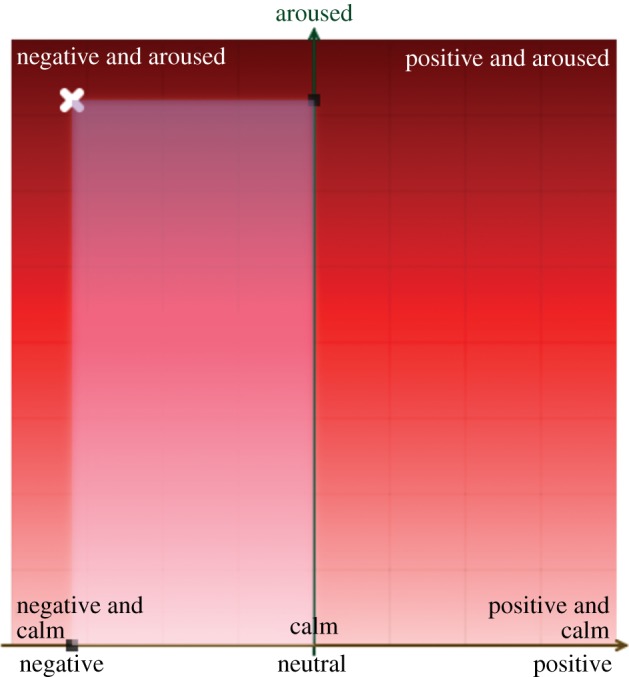
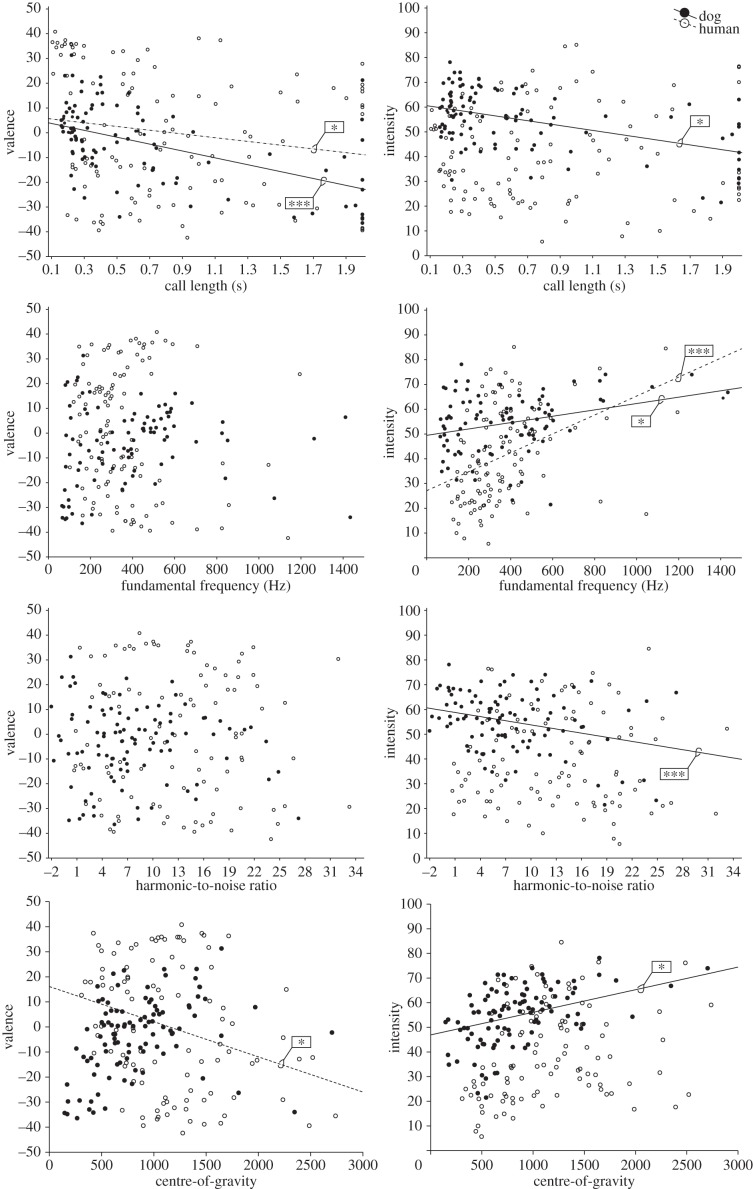
Humans excel at assessing conspecific emotional valence and intensity, based solely on non-verbal vocal bursts that are also common in other mammals. It is not known, however, whether human listeners rely on similar acoustic cues to assess emotional content in conspecific and heterospecific vocalizations, and which acoustical parameters affect their performance. Here, for the first time, we directly compared the emotional valence and intensity perception of dog and human non-verbal vocalizations. We revealed similar relationships between acoustic features and emotional valence and intensity ratings of human and dog vocalizations: those with shorter call lengths were rated as more positive, whereas those with a higher pitch were rated as more intense. Our findings demonstrate that humans rate conspecific emotional vocalizations along basic acoustic rules, and that they apply similar rules when processing dog vocal expressions. This suggests that humans may utilize similar mental mechanisms for recognizing human and heterospecific vocal emotions.
Keywords: dog; emotion intensity assessment; emotion valence assessment; human; non-verbal emotion expressions; vocal communication.
Figures
References
-
- Nesse RM. 1990. Evolutionary explanations of emotions. Hum. Nat. 1, 261–289 (doi:10.1007/BF02733986) - DOI - PubMed
-
- Simon-Thomas ER, Keltner DJ, Sauter DA, Sinicropi-Yao L, Abramson A. 2009. The voice conveys specific emotions: evidence from vocal burst displays. Emotion 9, 838–846 (doi:10.1037/a0017810) - DOI - PubMed
-
- Sauter DA, Eisner F, Ekman P, Scott SK. 2010. Cross-cultural recognition of basic emotions through nonverbal emotional vocalizations. Proc. Natl Acad. Sci. USA 107, 2408–2412 (doi:10.1073/pnas.0908239106) - DOI - PMC - PubMed
-
- Bachorowski J-A, Smoski MJ, Owren MJ. 2001. The acoustic features of human laughter. J. Acoust. Soc. Am. 110, 1581 (doi:10.1121/1.1391244) - DOI - PubMed
-
- Sauter DA, Eisner F, Calder AJ, Scott SK. 2010. Perceptual cues in nonverbal vocal expressions of emotion. Q. J. Exp. Psychol. 63, 2251–2272 (doi:10.1080/17470211003721642) - DOI - PMC - PubMed
Publication types
MeSH terms
LinkOut - more resources
Full Text Sources
Other Literature Sources
Miscellaneous
