Review
. 2014 Aug;21(4):843-60.
doi: 10.3758/s13423-013-0564-3.

Knowledge is power: how conceptual knowledge transforms visual cognition

Affiliations
Review

Knowledge is power: how conceptual knowledge transforms visual cognition

Jessica A Collins et al. Psychon Bull Rev. 2014 Aug.

Abstract

In this review, we synthesize the existing literature demonstrating the dynamic interplay between conceptual knowledge and visual perceptual processing. We consider two theoretical frameworks that demonstrate interactions between processes and brain areas traditionally considered perceptual or conceptual. Specifically, we discuss categorical perception, in which visual objects are represented according to category membership, and highlight studies showing that category knowledge can penetrate early stages of visual analysis. We next discuss the embodied account of conceptual knowledge, which holds that concepts are instantiated in the same neural regions required for specific types of perception and action, and discuss the limitations of this framework. We additionally consider studies showing that gaining abstract semantic knowledge about objects and faces leads to behavioral and electrophysiological changes that are indicative of more efficient stimulus processing. Finally, we consider the role that perceiver goals and motivation may play in shaping the interaction between conceptual and perceptual processing. We hope to demonstrate how pervasive such interactions between motivation, conceptual knowledge, and perceptual processing are in our understanding of the visual environment, and to demonstrate the need for future research aimed at understanding how such interactions arise in the brain.


Figures
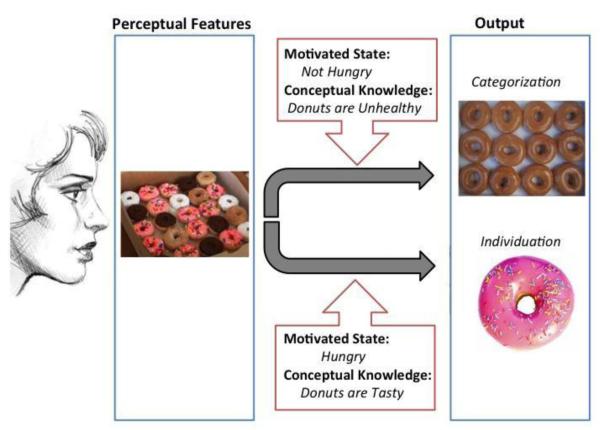
Figure 1
Figure 1
Schematic illustration of how motivational state and conceptual knowledge can influence visual processing. The top portion is an illustration of categorical perception: the donuts are perceived in terms of their category membership, with individual differences between each donut being abstracted over. If the perceiver is motivated to individuate each of the donuts, then categorical perception will be overridden and the characteristics that distinguish each donut will be highlighted.
Figure 2
Figure 2
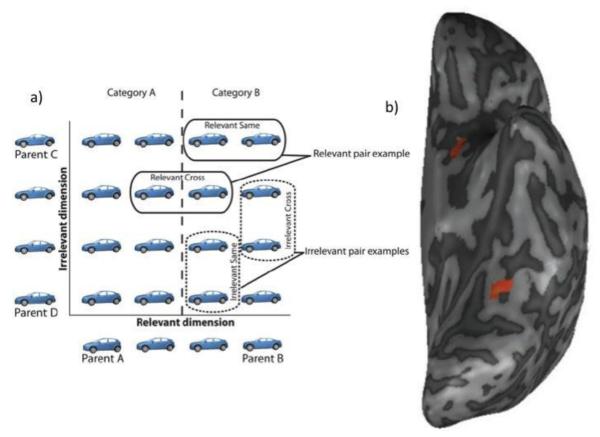
Folstein and colleagues trained participants to categorize morphed car stimuli into two categories based on their resemblance to two parent cars. Later, participants performed an orthogonal task on these stimuli while being scanned. fMRI adaptation was reduced along object dimensions relevant to categorization within object-selective cortex of the mid-fusiform gyrus, suggesting that neurons in this area had become more sensitive to perceptual variations relevant to the learned categories. The image in (b) depicts a whole-brain comparison of all relevant stimulus pairs compared with all irrelevant stimulus pairs. Adapted from Folstein, J. R., Palmeri, T. J., & Gauthier, I. (2012). Category learning increases discriminability of relevant object dimensions in visual cortex. Cerebral Cortex.
Figure 3
Figure 3
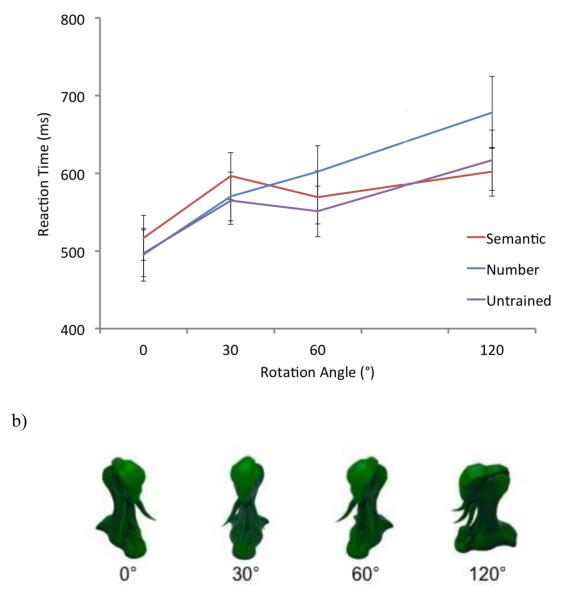
Participants learned to associate semantic features or number words with a set of novel objects (yufos). Afterwards, participants performed a speeded sequential matching task with the trained and untrained yufos. The first yufo was always presented in its canonical orientation (0°), whereas the second yufo could be presented at one of four viewpoints (0°, 30°, 60°, or 120°). (a) Lines represent mean reaction times on the perceptual matching of yufos that were in the untrained, number, or semantic learning condition, at each orientation. Error bars represent standard error of the mean. The image in (b) depicts the yufo stimuli used by Collins & Curby (2013).
Figure 4
Figure 4
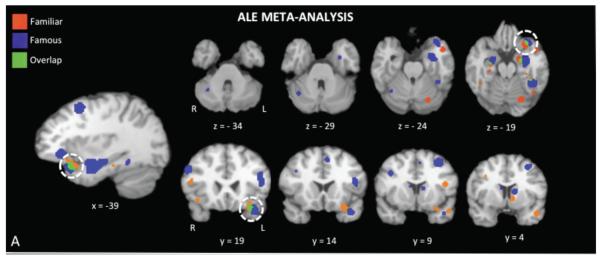
Activations to famous and familiar faces from a random effects ALE meta-analysis. The white circle highlights activations to famous and familiar faces in the left anterior temporal lobe (Von der Heid et al., 2013).

References

    1. Abdel Rahman R, Sommer W. Seeing what we know and understand: how knowledge shapes perception. Psychonomic bulletin & review. 2008;15:1055–63. doi:10.3758/PBR.15.6.1055. - PubMed
    1. Abdel-Rahman R, Sommer W. Knowledge scale effects in face recognition: An electrophysiological investigation. Cognitive Affective & Behavioral Neuroscience. 2012;12:161–174. doi: 10.3758/s13415-011-0063-9. - PubMed
    1. Acheson DJ, Hamidi M, Binder JR, Postle BR. A common neural substrate for language production and verbal working memory. Journal of Cognitive Neuroscience. 2011;23:1358–67. doi:10.1162/jocn.2010.21519. - PMC - PubMed
    1. Althoff RR, Cohen NJ. Eye-movementbased memory effect: A reprocessing effect in face perception. Journal of Experimental Psychology: Learning, Memory, and Cognition. 1999;25:997–1010. - PubMed
    1. Anderson E, Siegel EH, Bliss-Moreau E, Barrett LF. The visual impact of gossip. Science. 2011;17:1446–1448. doi: 10.1126/science.1201574. - PMC - PubMed

Publication types

LinkOut - more resources