. 2014 Jan 8;34(2):363-72.
doi: 10.1523/JNEUROSCI.2400-13.2014.

Restraint stress alters nociceptin/orphanin FQ and CRF systems in the rat central amygdala: significance for anxiety-like behaviors

Affiliations

Restraint stress alters nociceptin/orphanin FQ and CRF systems in the rat central amygdala: significance for anxiety-like behaviors

Roberto Ciccocioppo et al. J Neurosci. .

Abstract

Corticotropin releasing factor (CRF) is the primary mediator of stress responses, and nociceptin/orphanin FQ (N/OFQ) plays an important role in the modulation of these stress responses. Thus, in this multidisciplinary study, we explored the relationship between the N/OFQ and the CRF systems in response to stress. Using in situ hybridization (ISH), we assessed the effect of body restraint stress on the gene expression of CRF and N/OFQ-related genes in various subdivisions of the amygdala, a critical brain structure involved in the modulation of stress response and anxiety-like behaviors. We found a selective upregulation of the NOP and downregulation of the CRF1 receptor transcripts in the CeA and in the BLA after body restraint. Thus, we performed intracellular electrophysiological recordings of GABAA-mediated IPSPs in the central nucleus of the amygdala (CeA) to explore functional interactions between CRF and N/OFQ systems in this brain region. Acute application of CRF significantly increased IPSPs in the CeA, and this enhancement was blocked by N/OFQ. Importantly, in stress-restraint rats, baseline CeA GABAergic responses were elevated and N/OFQ exerted a larger inhibition of IPSPs compared with unrestraint rats. The NOP antagonist [Nphe1]-nociceptin(1-13)NH2 increased the IPSP amplitudes in restraint rats but not in unrestraint rats, suggesting a functional recruitment of the N/OFQ system after acute stress. Finally, we evaluated the anxiety-like response in rats subjected to restraint stress and nonrestraint rats after N/OFQ microinjection into the CeA. Intra-CeA injections of N/OFQ significantly and selectively reduced anxiety-like behavior in restraint rats in the elevated plus maze. These combined results demonstrate that acute stress increases N/OFQ systems in the CeA and that N/OFQ has antistress properties.


Figures
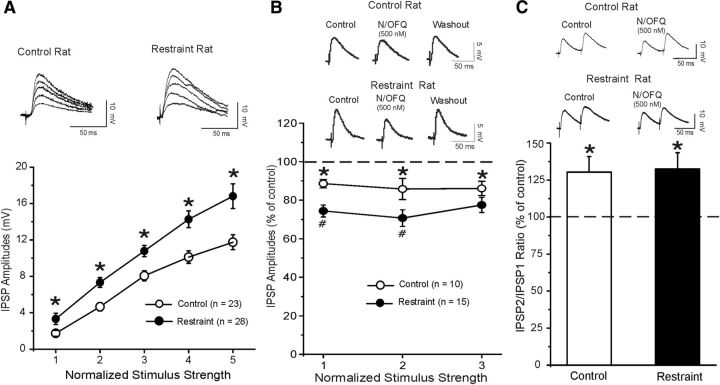
Figure 1.
Figure 1.
A, Central amygdala basal GABAergic transmission is enhanced in restraint rats compared with control unrestraint rats. Top, Representative evoked CeA GABAA IPSPs from the input–output curves generated in control and restraint rats. Bottom, Input–output curves of mean GABAA IPSP amplitudes. The IPSPs are larger in restraint rats using five equivalent stimulus intensities. The mean baseline GABAergic transmission is significantly increased in slices from restraint rats (n = 21) compared with unrestraint rats (n = 17): *p < 0.05 (unpaired t test). B, Top, Representative evoked CeA IPSPs from control and restraint rats during the control, 500 nm N/OFQ application and washout. Bottom, A total of 500 nm N/OFQ significantly (*p < 0.05) decreases the mean IPSP amplitudes of evoked IPSP over the middle three stimulus strength intensities tested. The N/OFQ-induced inhibition of IPSP amplitudes is larger (#p < 0.05) in CeA of restraint compared with unrestraint rats. C, Top, Representative PPF of evoked CeA IPSPs from control and restraint rats during control and 500 nm N/OFQ application. Bottom, Histograms representing percentage increase in mean ± SEM PPF ratios of IPSPs using 50 ms interstimulus interval in CeA of control and restraint rats. N/OFQ significantly increased the PPF ratio in both groups: *p < 0.05 (paired t test).
Figure 2.
Figure 2.
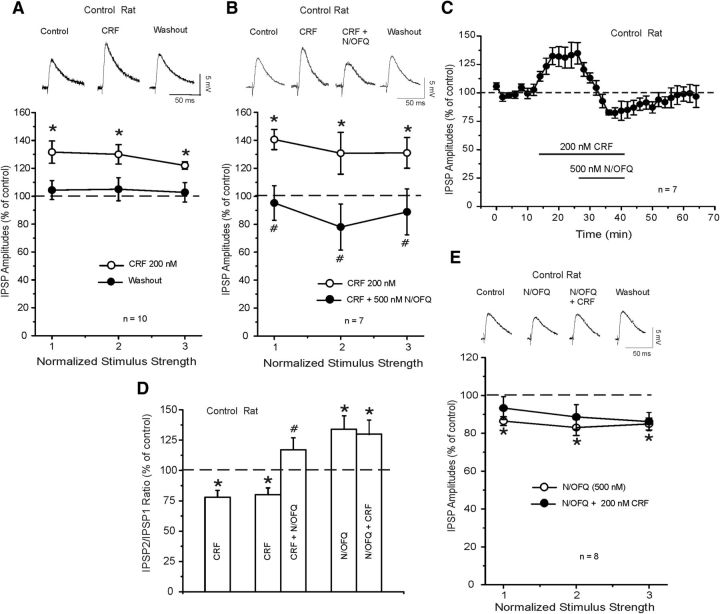
A, Top, Representative evoked CeA IPSPs from a control unrestraint rat during control, CRF, and washout. Bottom, CRF application reversibly and significantly increased the IPSP amplitude in CeA neurons of control rats: *p < 0.05. B, Top, Representative recordings of evoked IPSPs during CRF, CRF + N/OFQ, and washout of the two peptides. Bottom, CRF significantly (*p < 0.05; Newman–Keuls post hoc) increases mean IPSP amplitudes and subsequent application of N/OFQ significantly (#p < 0.05; Newman–Keuls post hoc) diminishes the CRF-induced enhancement. C, Time course of changes in evoked IPSP amplitude (at half-maximal intensity) induced by CRF, concurrent application of N/OFQ, and washout of the two peptides. D, Histograms summarized the percentage change in mean (± SEM) PPF ratio of IPSPs in the experimental conditions of A, B, and E. CRF significantly decreases the PPF ratio of IPSPs: *p < 0.05 (Newman–Keuls post hoc). #p < 0.05, significance between CRF alone and concurrent application of CRF and N/OFQ (Newman–Keuls post hoc). N/OFQ significantly increases PPF ratios compared with control (*p < 0.05; Newman–Keuls post hoc), and CRF coapplied with N/OFQ did not alter these PPF ratios. E, In the CeA of control rats, N/OFQ 500 nm significantly (*p < 0.05; Newman–Keuls post hoc) decreases the mean IPSP amplitudes, whereas subsequent CRF 200 nm has no effect.
Figure 3.
Figure 3.
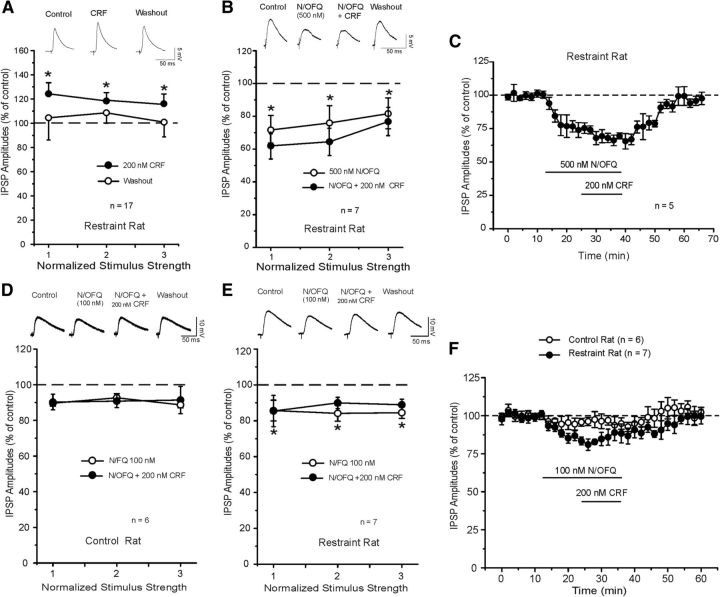
A, In the CeA from restraint rats, superfusion of CRF alone significantly increased the mean IPSP amplitudes to 120% of control (similar to control rats): *p < 0.05 (paired t test). B, Top, Representative evoked CeA IPSPs from a restraint rat during the N/OFQ, coapplication with CRF, and washout. Bottom, Superfusion of N/OFQ alone significantly decreased the mean IPSP amplitudes to 74% of control and prevented the enhancement of IPSPs induced by subsequent CRF (as unrestraint rats, E): *p < 0.05. C, Time course of the changes in evoked IPSP amplitude induced by N/OFQ, concurrent application of CRF, and washout of the two peptides in CeA of restraint rats. D, Top, Representative IPSPs during application of evoked CeA IPSPs from unrestraint rat during the 100 nm N/OFQ, coapplication with CRF, and washout. Bottom, Superfusion of 100 nm N/OFQ alone did not affect the mean IPSP amplitudes, but it prevented the enhancement of IPSPs induced by CRF. E, Top, Representative IPSPs during application of evoked CeA IPSPs from a restraint rat during the 100 nm N/OFQ, coapplication with CRF, and washout. Bottom, Superfusion of 100 nm N/OFQ alone significantly decreased the mean IPSP amplitudes and blocked the CRF-induced increase of IPSPs: *p < 0.05 (Newman–Keuls post hoc). F, Time course of changes in evoked IPSP amplitude (at half-maximal intensity) induced by N/OFQ, concurrent application of CRF, and washout of the two peptides in the control (n = 6) and restraint (n = 7) rats.
Figure 4.
Figure 4.
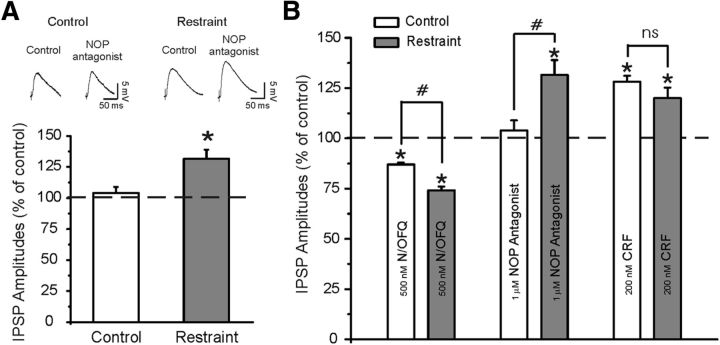
A, Top, Representative IPSPs during application of an NOP antagonist ([Nphe1]nociceptin(1–13)NH2) at 1 μm concentration. Bottom, The NOP antagonist does not alter the basal-evoked IPSP amplitudes (stimulus intensity equal to half-maximal IPSP amplitude) in control rats, but significantly increases their amplitudes in CeA neurons of restraint rats: *p < 0.05 (paired t test). B, Histograms summarized the percentage change in mean (± SEM) evoked IPSP amplitudes measured during N/OFQ, NOP antagonist, and CRF application in CeA of control and restraint rats. #p < 0.05, significance between drug effects in the two animal groups. *p < 0.05, significance between drug effects and baseline control within the same group. ns, Not significant.
Figure 5.
Figure 5.
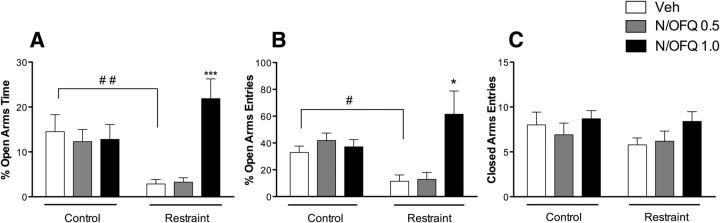
Effect of intra-CeA N/OFQ (0.0, 0.5, and 1.0 nmol/rat) injection on EPM test. A, Time spent in open arms. ##p < 0.01, Veh control versus Veh restraint (Newman–Keuls post hoc test). ***p < 0.001, N/OFQ 1.0 nmol versus Veh in the restraint group. B, Open arms entries. #p < 0.01, Veh control versus Veh restraint (Newman–Keuls post hoc test). *p < 0.05, N/OFQ 1.0 nmol versus Veh. C, Closed arm entries. The number of closed arm entries was not affected by the restraint procedure or N/OFQ treatment. In summary, our data show higher anxiety-like responses in restraint compared with unrestraint rats. N/OFQ significantly attenuated the effect of restraint stress on anxiety-like responses. Data are mean ± SEM (n = 9 or 10 rats/group).
Figure 6.
Figure 6.
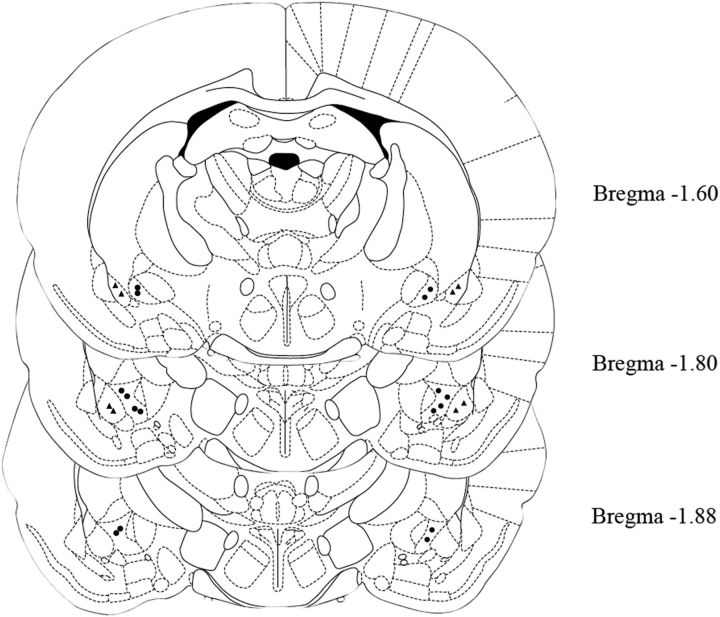
Histological reconstructions showing correct (filled circles) and incorrect (filled triangles) injections into the CeA. Data presented in the figures are indicative of the criteria used for identification of correct cannulae sites. Drawing is from the atlas by Paxinos and Watson (1998).

References

    1. Aujla H, Cannarsa R, Romualdi P, Ciccocioppo R, Martin-Fardon R, Weiss F. Modification of anxiety-like behaviors by nociceptin/orphanin FQ (N/OFQ) and time-dependent changes in N/OFQ-NOP gene expression following ethanol withdrawal. Addict Biol. 2013;18:467–479. doi: 10.1111/j.1369-1600.2012.00466.x. - DOI - PMC - PubMed
    1. Ciccocioppo R, Martin-Fardon R, Weiss F, Massi M. Nociceptin/orphanin FQ inhibits stress- and CRF-induced anorexia in rats. Neuroreport. 2001;12:1145–1149. doi: 10.1097/00001756-200105080-00019. - DOI - PubMed
    1. Ciccocioppo R, Biondini M, Antonelli L, Wichmann J, Jenck F, Massi M. Reversal of stress- and CRF-induced anorexia in rats by the synthetic nociceptin/orphanin FQ receptor agonist, Ro 64–6198. Psychopharmacology (Berl) 2002;161:113–119. doi: 10.1007/s00213-002-1020-7. - DOI - PubMed
    1. Ciccocioppo R, Fedeli A, Economidou D, Policani F, Weiss F, Massi M. The bed nucleus is a neuroanatomical substrate for the anorectic effect of corticotropin-releasing factor and for its reversal by nociceptin/orphanin FQ. J Neurosci. 2003;23:9445–9451. - PMC - PubMed
    1. Ciccocioppo R, Economidou D, Fedeli A, Angeletti S, Weiss F, Heilig M, Massi M. Attenuation of ethanol self-administration and of conditioned reinstatement of alcohol-seeking behaviour by the antiopioid peptide nociceptin/orphanin FQ in alcohol-preferring rats. Psychopharmacology (Berl) 2004;172:170–178. doi: 10.1007/s00213-003-1645-1. - DOI - PMC - PubMed

Publication types