Kava blocks 4-(methylnitrosamino)-1-(3-pyridyl)-1-butanone-induced lung tumorigenesis in association with reducing O6-methylguanine DNA adduct in A/J mice
- PMID: 24403291
- PMCID: PMC3888881
- DOI: 10.1158/1940-6207.CAPR-13-0301
Kava blocks 4-(methylnitrosamino)-1-(3-pyridyl)-1-butanone-induced lung tumorigenesis in association with reducing O6-methylguanine DNA adduct in A/J mice
Abstract
We previously reported the chemopreventive potential of kava against 4-(methylnitrosamino)-1-(3-pyridyl)-1-butanone (NNK)- and benzo(a)pyrene (BaP)-induced lung tumorigenesis in A/J mice during the initiation and postinitiation stages. In this study, we investigated the tumorigenesis-stage specificity of kava, the potential active compounds, and the underlying mechanisms in NNK-induced lung tumorigenesis in A/J mice. In the first experiment, NNK-treated mice were given diets containing kava at a dose of 5 mg/g of diet during different periods. Kava treatments covering the initiation stage reduced the multiplicity of lung adenomas by approximately 99%. A minimum effective dose is yet to be defined because kava at two lower dosages (2.5 and 1.25 mg/g of diet) were equally effective as 5 mg/g of diet in completely inhibiting lung adenoma formation. Daily gavage of kava (one before, during, and after NNK treatment) completely blocked lung adenoma formation as well. Kavalactone-enriched fraction B fully recapitulated kava's chemopreventive efficacy, whereas kavalactone-free fractions A and C were much less effective. Mechanistically, kava and fraction B reduced NNK-induced DNA damage in lung tissues with a unique and preferential reduction in O(6)-methylguanine (O(6)-mG), the highly tumorigenic DNA damage by NNK, correlating and predictive of efficacy on blocking lung adenoma formation. Taken together, these results demonstrate the outstanding efficacy of kava in preventing NNK-induced lung tumorigenesis in A/J mice with high selectivity for the initiation stage in association with the reduction of O(6)-mG adduct in DNA. They also establish the knowledge basis for the identification of the active compound(s) in kava.
©2013 AACR.
Figures

 ; NNK + kava:
 ). B. Relative amount of DNA adducts in NNK + kava treatment group at different time points after NNK treatment (the amount with kava treatment normalized to that induced by NNK alone at the same time point). C. The amount of DNA adducts with different kava fraction treatment 24 h after NNK treatment. D. Relative amount of DNA adducts by different kava fractions normalized to that induced by NNK alone at the 24 h time point.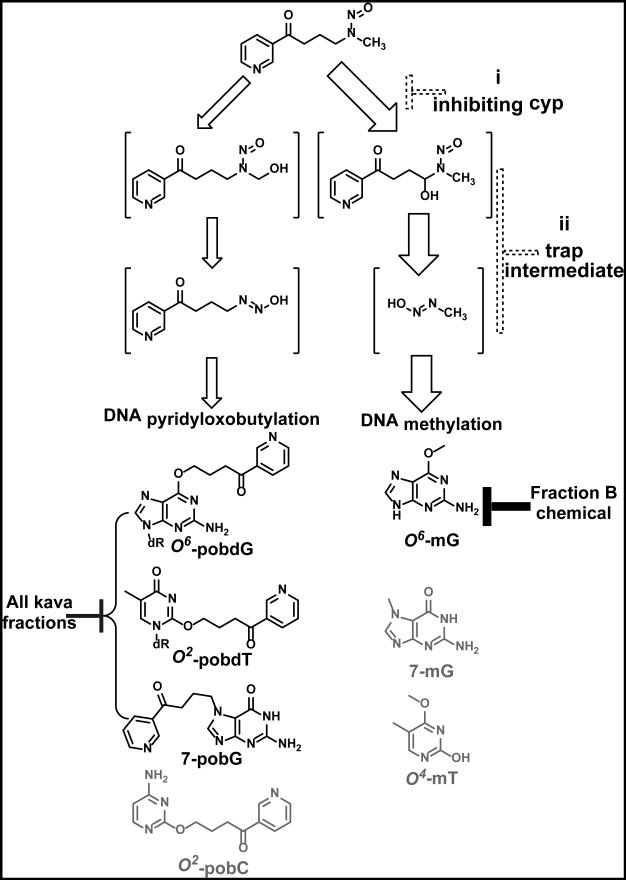
References
-
- Siegel R, Naishadham D, Jemal A. Cancer statistics, 2012. CA Cancer J Clin. 2012;62:10–29. - PubMed
-
- Siegel R, Naishadham D, Jemal A. Cancer statistics, 2013. CA Cancer J Clin. 2013;63:11–30. - PubMed
-
- Giovino GA, Mirza SA, Samet JM, Gupta PC, Jarvis MJ, Bhala N, et al. Tobacco use in 3 billion individuals from 16 countries: an analysis of nationally representative cross-sectional household surveys. Lancet. 2012;380:668–79. - PubMed
-
- Giovino GA. The tobacco epidemic in the United States. Am J Prev Med. 2007;33:S318–26. - PubMed
Publication types
MeSH terms
Substances
Grants and funding
LinkOut - more resources
Full Text Sources
Other Literature Sources
Medical