


Is the whole more than the sum of its parts? Evolutionary trade-offs between burst and sustained locomotion in lacertid lizards
- PMID: 24403334
- PMCID: PMC3896018
- DOI: 10.1098/rspb.2013.2677
Is the whole more than the sum of its parts? Evolutionary trade-offs between burst and sustained locomotion in lacertid lizards
Abstract
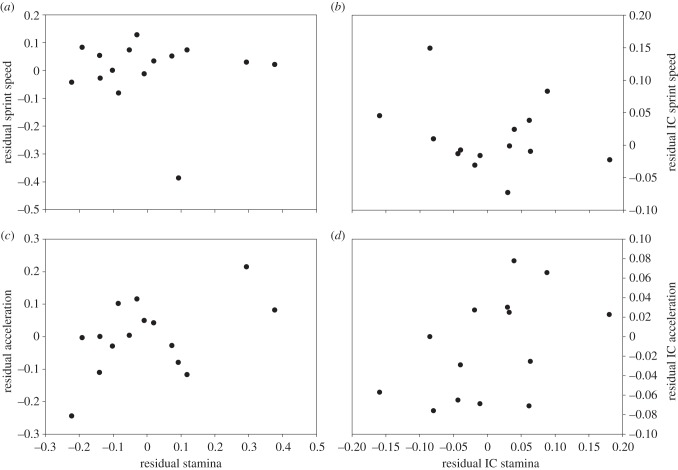
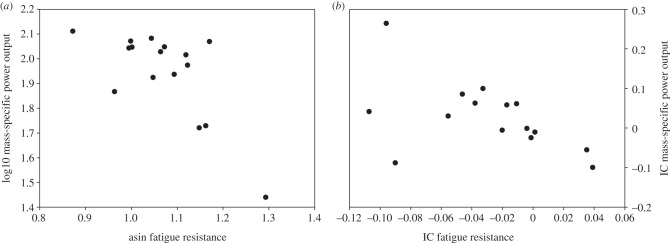
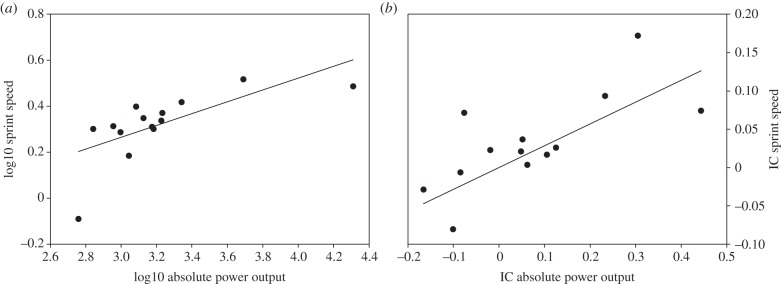
Trade-offs arise when two functional traits impose conflicting demands on the same design trait. Consequently, excellence in one comes at the cost of performance in the other. One of the most widely studied performance trade-offs is the one between sprint speed and endurance. Although biochemical, physiological and (bio)mechanical correlates of either locomotor trait conflict with each other, results at the whole-organism level are mixed. Here, we test whether burst (speed, acceleration) and sustained locomotion (stamina) trade off at both the isolated muscle and whole-organism level among 17 species of lacertid lizards. In addition, we test for a mechanical link between the organismal and muscular (power output, fatigue resistance) performance traits. We find weak evidence for a trade-off between burst and sustained locomotion at the whole-organism level; however, there is a significant trade-off between muscle power output and fatigue resistance in the isolated muscle level. Variation in whole-animal sprint speed can be convincingly explained by variation in muscular power output. The variation in locomotor stamina at the whole-organism level does not relate to the variation in muscle fatigue resistance, suggesting that whole-organism stamina depends not only on muscle contractile performance but probably also on the performance of the circulatory and respiratory systems.
Keywords: locomotion; muscle; trade-off; whole-organism.
Figures
References
-
- Careau VC, Garland T., Jr 2012. Performance, personality, and energetics: correlation, causation, and mechanism. Phys. Biochem. Zool. 85, 543–571 (doi:10.1086/666970) - DOI - PubMed
-
- Lewontin RC. 1978. Adaptation. Scient. Am. 239, 156–169 (doi:10.1038/scientificamerican0978-212) - DOI - PubMed
-
- Arnold SJ. 1992. Constraints on phenotypic evolution. Am. Nat. 140, S85–S107 (doi:10.1086/285398) - DOI - PubMed
-
- DeWitt TJ, Scheiner SM. 2004. Phenotypic plasticity: functional and conceptual approaches. Oxford, UK: Oxford University Press
-
- Konuma J, Chiba S. 2007. Trade-offs between force and fit: extreme morphologies associated with feeding behavior in carabid beetles. Am. Nat. 170, 90–100 (doi:10.1086/518182) - DOI - PubMed
Publication types
MeSH terms
LinkOut - more resources
Full Text Sources
Other Literature Sources
