Review
. 2013 Nov;21(6):411-22.
doi: 10.4062/biomolther.2013.080.

Intercellular Lipid Mediators and GPCR Drug Discovery

Affiliations
Review

Intercellular Lipid Mediators and GPCR Drug Discovery

Dong-Soon Im. Biomol Ther (Seoul). 2013 Nov.

Abstract

G-protein-coupled receptors (GPCR) are the largest superfamily of receptors responsible for signaling between cells and tissues, and because they play important physiological roles in homeostasis, they are major drug targets. New technologies have been developed for the identification of new ligands, new GPCR functions, and for drug discovery purposes. In particular, intercellular lipid mediators, such as, lysophosphatidic acid and sphingosine 1-phosphate have attracted much attention for drug discovery and this has resulted in the development of fingolimod (FTY-720) and AM095. The discovery of new intercellular lipid mediators and their GPCRs are discussed from the perspective of drug development. Lipid GPCRs for lysophospholipids, including lysophosphatidylserine, lysophosphatidylinositol, lysophosphatidylcholine, free fatty acids, fatty acid derivatives, and other lipid mediators are reviewed.

Keywords: Drug discovery; Fatty acid; GPCR; Lipid; Lipid mediator; Lysophospholipid.


Figures
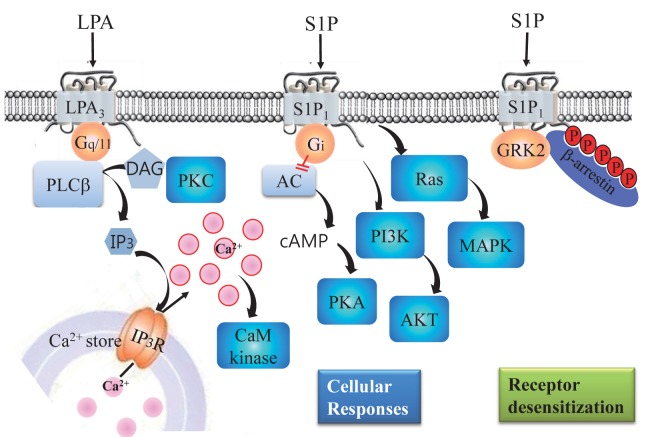
Fig. 1.
Fig. 1.. Schematic diagram of lipid-mediated signal transduction pathways. For cellular responses, LPA activates LPA3, which leads to activation of phospholipase C (PLC). Activated PLC produces IP3 and diacylglycerol (DAG), DAG activates protein kinase C (PKC), and IP3 mobilizes Ca2+ from internal Ca2+ stores by activating IP3 receptors. The resulting increase in intracellular Ca2+ activates calmodulin-dependent protein kinases. Alternatively, S1P activates S1P1, which leads to inhibition of adenylyl cyclase and the activations of ras, MAPK, PI3K, and AKT via Gi proteins. For desensitization, S1P activates S1P1, which leads to GRK2 activation, S1P1 phosphorylation, and to the recruitment β-arrestins by S1P1. The recruited β-arrestins then inhibit S1P1-G protein coupling.
Fig. 2.
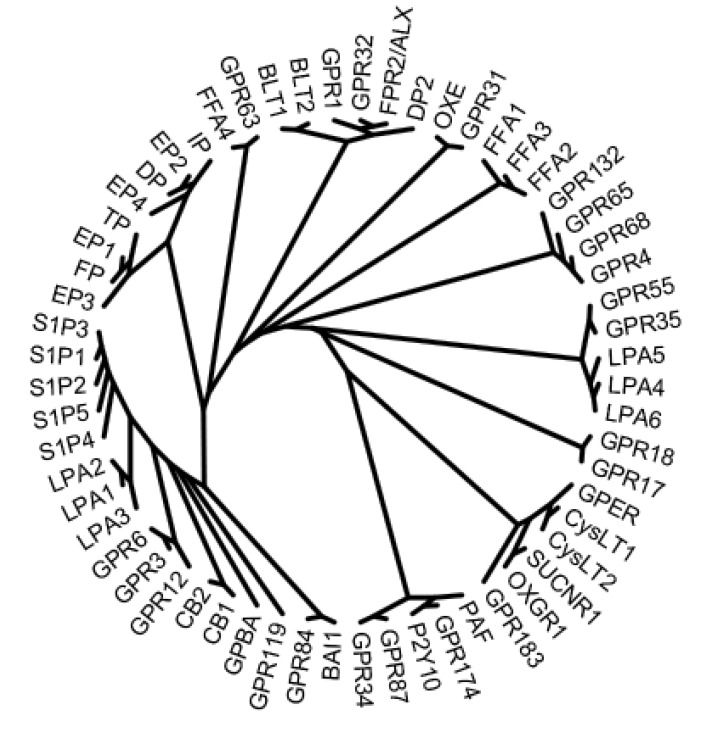
Fig. 2.. Phylogenetic tree of lipid GPCRs. The phylogenetic tree was constructed using the Clustal Omega multiple sequence alignment and TreeIllustrator programs.

References

    1. Arterburn J. B., Oprea T. I., Prossnitz E. R., Edwards B. S., Sklar L. A. Discovery of selective probes and antagonists for G-protein-coupled receptors FPR/FPRL1 and GPR30. Curr. Top. Med. Chem. (2009);9:1227–1236. doi: 10.2174/156802609789753608. - DOI - PMC - PubMed
    1. Baker D., Pryce G., Davies W. L., Hiley C. R. In silico patent searching reveals a new cannabinoid receptor. Trends Pharmacol. Sci. (2006);27:1–4. doi: 10.1016/j.tips.2005.11.003. - DOI - PubMed
    1. Benned-Jensen T., Rosenkilde M. M. Distinct expression and ligand-binding profiles of two constitutively active GPR17 splice variants. Br. J. Pharmacol. (2010);159:1092–1105. doi: 10.1111/j.1476-5381.2009.00633.x. - DOI - PMC - PubMed
    1. Bratton D. L., Henson P. M. Apoptotic cell recognition: will the real phosphatidylserine receptor(s) please stand up? Curr. Biol. (2008);18:R76–79. doi: 10.1016/j.cub.2007.11.024. - DOI - PubMed
    1. Bresnick J. N., Skynner H. A., Chapman K. L., Jack A. D., Zamiara E., Negulescu P., Beaumont K., Patel S., McAllister G. Identification of signal transduction pathways used by orphan g protein-coupled receptors. Assay Drug Dev. Technol. (2003);1:239–249. doi: 10.1089/15406580360545053. - DOI - PubMed

LinkOut - more resources