. 2013 Nov;21(6):462-9.
doi: 10.4062/biomolther.2013.074.

Inhibitory Effects of Eucommia ulmoides Oliv. Bark on Scopolamine-Induced Learning and Memory Deficits in Mice

Affiliations

Inhibitory Effects of Eucommia ulmoides Oliv. Bark on Scopolamine-Induced Learning and Memory Deficits in Mice

Seung-Hwan Kwon et al. Biomol Ther (Seoul). 2013 Nov.

Abstract

Eucommia ulmoides Oliv. Bark (EUE) is commonly used for the treatment of hypertension, rheumatoid arthritis, lumbago, and ischialgia as well as to promote longevity. In this study, we tested the effects of EUE aqueous extract in graded doses to protect and enhance cognition in scopolamine-induced learning and memory impairments in mice. EUE significantly improved the impairment of short-term or working memory induced by scopolamine in the Y-maze and significantly reversed learning and memory deficits in mice as measured by the passive avoidance and Morris water maze tests. One day after the last trial session of the Morris water maze test (probe trial session), EUE dramatically increased the latency time in the target quadrant in a dose-dependent manner. Furthermore, EUE significantly inhibited acetylcholinesterase (AChE) and thiobarbituric acid reactive substance (TBARS) activities in the hippocampus and frontal cortex in a dose-dependent manner. EUE also markedly increased brain-derived neurotrophic factor (BDNF) and phosphorylation of cAMP element binding protein (CREB) in the hippocampus of scopolamine-induced mice. Based on these findings, we suggest that EUE may be useful for the treatment of cognitive deficits, and that the beneficial effects of EUE are mediated, in part, by cholinergic signaling enhancement and/or protection.

Keywords: Alzheimer’s disease; Brain-derived neurotrophic factor; Eucommia ulmoides Oliv. Bark; Learning and memory; Scopolamine; cAMP element binding protein.


Figures
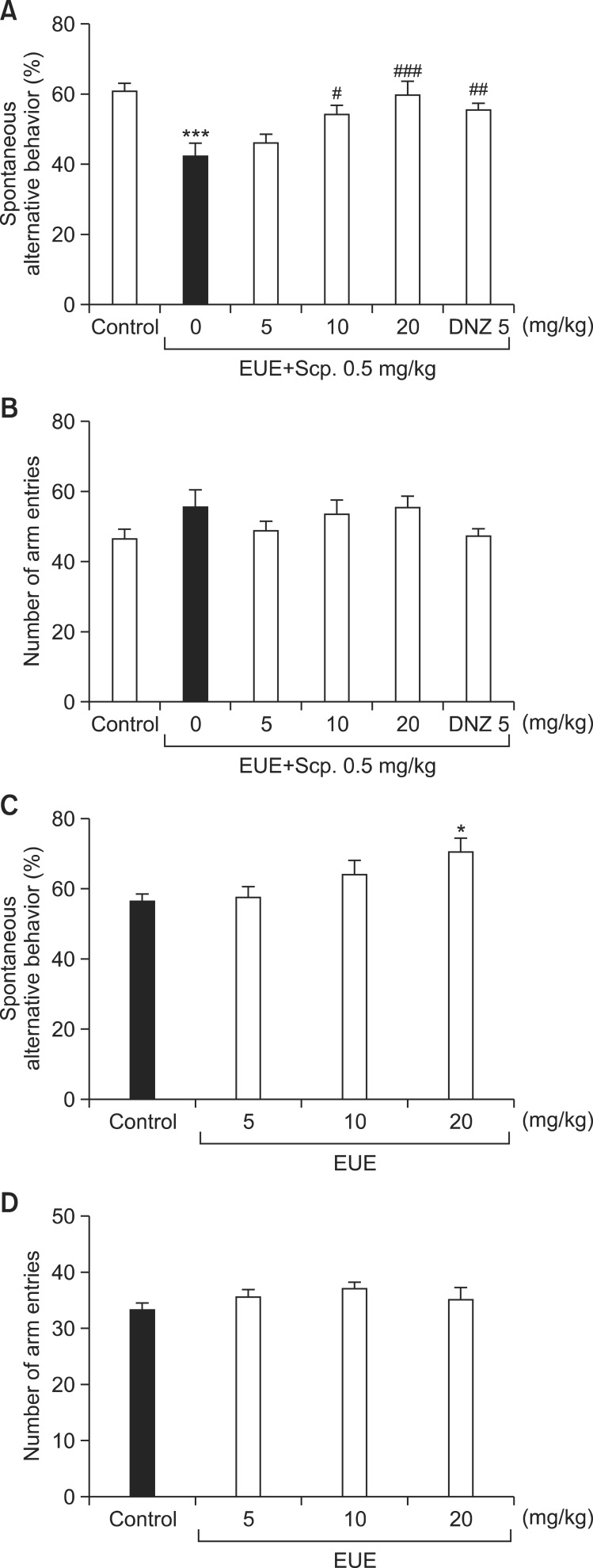
Fig. 1.
Fig. 1.. Effects of EUE on the spontaneous alternation behavior Y-maze test. EUE (5, 10, and 20 mg/kg, p.o.) or donepezil (DNZ, 5 mg/kg, p.o.) was administered to mice 60 min before the tests. Thirty minutes later, the mice were treated with scopolamine (Scp., 0.5 mg/kg, i.p.) and tested in the Y-maze (A, B). To assess the effect of EUE (5, 10, and 20 mg/kg, p.o.) in the Y-maze, EUE (5, 10, and 20 mg/kg, p.o.) was administered to mice 60 min before the tests (C, D). Data are presented as the mean ± S.E.M. (n=10/group). *p<0.05 and ***p<0.001 compared with the control group. #p<0.05, ##p<0.01, and ###p<0.001 compared with the scopolamine-treated group.
Fig. 2.
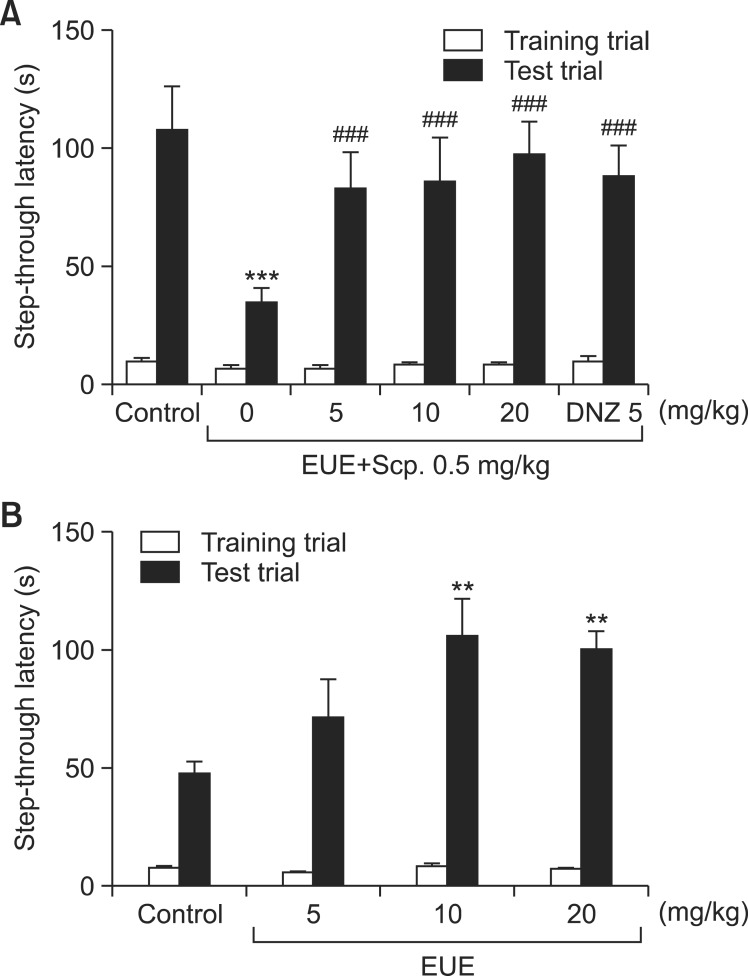
Fig. 2.. Effects of EUE on the step-through passive avoidance test. EUE (5, 10, and 20 mg/kg, p.o.) or donepezil (DNZ, 5 mg/kg, p.o.) was administered to mice 60 min before the test. Thirty minutes later, the mice were treated with scopolamine (Scp., 0.5 mg/kg, i.p.) and tested for passive avoidance (A). To assess the effect of EUE (5, 10, and 20 mg/kg, p.o.) on passive avoidance, EUE (5, 10, and 20 mg/kg, p.o.) was administered to mice 60 min before the tests (B). Data are presented as the mean ± S.E.M. (n=19-21/group). **p<0.01 and ***p<0.001 compared with the control group. ###p<0.001 compared with the scopolamine-treated group.
Fig. 3.
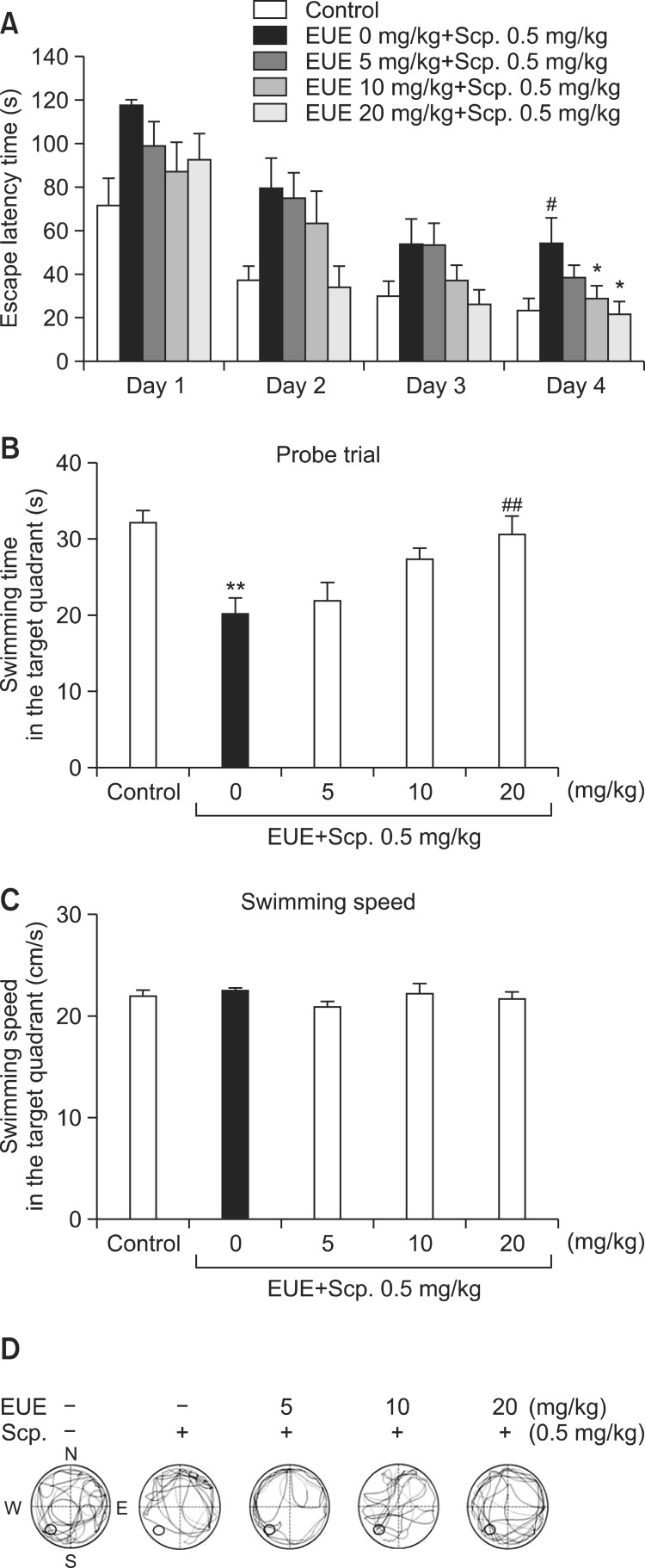
Fig. 3.. Effect of EUE on average latency time (A), probe trial (B), and swimming speed (C) in trial sessions of the Morris water maze test. At 60 min before the first trial session and probe trial session, EUE (5, 10, and 20 mg/kg, p.o.) was administered to the mice. Thirty minutes later, the mice were treated with scopolamine (Scp., 0.5 mg/kg, i.p.) and tested in the Morris water maze test. Probe trial sessions were performed for 60 sec. Representative swimming paths of mice from each group in the Morris water maze test on the training trial day 4 (D). Data represent mean ± S.E.M. (n=10/group). *p<0.05 and **p<0.01 compared with the control group. #p<0.05 and ##p<0.01 compared with the scopolamine-treated group.
Fig. 4.
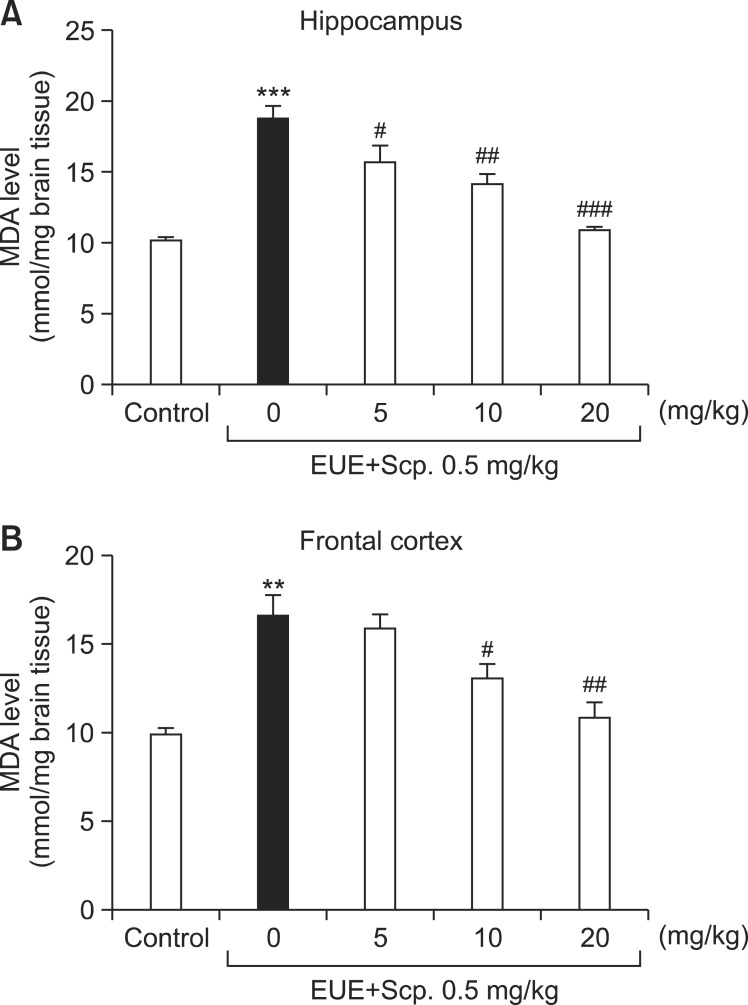
Fig. 4.. Effects of EUE on MDA levels in the hippocampus (A) and frontal cortex (B). Animals were decapitated 60 min after probe trial sessions of the Morris water maze test, and the hippocampus and frontal cortex were dissected to assay TBARS activity. Data represent mean ± S.E.M. (n=3/group). **p<0.01 and ***p<0.001 compared with the control group. #p<0.05, ##p<0.01, and ###p<0.001 compared with the scopolamine-treated group.
Fig. 5.
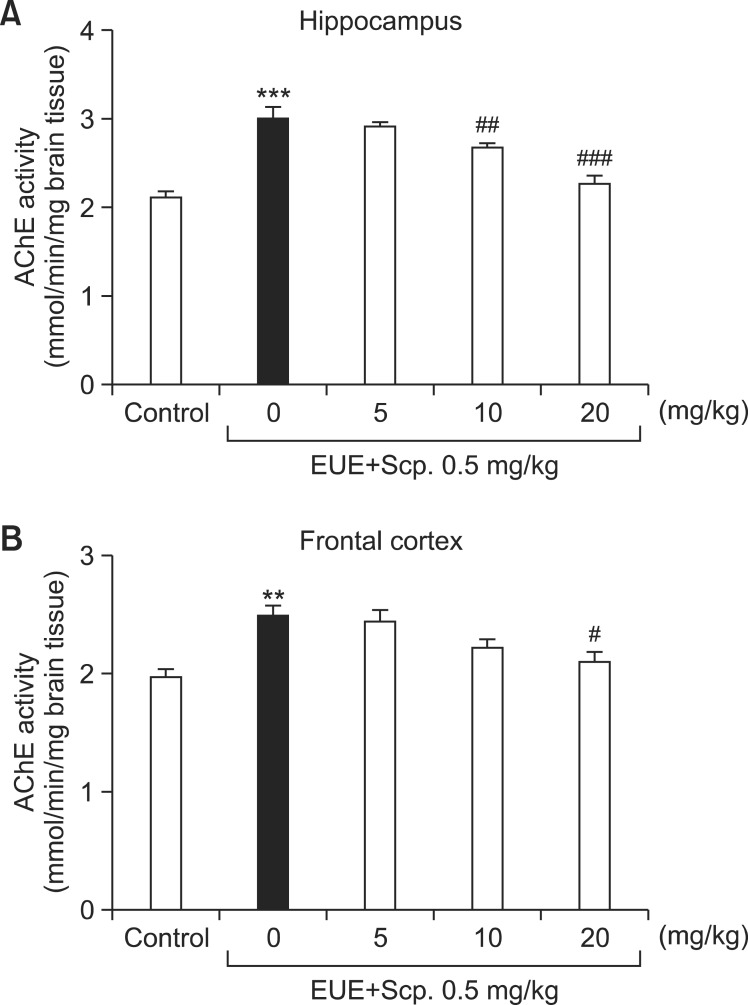
Fig. 5.. Effects of EUE on AChE activity in the hippocampus (A) and frontal cortex (B). Animals were decapitated 60 min after probe trial sessions of the Morris water maze test, and the hippocampus (A) and frontal cortex (B) were dissected to assay AChE activity. Data represent mean ± S.E.M. (n=3/group). **p<0.01 and ***p<0.001 compared with the control group. #p<0.05, ##p<0.01, and ###p<0.001 compared with the scopolamine-treated group.
Fig. 6.
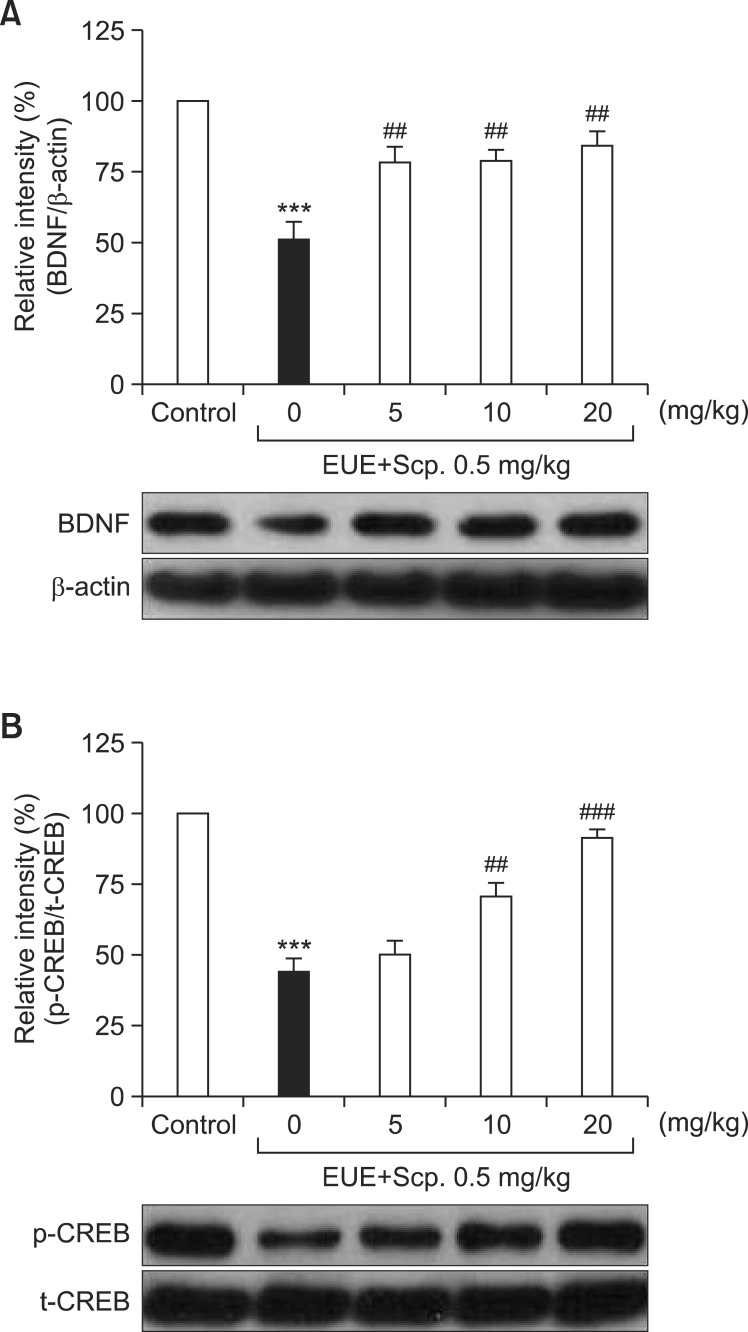
Fig. 6.. Effects of EUE on BDNF (A) and phosphorylation of CREB (B) expression levels in the hippocampus. Animals were decapitated 60 min after probe trial sessions of the Morris water maze test. The hippocampus was dissected for Western blot analysis. Data represent mean ± S.E.M. (n=3/group). ***p<0.001 compared with the control group. ##p<0.01 and ###p<0.001 compared with the scopolamine-treated group.

References

    1. Alberini C. M. Transcription factors in long-term memory and synaptic plasticity. Physiol. Rev. (2009);89:121–145. doi: 10.1152/physrev.00017.2008. - DOI - PMC - PubMed
    1. Annunziato L., Amoroso S., Pannaccione A., Cataldi M., Pignataro G., D'Alessio A., Sirabella R., Secondo A., Sibaud L., Di Renzo G. F. Apoptosis induced in neuronal cells by oxidative stress: role played by caspases and intracellular calcium ions. Toxicol. Lett. (2003);139:125–133. doi: 10.1016/S0378-4274(02)00427-7. - DOI - PubMed
    1. Bartus R. T., Dean R. L., 3rd, Beer B., Lippa A. S. The cholinergic hypothesis of geriatric memory dysfunction. Science. (1982);217:408–414. doi: 10.1126/science.7046051. - DOI - PubMed
    1. Beatty W. W., Butters N., Janowsky D. S. Patterns of memory failure after scopolamine treatment: implications for cholinergic hypotheses of dementia. Behav. Neural Biol. (1986);45:196–211. doi: 10.1016/S0163-1047(86)90772-7. - DOI - PubMed
    1. Becker R., Giacobini E., Elble R., McIlhany M., Sherman K. Potential pharmacotherapy of Alzheimer disease. A comparison of various forms of physostigmine administration. Acta Neurol. Scand. Suppl. (1988);116:19–32. doi: 10.1111/j.1600-0404.1988.tb07983.x. - DOI - PubMed

LinkOut - more resources