. 2013 Oct 1;2(10):e26527.
doi: 10.4161/onci.26527. Epub 2013 Oct 22.

Retargeting NK-92 cells by means of CD19- and CD20-specific chimeric antigen receptors compares favorably with antibody-dependent cellular cytotoxicity

Affiliations

Retargeting NK-92 cells by means of CD19- and CD20-specific chimeric antigen receptors compares favorably with antibody-dependent cellular cytotoxicity

Laurent Boissel et al. Oncoimmunology. .

Abstract

Multiple natural killer (NK) cell-based anticancer therapies are currently under development. Here, we compare the efficiency of genetically modified NK-92 cells expressing chimeric antigen receptors (CARs) at killing NK cell-resistant B-lymphoid leukemia cells to the antibody-dependent cell-mediated cytotoxicity (ADCC) of NK-92 cells expressing a high affinity variant of the IgG Fc receptor (FcγRIII). First, we compared in vitro the abilities of NK-92 cells expressing CD20-targeting CARs to kill primary chronic lymphocytic leukemia (CLL) cells derived from 9 patients with active, untreated disease to the cytotoxicity of NK-92 cells expressing FcγRIII combined with either of the anti-CD20 monoclonal antibodies (mAbs) rituximab or ofatumumab. We found that CAR-expressing NK-92 cells effectively kill NK cell-resistant primary CLL cells and that such a cytotoxic response is significantly stronger than that resulting from ADCC. For studying CAR-expressing NK cell-based immunotherapy in vivo, we established xenograft mouse models of residual leukemia using the human BCR-ABL1+ cell lines SUP-B15 (CD19+CD20-) and TMD-5 (CD19+CD20+), two acute lymphoblastic leukemia (ALL) lines that are resistant to parental NK-92 cells. Intravenous injection of NK-92 cells expressing CD19-targeting CARs eliminated SUP-B15 cells, whereas they had no such effect on TMD-5 cells. However, the intrafemoral injection of NK-92 cells expressing CD19-targeting CAR resulted in the depletion of TMD-5 cells from the bone marrow environment. Comparative studies in which NK-92 cells expressing either CD19- or CD20-targeting CARs were directly injected into subcutaneous CD19+CD20+ Daudi lymphoma xenografts revealed that CD20-targeting CAR is superior to its CD19-specific counterpart in controlling local tumor growth. In summary, we show here that CAR-expressing NK-92 cells can be functionally superior to ADCC (as mediated by anti-CD20 mAbs) in the elimination of primary CLL cells. Moreover, we provide data demonstrating that the systemic administration of CAR-expressing NK-92 cells can control lymphoblastic leukemia in immunocompromised mice. Our results also suggest that the direct injection of CAR-expressing NK-92 cells to neoplastic lesions could be an effective treatment modality against lymphoma.

Keywords: CAR; NK cells; NK-92; lentiviral vector; lymphoid malignancies.


Figures

None
Figure 1. Cytotoxic potential of ADCC vs. CAR-expressing NK-92. Antibody-dependent cell-mediated cytotoxicity (ADCC) against primary chronic lymphocytic leukemia (CLL) cells (n = 9) as triggered by the anti-CD20 antibodies rituximab (gray, full), and ofatumumab (white, full) as compared with CLL cell killing mediated by NK-92 cells engineered to express a CD20-specific chimeric antigen receptor (αCD20-CAR) (black, full). The cytotoxic response to parental NK-92 cells alone (checkered, control for CAR-dependent cytotoxicity) and parental NK-92 cells with mAbs (stripes, control for ADCC) is presented for each sample. In all experiments, the effector to target cell ratio was 10:1.
None
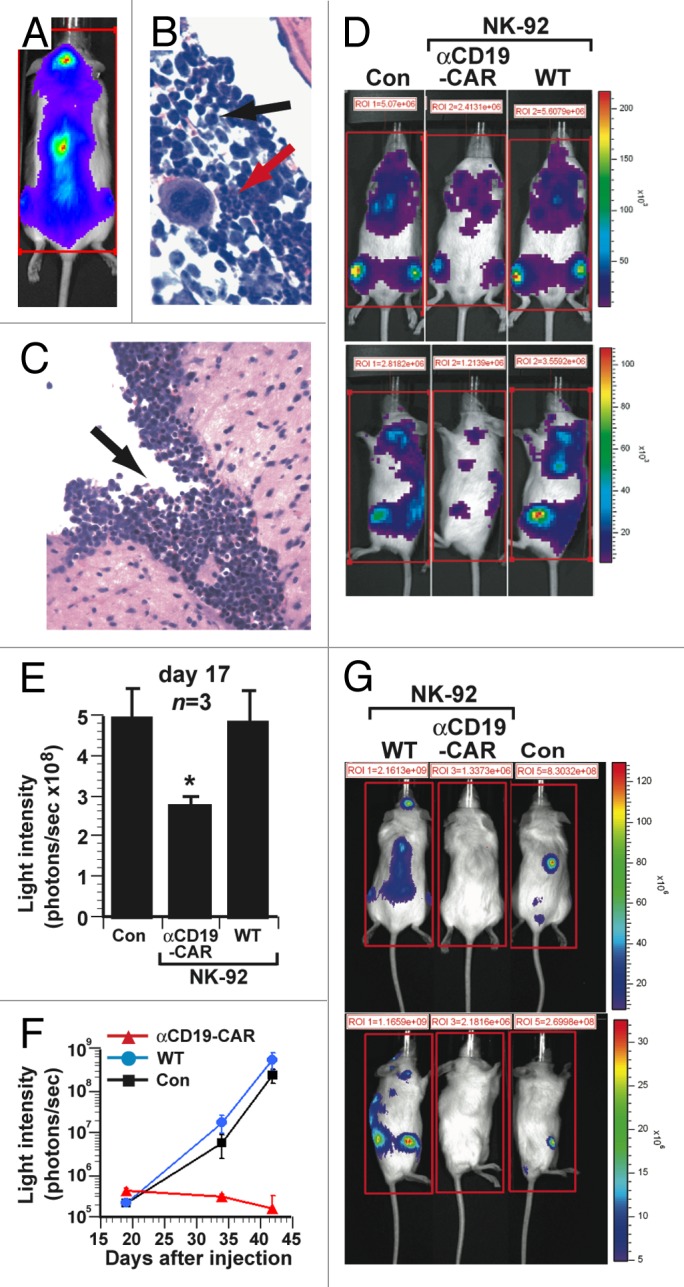
Figure 2. Therapeutic efficacy of NK-92 cells expressing CD19-specific CAR in a xenograft model of aggressive human B-cell acute lymphoblastic leukemia. (A–C) Immunocompromised NOD scid gamma (NSG) mice were inoculated i.v. with 1 × 10⁶ luciferase (Luc)-expressing SUP-B15 acute lymphoblastic leukemia (ALL) cells. (A) Bioluminescence imaging (dorsal view) of mice 17 d after the injection of ALL cells, showing localization to the spine and calvarium. (B) Infiltration of bone marrow by SUP-B15 leukemia cells (black arrow) adjacent to area of normal hematopoiesis (red arrow). (C) Leptomeningeal SUP-B15 leukemic infiltrate. (D–E) NSG mice (n = 3) were inoculated i.v. with 2 × 10⁵ Luc-expressing SUP-B15 cells and subsequently with 1 × 10⁷ parental NK-92 cells (WT), 1 × 10⁷ NK-92 cells expressing CD19-targeting chimeric antigen receptors (αCD19-CAR) or PBS control (Con), on days 1 to 5 post-inoculation. (D) Bioluminescence imaging of representative mice 17 d after the inoculation of ALL cells. (E) Quantification of leukemic burden from the experiment in (D) on day 17. The total bioluminescence (average of 4 sides measurements) in mice receiving NK-92 cells expressing the CD19-targeting CAR was significantly lower than in animals treated with parental NK-92 cells (*p = 0.02). (F-G) NSG mice (n = 3) were inoculated i.v. with 1 × 10³ Luc-expressing SUP-B15 cells and then treated with 1 × 10⁷ parental NK-92 cells (WT), 1 × 10⁷ NK-92 cells expressing CD19-targeting CAR (αCD19-CAR) or PBS control (Con), on days 4, 5, and 6. (F) Mean serial bioluminescence of cohorts of leukemic mice. (G) Bioluminescence images of representative mice from cohorts in (F) at day 42. Statistical analyses were performed by unpaired Student t-tests.
None
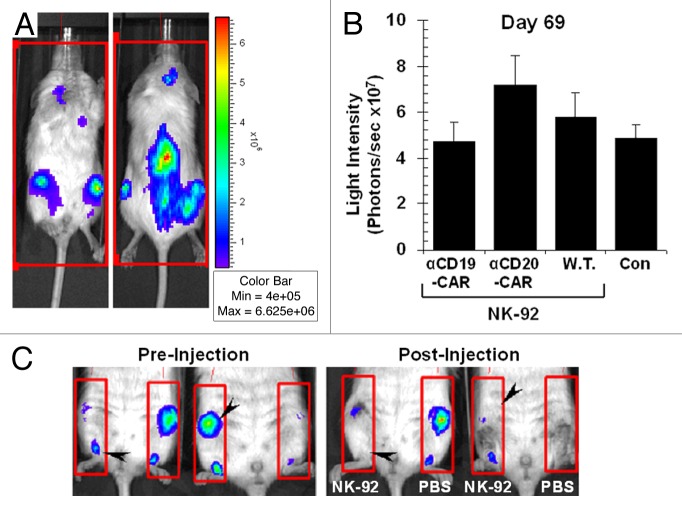
Figure 3. Therapeutic efficacy of NK-92 cells expressing CD19-specific CAR in a xenograft model of slow-growing B-cell acute lymphoblastic leukemia. (A) Bioluminescence imaging of tumor-bearing immunocompromised NOD scid gamma (NSG) mice 70 d after the intravenous injection of 5 × 10⁶ luciferase (Luc)-expressing TMD-5 cells, showing predominant localization to the spine, long bones (bone marrow) and calvarium. (B) Quantification of leukemic burden (average of 4 sides measurements) from mice (n = 2) inoculated intravenously with 5 × 10⁶ Luc-expressing TMD-5 cells followed by the injection of 1 × 10⁷ parental NK-92 cells (W.T.), 1 × 10⁷ NK-92 cells expressing CD19-targeting chimeric antigen receptors (αCD19-CAR), 1 × 10⁷ NK-92 cells expressing CD20-targeting CAR (αCD20-CAR), or PBS control (Con), on days 7, 9, and 11 after the inoculation of leukemic cells. (C) Two NSG mice bearing TMD-5 leukemia were injected with 3 × 10⁶ NK-92 cells expressing CD19-targeting CAR in 50 μL PBS in their right femur (NK-92) and PBS alone in the contralateral one (PBS). Forty-eight h later, mice were re-imaged using the same settings. Note the eradication of disease foci within each femur injected with CAR-expressing NK-92 cells (black arrowheads).
None
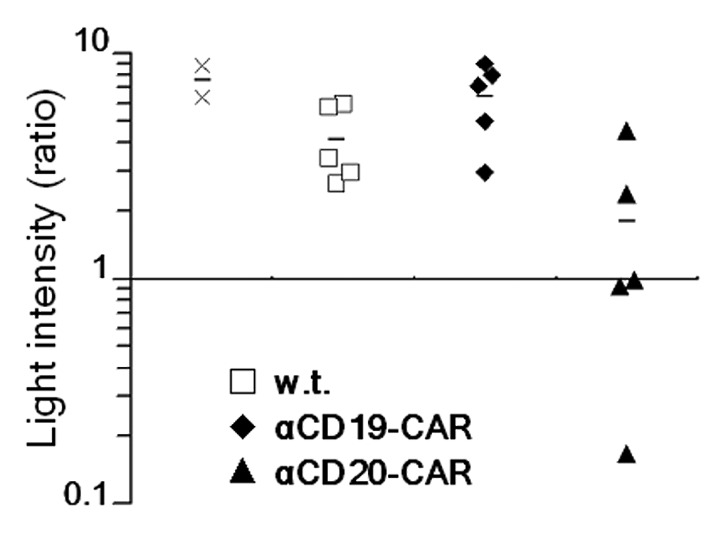
Figure 4. Therapeutic effects of intratumoral injection of CAR-expressing NK-92 cells against subcutaneous Daudi lymphomas. NOD/SCID mice (n = 5) were injected subcutaneously with 2.5 × 10⁵ natural killer (NK) cell-resistant luciferase (Luc)-expressing DaudiNKR cells in PBS. When the tumor had grown to about 0.5 cm3, mice were treated with intratumoral injections of 5 × 10⁶ parental NK-92 cells (w.t.), 5 × 10⁶ NK-92 cells expressing CD19-targeting chimeric antigen receptors (αCD19-CAR), or 5 × 10⁶ NK-92 cells expressing CD20-targeting CAR (αCD20-CAR), on days 4, 5, 6. Results are expressed as fold change in bioluminescence before and after the injection of NK-92 cells. Data relative to each mouse are shown for cohorts of animals treated with NK-92 cells expressing CD19- (black diamonds) or CD20-targeting (black triangles) CARs, treated with parental NK-92 cells (white squares), or treated with PBS (x marks). Mean values (black lines) are also shown for each cohort.

References

    1. Coiffier B. Effective immunochemotherapy for aggressive non-Hodgkin’s lymphoma. Semin Oncol. 2004;31(Suppl 2):7–11. doi: 10.1053/j.seminoncol.2003.12.003. - DOI - PubMed
    1. Micallef IN, Maurer MJ, Wiseman GA, Nikcevich DA, Kurtin PJ, Cannon MW, Perez DG, Soori GS, Link BK, Habermann TM, et al. Epratuzumab with rituximab, cyclophosphamide, doxorubicin, vincristine, and prednisone chemotherapy in patients with previously untreated diffuse large B-cell lymphoma. Blood. 2011;118:4053–61. doi: 10.1182/blood-2011-02-336990. - DOI - PMC - PubMed
    1. Bacher U, Klyuchnikov E, Le-Rademacher J, Carreras J, Armand P, Bishop MR, Bredeson CN, Cairo MS, Fenske TS, Freytes CO, et al. Lymphoma Working Committee of the CIBMTR Conditioning regimens for allotransplants for diffuse large B-cell lymphoma: myeloablative or reduced intensity? Blood. 2012;120:4256–62. doi: 10.1182/blood-2012-06-436725. - DOI - PMC - PubMed
    1. Porter DL, Levine BL, Kalos M, Bagg A, June CH. Chimeric antigen receptor-modified T cells in chronic lymphoid leukemia. N Engl J Med. 2011;365:725–33. doi: 10.1056/NEJMoa1103849. - DOI - PMC - PubMed
    1. Ramos CA, Dotti G. Chimeric antigen receptor (CAR)-engineered lymphocytes for cancer therapy. Expert Opin Biol Ther. 2011;11:855–73. doi: 10.1517/14712598.2011.573476. - DOI - PMC - PubMed

Publication types