. 2013 Sep 25;3(4):853-866.
doi: 10.3390/metabo3040853.

A Computational Framework for High-Throughput Isotopic Natural Abundance Correction of Omics-Level Ultra-High Resolution FT-MS Datasets

Affiliations

A Computational Framework for High-Throughput Isotopic Natural Abundance Correction of Omics-Level Ultra-High Resolution FT-MS Datasets

William J Carreer et al. Metabolites. .

Abstract

New metabolomics applications of ultra-high resolution and accuracy mass spectrometry can provide thousands of detectable isotopologues, with the number of potentially detectable isotopologues increasing exponentially with the number of stable isotopes used in newer isotope tracing methods like stable isotope-resolved metabolomics (SIRM) experiments. This huge increase in usable data requires software capable of correcting the large number of isotopologue peaks resulting from SIRM experiments in a timely manner. We describe the design of a new algorithm and software system capable of handling these high volumes of data, while including quality control methods for maintaining data quality. We validate this new algorithm against a previous single isotope correction algorithm in a two-step cross-validation. Next, we demonstrate the algorithm and correct for the effects of natural abundance for both (13)C and (15)N isotopes on a set of raw isotopologue intensities of UDP-N-acetyl-D-glucosamine derived from a (13)C/(15)N-tracing experiment. Finally, we demonstrate the algorithm on a full omics-level dataset.

Keywords: Fourier transform mass spectrometry; analytical derivation; multi-isotope natural abundance correction; parallelization; stable isotope tracing; stable isotope-resolved metabolomics.


Figures
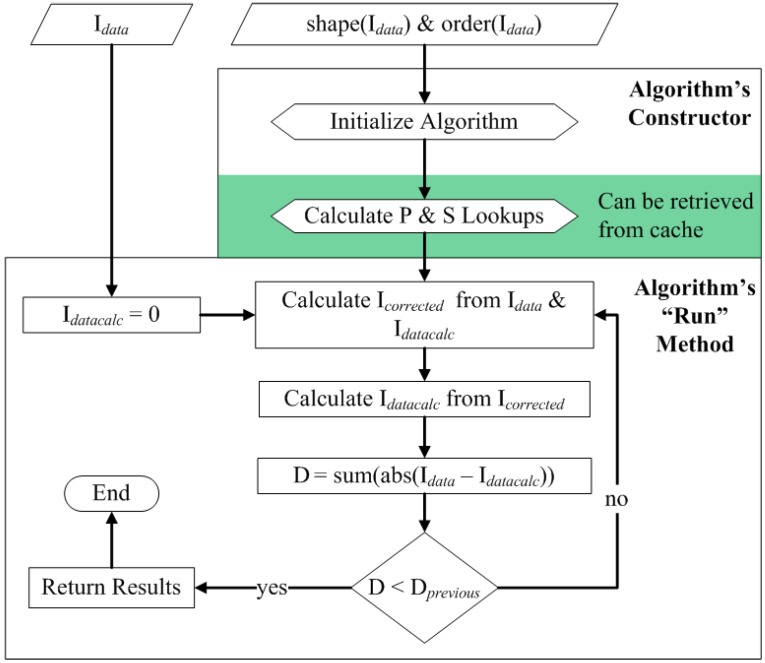
Figure 1
Figure 1
Procedural diagram of the isotopic natural abundance correction algorithm. Starting with the shape and order of the set of observed isotopologues, the algorithm is initialized, followed by the calculation of the P and S tables or their recovery from a cache. Next, the corrected isotopologue intensities (Icorrected) are calculated from the observed isotopologue intensities (Idata). Then the isotopical natural abundance contaminated intensities (Idatacalc) are calculated from the corrected intensities. The calculated and observed intensities are compared. If an improvement is made, the calculation cycle is repeated.
Figure 2
Figure 2
Algorithm generalization and class relations in the modularization of the code. (a) The orange xnacrange object is generalized to handle the different summations in each formula. The light green plookup object generalizes the P table representing different sets of binomial terms specific to each formula. The purple slookup object generalizes the S table representing different sets of summative binomial terms specific to each formula. (b) The PyNAC module has several classes separated into the green Core submodule or the red Analysis submodule. The blue multiprocessing module is provided by the standard Python language library. The yellow numpy module is the only additional python library that is necessary. The NACorrector class implements the main correction algorithm using the ndarray class from the nympy module. The PenultimateNACIter, NAProduct, and NASumProduct classes implement the orange xnacrange, light green plookup, and purple slookup objects.
Figure 3
Figure 3
Validation of the multi-isotope natural abundance correction algorithm. (a) The matrix outlined by the black lines represents isotopologue intensities with 13C and 15N isotopes from both a labeling source and natural abundance. It is calculated from the vector outerproduct of two single isotope labeled vectors of isotopologue intensities. These single-labeledvectors represent the addition of 13C/15N natural abundance to the corresponding single-labeled vectors in (b). Each vector and matrix of intensities is normalized to a sum of 1. (b) The matrix outlined by the black lines represents isotopologue intensities with 13C and 15N isotopes from only a labeling source. It is calculated from the vector outer product of two single isotope labeled vectors of isotopologue intensities. (c) This matrix is the result of just one iteration of the multi-isotope natural abundance correction algorithm implemented in the Python programming language. (d) This matrix is the absolute difference between the matrices in (b) and (c). No element is larger than 10−17.
Figure 4
Figure 4
Corrected and observed 13C/15N isotopologues of UDP-GlcNAc. Each graph represents a set of 13C-labeled isotopologues with a specific number of 15N nuclei incorporated. IM+i,0, IM+i,1, IM+i,2, and IM+i,3 represent 0,1,2, and 3 15N nuclei. Observed intensities are in red and the isotopic natural abundance corrected intensities are in blue. The calculation of the corrected intensities required 12 iterations of the algorithm.

References

    1. Rittenberg D., Schoenheimer R. Deuterium as an indicator in the study of intermediary metabolism. J. Biol. Chem. 1937;121:235. - PubMed
    1. Schoenheimer R., Rittenberg D. The study of intermediary metabolism of animals with the aid of isotopes. Physiol. Rev. 1940;20:218.
    1. Schoenheimer R., Rittenberg D. Deuterium as an indicator in the study of intermediary metabolism. J. Biol. Chem. 1935;111:163.
    1. Boros L.G., Brackett D.J., Harrigan G.G. Metabolic biomarker and kinase drug target discovery in cancer using stable isotope-based dynamic metabolic profiling (SIDMAP) Curr. Cancer Drug Tar. 2003;3:445–453. doi: 10.2174/1568009033481769. - DOI - PubMed
    1. Fan T.W., Lane A.N., Higashi R.M., Farag M.A., Gao H., Bousamra M., Miller D.M. Altered regulation of metabolic pathways in human lung cancer discerned by (13)C stable isotope-resolved metabolomics (SIRM) Mol. Cancer. 2009;8:41. doi: 10.1186/1476-4598-8-41. - DOI - PMC - PubMed