Prevalence of overweight and obesity in portuguese adolescents: comparison of different anthropometric methods
- PMID: 24404544
- PMCID: PMC3877439
- DOI: 10.4103/1947-2714.122309
Prevalence of overweight and obesity in portuguese adolescents: comparison of different anthropometric methods
Abstract
Background: The recommended anthropometric methods to assess the weight status include body mass index (BMI), skinfold thickness, and waist circumference. However, these methods have advantages and disadvantages regarding the classification of overweight and obesity in adolescents.
Aims: The study was to analyze the correlation between the measurements of BMI, skinfold thickness and waist circumference to assess overweight and obesity in Portuguese adolescents.
Materials and methods: A sample of 966 students of Portugal was used. Of them, 437 (45.2%) were males and 529 (54.8%) were females aged between 10 and 16 years. The evaluations included BMI calculation, skinfold thickness, and waist circumference measurements.
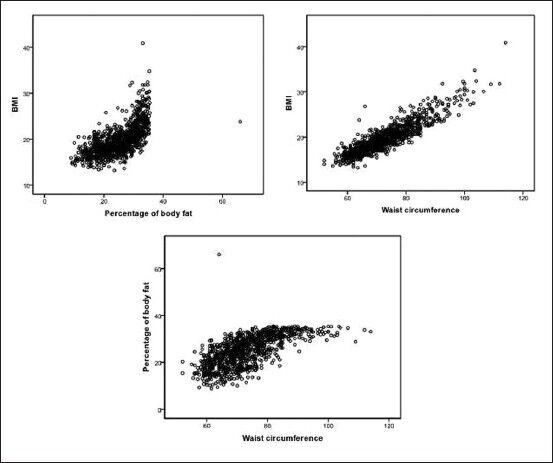
Results: This study revealed a high prevalence of overweight and obesity with values ranging from 31.6%, 61.4%, and 41.1% according to the measurement of BMI, skinfold thickness, and waist circumference, respectively. The results found a high level of correlation between BMI and skinfold thickness (P < 0.001, r = 0.712), between BMI and waist circumference (P < 0.001, r = 0.884), and waist circumference and skinfold thickness (P < 0.001, r = 0.701).
Conclusions: This study revealed a high prevalence of overweight and obesity in Portuguese adolescents using three different anthropometric methods, where the BMI showed the lowest values of prevalence of overweight and obesity and the skinfold thickness showed the highest values. The three anthropometric methods were highly correlated.
Keywords: Adolescent; BMI; Obesity; Skinfold thickness; Waist circumference.
Conflict of interest statement
Figures
References
-
- Rodríguez G, Moreno LA, Blay MG, Blay VA, Garagorri JM, Sarría A, et al. Body composition in adolescents: Measurements and metabolic aspects. Int J Obes Relat Metab Disord. 2004;28:S54–8. - PubMed
-
- Geneva: WHO Technical Report Series no. 854; 1995. World Health Organization. Physical Status: The use and interpretation of anthropometry. Report of a WHO Expert Committee. - PubMed
-
- De Onis M, Habicht JP. Anthropometric reference data for international use: Recommendations from a World Health Organization Expert Committee. Am J Clin Nutr. 1996;64:650–8. - PubMed
-
- Glaber N, Zellner K, Kromeyer-Hauschild K. Validity of body mass index and waist circumference to detect excess fat mass in children aged 7-14 years. Eur J Clin Nutr. 2011;65:151–9. - PubMed
-
- Guidelines for exercise testing and prescription. USA: Lippincott Willians and Wilkins; 2006. American College of Sports Medicine (ACSM). Pre-exercise evaluations. In: ACSM; pp. 39–54.
LinkOut - more resources
Full Text Sources
Other Literature Sources