. 2014 Jun;26(6):1283-91.
doi: 10.1162/jocn_a_00568. Epub 2014 Jan 9.

PFC neurons reflect categorical decisions about ambiguous stimuli

Affiliations

PFC neurons reflect categorical decisions about ambiguous stimuli

Jefferson E Roy et al. J Cogn Neurosci. 2014 Jun.

Abstract

We examined whether PFC neuron activity reflects categorical decisions in monkeys categorizing ambiguous stimuli. A morphing system was used to systematically vary stimulus shape and precisely define category boundaries. Ambiguous stimuli were centered on a category boundary, that is, they were a mix of 50% of two prototypes and therefore had no category information, so monkeys guessed at their category membership. We found that the monkeys' trial-by-trial decision about the category membership of an ambiguous image was reflected in PFC activity. Activity to the same ambiguous image differed significantly, depending on which category the monkey had assigned it to. This effect only occurred when that scheme was behaviorally relevant. These indicate that PFC activity reflects categorical decisions.


Figures
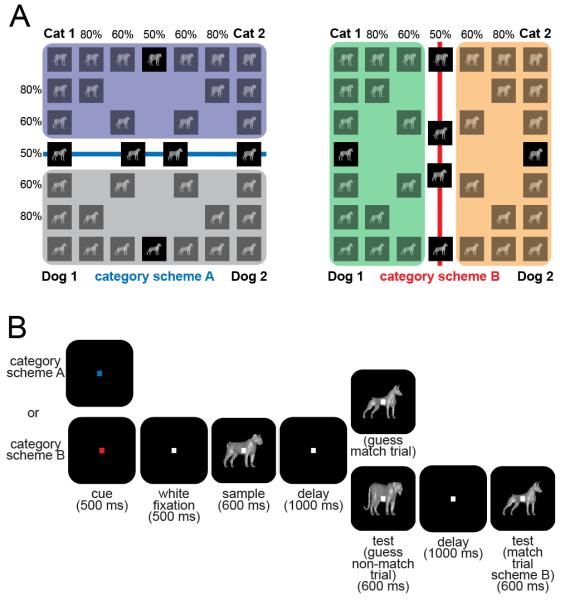
Figure 1
Figure 1
Stimuli and behavioral task. (A) Images were generated by morphing prototypes along six morph lines. Monkeys learned to categorize the same images under two different schemes. Some images were of equal proportion of two prototypes that is they were ambiguous and sat on the boundary lines. (B) Monkeys performed a delayed match-to-category task (see Methods). For the ambiguous stimuli, the category match/nonmatch was randomly assigned.
Figure 2
Figure 2
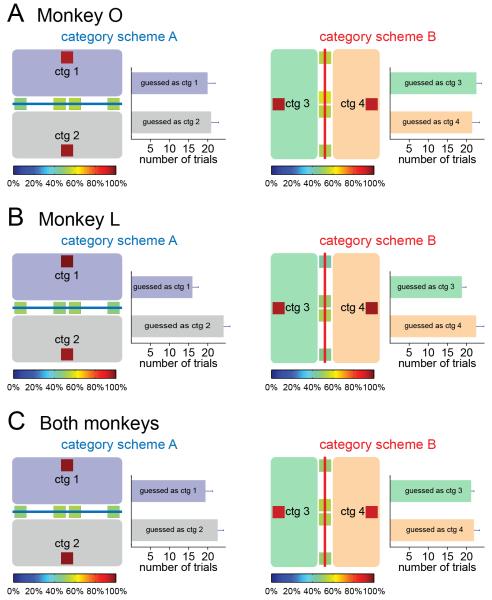
Behavioral performance of both monkeys. Monkey O (A) and monkey L (B) categorized the ambiguous stimuli as members of the appropriate category when they were not on the boundary lines (darker squares) and guessed the membership with equal probability (50%) when they sat on the boundary lines (green squares). On average across all sessions, both monkeys guessed a similar number of trials in each category (horizontal plots, mean +/− SEM). (C) Combined behavioral performance of the two animals.
Figure 3
Figure 3
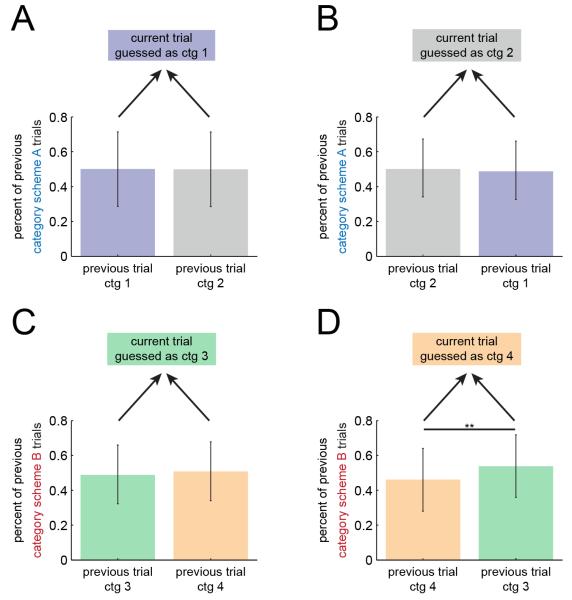
Influence of previous trial. The subset of trials where the previous trial was of the same category scheme and the sample image was unambiguous were investigated for each category across all sessions (mean =/− std). For three of the categories (A, B, C), the previous trial behavioral decision did not impact the guessing. There was a slight, but significant, bias away from guessing category 4 when the previous trial was a category 3 image (D).
Figure 4
Figure 4
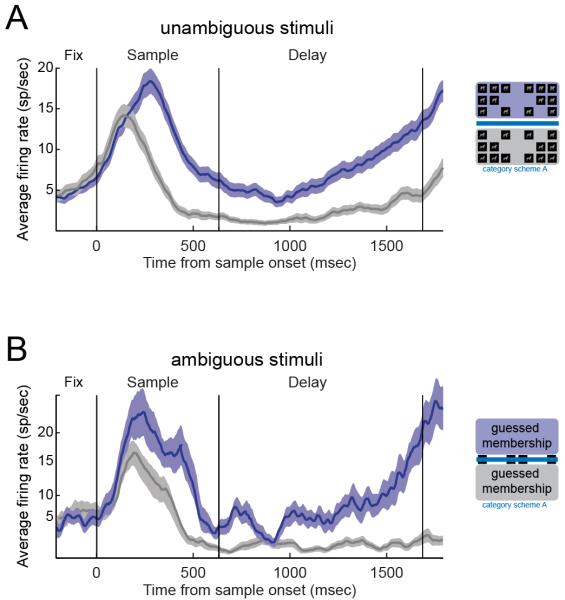
Category and guessing sensitivity of an example PFC neuron. (A) This neuron preferred category scheme A with its average activity (mean+/−SEM) in response to images of category 1 (purple line) was greater than its response for category 2 (gray line) in the sample presentation interval and throughout the memory delay. (B) The neuron showed the same category sensitivity for ambiguous stimuli, with an increased activity when the monkey guessed the image to be category 1 (purple line) as opposed to category 2 (gray line).
Figure 5
Figure 5
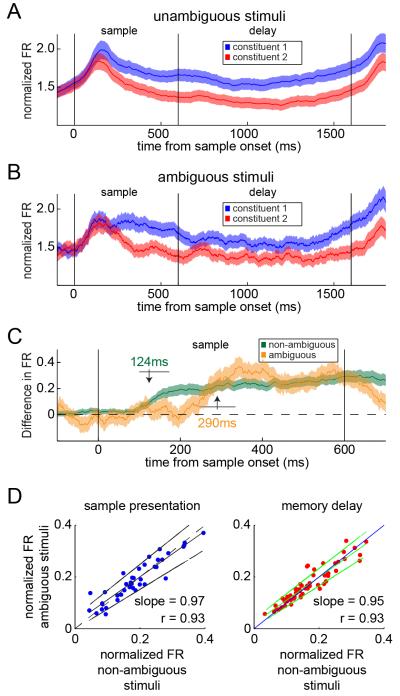
Latency of category sensitivity.The average (mean+/−SEM) neural response for the preferred category of PFC neurons that maintained the same preference during trials with unambiguous (A) and ambiguous (B) stimuli. (C) The maximum rise time was calculated in a 50 ms window centered on the first time point of significance in the difference in neural activity. It took significantly longer during the guessing trials than the unambiguous trials (124ms versus 290ms). (D) Comparison of normalized neural responses averaged over the sample presentation (left panel) and the memory delay (right panel) for unambiguous and ambiguous stimuli. The activity level of the population of PFC neurons were similar with both types of stimuli with slopes not different from unity. Note the number of trials in the unambiguous averages was stratified to match the lower number of ambiguous trials.
Figure 6
Figure 6
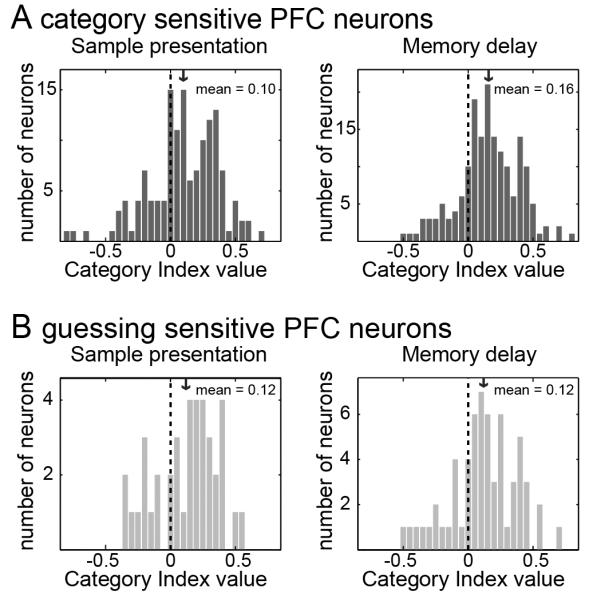
Category selectivity index values. (A) Index values of PFC neurons (n=206) that showed category sensitivity for one of the category schemes with unambiguous stimuli. (B) Index values for the sub-population of neurons (n=98) that maintained the same category sensitivity during trials with ambiguous stimuli.

References

    1. De Baene W, Ons B, Wagemans J, Vogels R. Effects of category learning on the stimulus selectivity of macaque inferior temporal neurons. Learning & Memory (Cold Spring Harbor, N.Y.) 2008;15(9):717–727. - PubMed
    1. Bonelli RM, Cummings JL. Frontal-subcortical circuitry and behavior. Dialogues in Clinical Neuroscience. 2007;9(2):141–151. - PMC - PubMed
    1. Buschman TJ, Miller EK. Top-down versus bottom-up control of attention in the prefrontal and posterior parietal cortices. Science (New York, N.Y.) 2007;315(5820):1860–1862. - PubMed
    1. Buschman TJ, Siegel M, Roy JE, Miller EK. Neural Substrates of Cognitive Capacity Limitations. Proceedings of the National Academy of Sciences. 2011;108(27):11252–11255. - PMC - PubMed
    1. Cromer JA, Roy JE, Miller EK. Representation of Multiple, Independent Categories in the Primate Prefrontal Cortex. Neuron. 2010;66(5):796–807. - PMC - PubMed

Publication types