. 2014 Jan 9:9:4.
doi: 10.1186/1750-1172-9-4.

VPAC2 receptor agonist BAY 55-9837 increases SMN protein levels and moderates disease phenotype in severe spinal muscular atrophy mouse models

Affiliations

VPAC2 receptor agonist BAY 55-9837 increases SMN protein levels and moderates disease phenotype in severe spinal muscular atrophy mouse models

Jeremiah Hadwen et al. Orphanet J Rare Dis. .

Abstract

Background: Spinal Muscular Atrophy (SMA) is one of the most common inherited causes of infant death and is caused by the loss of functional survival motor neuron (SMN) protein due to mutations or deletion in the SMN1 gene. One of the treatment strategies for SMA is to induce the expression of the protein from the homologous SMN2 gene, a rescuing paralog for SMA.

Methods and results: Here we demonstrate the promise of pharmacological modulation of SMN2 gene by BAY 55-9837, an agonist of the vasoactive intestinal peptide receptor 2 (VPAC2), a member of G protein coupled receptor family. Treatment with BAY 55-9837 lead to induction of SMN protein levels via activation of MAPK14 or p38 pathway in vitro. Importantly, BAY 55-9837 also ameliorated disease phenotype in severe SMA mouse models.

Conclusion: Our findings suggest the VPAC2 pathway is a potential SMA therapeutic target.


Figures
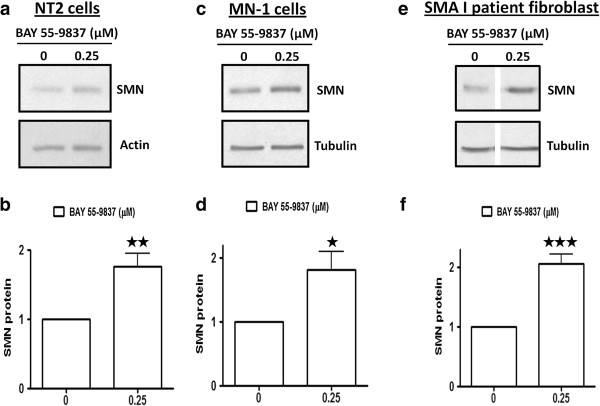
Figure 1
Figure 1
BAY 55-9837 treatment upregulates SMN protein in vitro. NT2, MN-1 and SMA I patient fibroblasts were treated with BAY 55-9837 (0.25 μM) and then harvested at 24 hours for western blot analyses. (a) Representative western blots showing the effect of BAY 55-9837 on SMN protein in NT2 cells. (b) Densitometric quantification of SMN protein relative to Actin (the ratio at control treatment was set as 1; mean + SEM (bars) of six independent experiments) are shown for NT2 cells. (c) Representative western blot showing effect of BAY 55-9837 on SMN protein in MN-1 cells. (d) Densitometric quantification of SMN protein relative to Tubulin (the ratio at control treatment was set as 1; mean + SEM (bars) of three independent experiments) are shown for MN-1 cells. (e) Representative western blots showing the effect of BAY 55-9837 on SMN protein in SMA I patient fibroblasts (all lanes were run on the same gel but were non-contiguous). (f) Densitometric quantification of SMN protein relative to Tubulin (the ratio at control treatment was set as 1; mean + SEM (bars) of five independent experiments) are shown for SMA I patient fibroblasts. *P < 0.05; **P < 0.01; ***P < 0.001, t-test.
Figure 2
Figure 2
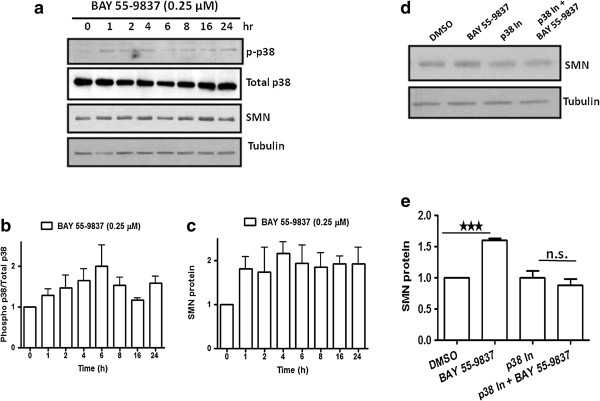
BAY 55-9837 treatment increases SMN expression via p38 MAPK pathway. (a) Representative western blot showing activation of p38 MAPK pathway upon BAY 55-9837 treatment in NT2 cells. NT2 cells were treated with BAY 55-9837 at indicated times and then harvested for western blot analysis. Activation of p38 pathway by BAY 55-9837 leads to an increase in SMN protein. (b) Densitometric quantification of phospho-p38 relative to total-p38 (the ratio at control treatment was set as 1; mean + SEM (bars) of three independent experiments) are shown for NT2 cells. (c) Densitometric quantification of SMN protein relative to Tubulin (the ratio at control treatment was set as 1; mean + SEM (bars) of three independent experiments) are shown for NT2 cells. (d) Representative western blots showing the effect of p38 inhibition on BAY 55-9837-induced increase in SMN protein. p38 inhibitor (SB-239580) blocked the BAY 55-9837-induced increase in SMN protein in NT2 cells. NT2 cells were treated with SB-239580 (p38 In; 3 μM) for 2 h followed by treatment with BAY 55-9837 for 24 h and than harvested for western blot analysis. (e) Densitometric quantification of SMN protein relative to Tubulin (the ratio at control treatment was set as 1; mean + SEM (bars) of three independent experiments) are shown for NT2 cells showing the effect of p38 inhibition on BAY 55-9837-induced increase in SMN protein. *P < 0.05; **P < 0.01, t-test.
Figure 3
Figure 3
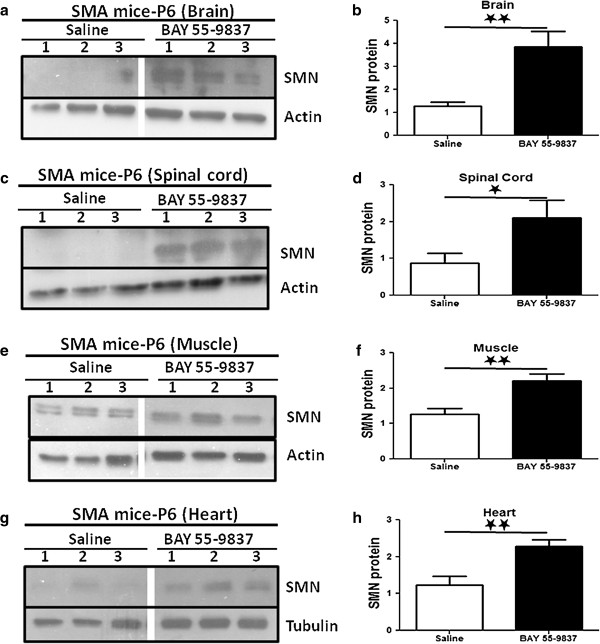
BAY 55-9837 upregulates SMN protein in SMA mouse model. SMA∆7 mice were treated daily with saline or BAY 55-9837 (200 μg/kg) from P1 for 6 days, then sacrificed at P7. Brain, spinal cord,skeletal muscle and heart tissues were harvested for western blot analysis. Representative western blots showing effect of BAY 55-9837 on SMN protein in brain (a), spinal cord (c), muscle (e) and heart (g) samples of SMA∆7 mice treated with Saline (control, lane 1, 2 & 3) or BAY 55-9837 (treatment lane 1, 2 & 3 respectively) (each lane represents individual animal; all lanes were run on the same gel but were non-contiguous). Densitometric quantification of SMN relative to Actin/Tubulin [mean + SEM (bars)] is shown for brain (b; n=11), spinal cord (d; n=6), muscle (f; n=11) and heart (h; n=11) samples. *P < 0.05; **P < 0.01; t-test.
Figure 4
Figure 4
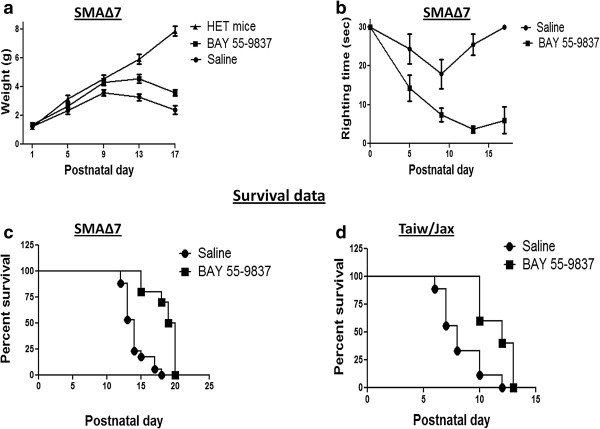
BAY 55-9837 ameliorates disease phenotype and increases survival of SMA mouse models. SMA∆7 mice were treated daily with intraperitoneal injections of BAY 55-9837 (200.0 μg/kg) from P1 onward. (a) Weights of SMA∆7 mice treated with BAY 55-9837 (black filled square, n =10) or saline (black filled circle, n =10); weights for heterozygous mice treated with saline (black filled triangle, n =5) are also shown for comparison [mean ± SEM (bars)]. (b) Righting times of SMA∆7 mice treated with BAY 55-9837 (black filled square, n = 10) or saline (black filled circle, n =10) [mean ± SEM (bars)]. (c) Kaplan-Meier survival curves of SMA∆7 mice treated with BAY 55-9837 (black filled square, n = 10; median survival 19.5 days) or saline (black filled circle, n =17; median survival 14.0 days ). (d) Kaplan-Meier survival curves of Taiwanese-SMA mice treated with BAY 55-9837 (black filled square, n = 5; median survival 12.0 days) or saline (black filled circle, n =10; median survival 8.0 days); *P < 0.05; ***P < 0.0001, log-rank test.
Figure 5
Figure 5
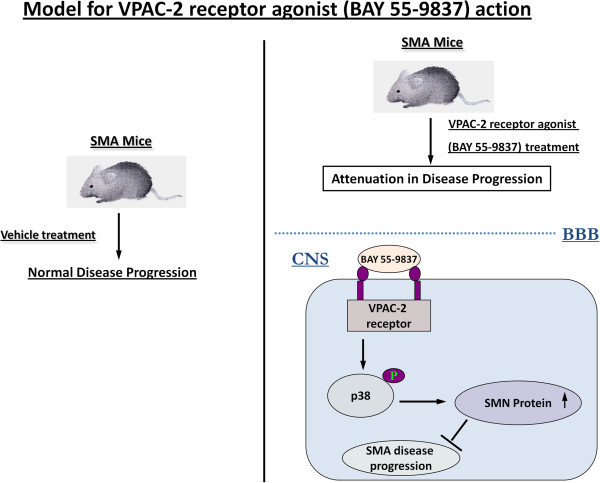
Model for VPAC2 receptor agonist (BAY 55-9837) action.

References

    1. Sugarman EA, Nagan N, Zhu H, Akmaev VR, Zhou Z, Rohlfs EM, Flynn K, Hendrickson BC, Scholl T, Sirko-Osadsa DA, Allitto BA. Pan-ethnic carrier screening and prenatal diagnosis for spinal muscular atrophy: clinical laboratory analysis of >72,400 specimens. Eur J Hum Gen. 2012;20:27–32. doi: 10.1038/ejhg.2011.134. - DOI - PMC - PubMed
    1. D’Amico A, Mercuri E, Tiziano FD, Bertini E. Spinal muscular atrophy. Orphanet J Rare Dis. 2011;6:71. doi: 10.1186/1750-1172-6-71. - DOI - PMC - PubMed
    1. Lefebvre S, Burglen L, Reboullet S, Clermont O, Burlet P, Viollet L, Benichou B, Cruaud C, Millasseau P, Zeviani M. Identification and characterization of a spinal muscular atrophy-determining gene. Cell. 1995;80:155–165. doi: 10.1016/0092-8674(95)90460-3. - DOI - PubMed
    1. Lorson CL, Hahnen E, Androphy EJ, Wirth B. A single nucleotide in the SMN gene regulates splicing and is responsible for spinal muscular atrophy. Proc Natl Acad Sci USA. 1999;96:6307–6311. doi: 10.1073/pnas.96.11.6307. - DOI - PMC - PubMed
    1. Monani UR, Lorson CL, Parsons DW, Prior TW, Androphy EJ, Burghes AH, McPherson JD. A single nucleotide difference that alters splicing patterns distinguishes the SMA gene SMN1 from the copy gene SMN2. Hum Mol Genet. 1999;8:1177–1183. doi: 10.1093/hmg/8.7.1177. - DOI - PubMed

Publication types

MeSH terms

Substances

LinkOut - more resources