


Small-scale transcriptomics reveals differences among gonadal stages in Asian seabass (Lates calcarifer)
- PMID: 24405829
- PMCID: PMC3896769
- DOI: 10.1186/1477-7827-12-5
Small-scale transcriptomics reveals differences among gonadal stages in Asian seabass (Lates calcarifer)
Abstract
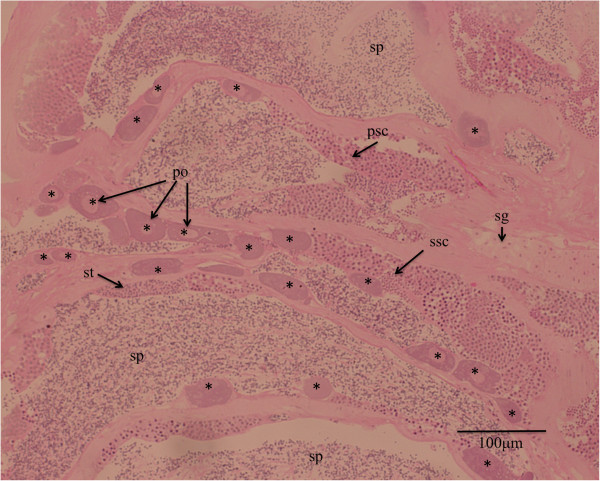
Background: The Asian seabass (Lates calcarifer) is a protandrous hermaphrodite that typically matures as a male at approximately 2-4 years of age and then changes sex in subsequent years. Although several sexual maturation stages have been described histologically for both testis and ovary, the underlying gene expression profiles remain lacking. The development of a gene expression platform is therefore necessary to improve our understanding of the gonad development of this cultured teleost species.
Methods: Thirty Asian seabass gonads were collected from farms in Singapore, examined histologically and staged according to their sex and gonadal maturation status. Partial coding sequences of 24 sex-related genes were cloned using degenerate primers and were sequenced. Additional 13 cDNA sequences were obtained through next-generation sequencing. A real-time qPCR was then performed using the microfluidic-based Fluidigm 48.48 Dynamic arrays.
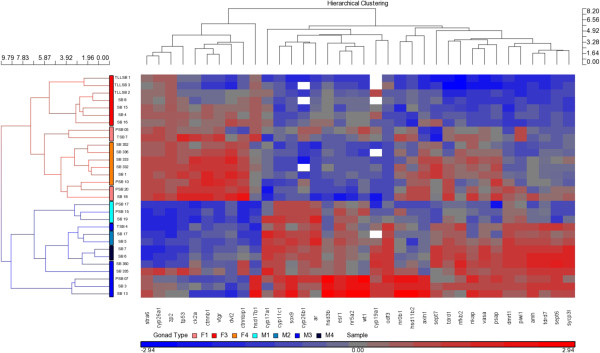
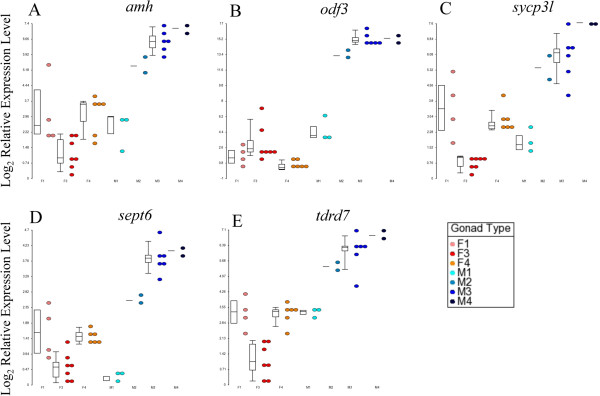
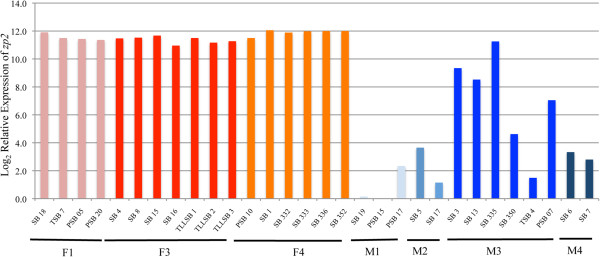
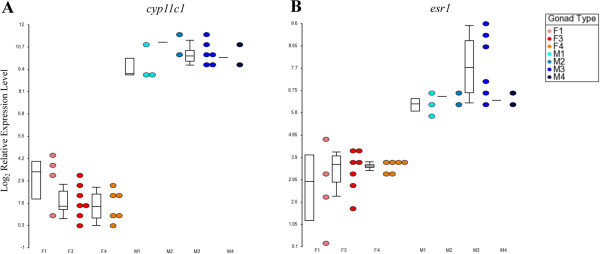
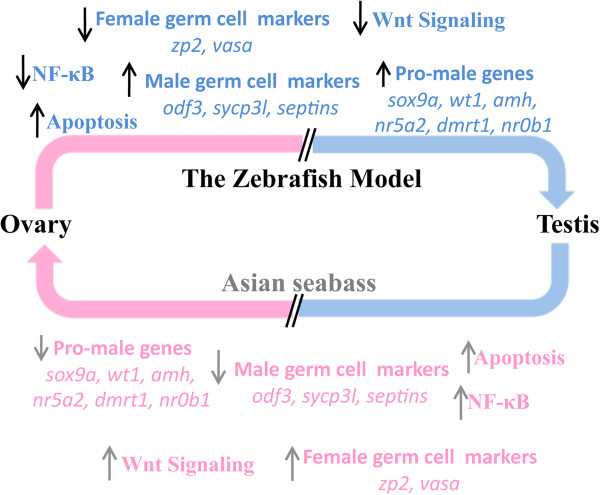
Results: We obtained 17 ovaries and 13 testes at various stages of sexual maturation. Of the 37 genes that were tested, 32 (86%) showed sexually dimorphic expression. These genes included sex-related genes, sox9, wt1, amh, nr5a2, dmrt1 and nr0b1, which showed testis-enhanced expression similar to other vertebrate species. Known male- and female-enhanced germ cells markers, which were established from studies in other species, similarly showed testis- and ovary-enhanced expression, respectively, in the Asian seabass. Three pro-Wnt signaling genes were also upregulated in the ovary, consistent with existing studies that suggested the role of Wnt signaling in ovarian differentiation in teleosts and mammals. The expression patterns of genes involved in steroidogenesis, retinoic acid metabolism, apoptosis and NF-κB signaling were also described. We were able to classify gonads according to sex and gonadal maturation stages, based on their small-scale transcriptomic profiles, and to uncover a wide variation in expression profiles among individuals of the same sex.
Conclusions: The analysis of a selected set of genes related to reproduction and in sufficient number of individuals using a qPCR array can elucidate new insights into the molecular mechanisms involved in Asian seabass gonad development. Given the conservation of gene expression patterns found in this study, these insights may also help us draw parallels with other teleosts.
Figures
References
-
- Davis T. Maturity and sexuality in barramundi, Lates calcarifer (Bloch), in the Northern Territory and south-eastern Gulf of Carpentaria. Mar Freshw Res. 1982;33(3):529–545. doi: 10.1071/MF9820529. - DOI
-
- Guiguen Y, Cauty C, Fostier A, Fuchs J, Jalabert B. Reproductive cycle and sex inversion of the seabass, Lates calcarifer, reared in sea cages in French Polynesia: histological and morphometric description. Environ Biol Fishes. 1994;39(3):231–247. doi: 10.1007/BF00005126. - DOI
-
- Moore R. Natural sex inversion in the giant perch (Lates calcarifer) Mar Freshw Res. 1979;30(6):803–813. doi: 10.1071/MF9790803. - DOI
-
- Szentes K, Mészáros E, Szabó T, Csorbai B, Borbély G, Bernáth G, Urbányi B, Horváth Á. Gonad development and gametogenesis in the Asian sea bass (Lates calcarifer) grown in an intensive aquaculture system. J Appl Ichthyol. 2012;28(6):883–885. doi: 10.1111/jai.12064. - DOI
-
- Newton JR, Zenger KR, Jerry DR. Next-generation transcriptome profiling reveals insights into genetic factors contributing to growth differences and temperature adaptation in Australian populations of barramundi (Lates calcarifer) Mar Genomics. 2013;11:45–52. - PubMed
Publication types
MeSH terms
LinkOut - more resources
Full Text Sources
Other Literature Sources
Molecular Biology Databases
Research Materials
