


Latent hepatitis B is a risk factor for hepatocellular carcinoma in patients with chronic hepatitis C
- PMID: 24409059
- PMCID: PMC3882405
- DOI: 10.3748/wjg.v19.i48.9328
Latent hepatitis B is a risk factor for hepatocellular carcinoma in patients with chronic hepatitis C
Abstract
Aim: To study the potential association between hepatocellular carcinoma (HCC) in patients with chronic hepatitis C (CHC), cirrhosis and latent hepatitis B (LHB) infection, defined as the absence of detectable serum hepatitis B surface antigen (HBsAg) and the presence of hepatitis B core antibody (HBcAb).
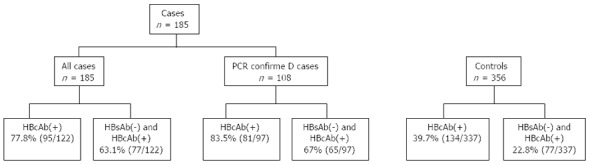
Methods: This retrospective analysis is comprised of 185 cirrhotic patients with HCC who were hepatitis C virus antibody (HCV Ab) (+) and HBsAg(-) at Wayne State University between 1999 and 2008. From these, 108 patients had HCV polymerase chain reaction confirmation of viremia while the remaining (77) were considered to have CHC on the basis of a positive HCV Ab and the absence of any other cause of liver disease. Controls were drawn from our institutional database from the same time period and consisted of 356 HBsAg(-) age, race and gender matched patients with HCV RNA-confirmed CHC and without evidence of HCC. A subgroup of controls included 118 matched patients with liver cirrhosis. χ² test and t test were used for data analysis.
Results: Seventy-seven percent of patients in all 3 groups were African Americans. Patients with HCC had a significantly higher body mass index (P = 0.03), a higher rate of co-infection with human immunodeficiency virus (HIV) (P = 0.05) and a higher prevalence of alcohol abuse (P = 0.03) than the controls. More patients with HCC had LHB than controls (78% vs 39%, P = 0.01). Sixty three percent of patients with HCC were both hepatitis B surface antigen (HBsAb)(-) and HBcAb(+) compared to 23% of controls (P < 0.01). When compared to cirrhotic controls, the frequency of HBcAb(+) remained higher in patients with HCC (78% vs 45%, P = 0.02). Patients with HCC were more likely to be both HBsAb(-) and HBcAb(+) than the cirrhotic controls (63% vs 28%, P = 0.01). Although not statistically significant, 100% of CHC and HIV co-infected patients with HCC (n = 11) were HBcAb(+) when compared to controls (44%; n = 9).
Conclusion: These data suggest that LHB occurs at a significantly increased frequency in patients with CHC and HCC than in patients with CHC without HCC.
Keywords: Chronic hepatitis C; Hepatitis C virus; Hepatocellular carcinoma; Latent hepatitis B.
Figures
References
-
- Fattovich G, Stroffolini T, Zagni I, Donato F. Hepatocellular carcinoma in cirrhosis: incidence and risk factors. Gastroenterology. 2004;127:S35–S50. - PubMed
-
- Vitale F, Tramuto F, Orlando A, Vizzini G, Meli V, Cerame G, Mazzucco W, Virdone R, Palazzo U, Villafrate MR, et al. Can the serological status of anti-HBc alone be considered a sentinel marker for detection of occult HBV infection? J Med Virol. 2008;80:577–582. - PubMed
-
- Toyoda H, Kumada T, Kiriyama S, Sone Y, Tanikawa M, Hisanaga Y, Kanamori A. Prevalence of low-level hepatitis B viremia in patients with HBV surface antigen-negative hepatocellular carcinoma with and without hepatitis C virus infection in Japan: analysis by COBAS TaqMan real-time PCR. Intervirology. 2007;50:241–244. - PubMed
-
- Adachi S, Shibuya A, Miura Y, Takeuchi A, Nakazawa T, Saigenji K. Impact of occult hepatitis B virus infection and prior hepatitis B virus infection on development of hepatocellular carcinoma in patients with liver cirrhosis due to hepatitis C virus. Scand J Gastroenterol. 2008;43:849–856. - PubMed
MeSH terms
Substances
LinkOut - more resources
Full Text Sources
Other Literature Sources
Medical
