Longitudinal trajectories of peer relations in children with specific language impairment
- PMID: 24410167
- PMCID: PMC4283728
- DOI: 10.1111/jcpp.12190
Longitudinal trajectories of peer relations in children with specific language impairment
Abstract
Background: Peer relations is a vulnerable area of functioning in children with specific language impairment (SLI), but little is known about the developmental trajectories of individuals.
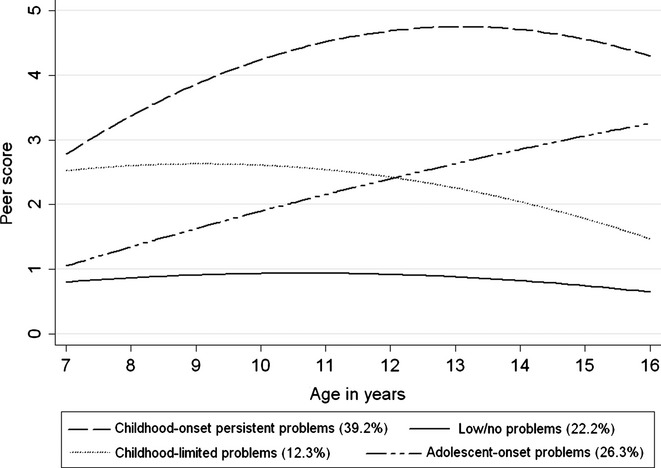
Methods: Peer problems were investigated over a 9-year period (from 7 to 16 years of age) in 171 children with a history of SLI. Discrete factor growth modelling was used to chart developmental trajectories. Multinomial logistic regression analysis was conducted to investigate factors associated with group membership.
Results: Four distinct developmental trajectories were identified: low-level/no problems in peer relations (22.2% of participants), childhood-limited problems (12.3%), childhood-onset persistent problems (39.2%) and adolescent-onset problems (26.3%). Risk of poor trajectories of peer relations was greater for those children with pragmatic language difficulties. Prosocial behaviour was the factor most strongly associated with trajectory group membership. Overall, the more prosocial children with better pragmatic language skills and lower levels of emotional problems had less difficulty in developing peer relations.
Conclusions: Analysis of developmental trajectories enriches our understanding of social development. A sizeable minority in the present sample sustained positive relations through childhood and adolescence, and others overcame early difficulties to achieve low levels of problems by their early teens; the majority, however, showed childhood-onset persistent or adolescent-onset problems.
Keywords: Specific language impairment; autistic symptomatology; developmental trajectories; peer relations; pragmatic language impairment; prosocial behaviour.
© 2014 The Authors Journal of Child Psychology and Psychiatry published by John Wiley © Sons Ltd on behalf of Association for Child and Adolescent Mental Health.
Figures
References
-
- Achenbach T. Rescorla L. Child behaviour checklist. Burlington, VT: University of Vermont Press; 2001.
-
- Adams C, Lockton E, Freed J, Gaile J, Earl G, McBean K. Law J. The Social Communication Intervention Project: A randomized controlled trial of the effectiveness of speech and language therapy for school-age children who have pragmatic and social communicative problems with or without autism spectrum disorders. International Journal of Language and Communication Disorders. 2012;47:233–244. - PubMed
-
- Agresti A. Finlay B. Statistical methods for the social sciences. Upper Saddle River, New Jersey: Pearson Prentice Hall; 2009.
-
- Alderfer M, Wiebe DJ. Hartmann D. Social behaviour and illness information interact to influence the peer acceptance of children with chronic illness. British Journal of Health Psychology. 2001;6:243–255. - PubMed
-
- Barry CM. Wentzel KR. Friend influence on prosocial behaviour: The role of motivational factors and friendship characteristics. Developmental Psychology. 2006;42:153–163. - PubMed
Publication types
MeSH terms
Grants and funding
- G0400577/MRC_/Medical Research Council/United Kingdom
- G0600555/MRC_/Medical Research Council/United Kingdom
- G0900678/MRC_/Medical Research Council/United Kingdom
- G0500272/MRC_/Medical Research Council/United Kingdom
- MR/J01348X/1/MRC_/Medical Research Council/United Kingdom
- G0900654/MRC_/Medical Research Council/United Kingdom
- WT_/Wellcome Trust/United Kingdom
- G0901491/MRC_/Medical Research Council/United Kingdom
- G0400065/MRC_/Medical Research Council/United Kingdom
- MR/K005863/1/MRC_/Medical Research Council/United Kingdom
- G0802307/MRC_/Medical Research Council/United Kingdom
- G0401546/MRC_/Medical Research Council/United Kingdom
- G0300610/MRC_/Medical Research Council/United Kingdom
LinkOut - more resources
Full Text Sources
Other Literature Sources
Medical