


Behaviourally inhibited temperament and female sex, two vulnerability factors for anxiety disorders, facilitate conditioned avoidance (also) in humans
- PMID: 24412263
- PMCID: PMC3972301
- DOI: 10.1016/j.beproc.2014.01.003
Behaviourally inhibited temperament and female sex, two vulnerability factors for anxiety disorders, facilitate conditioned avoidance (also) in humans
Abstract
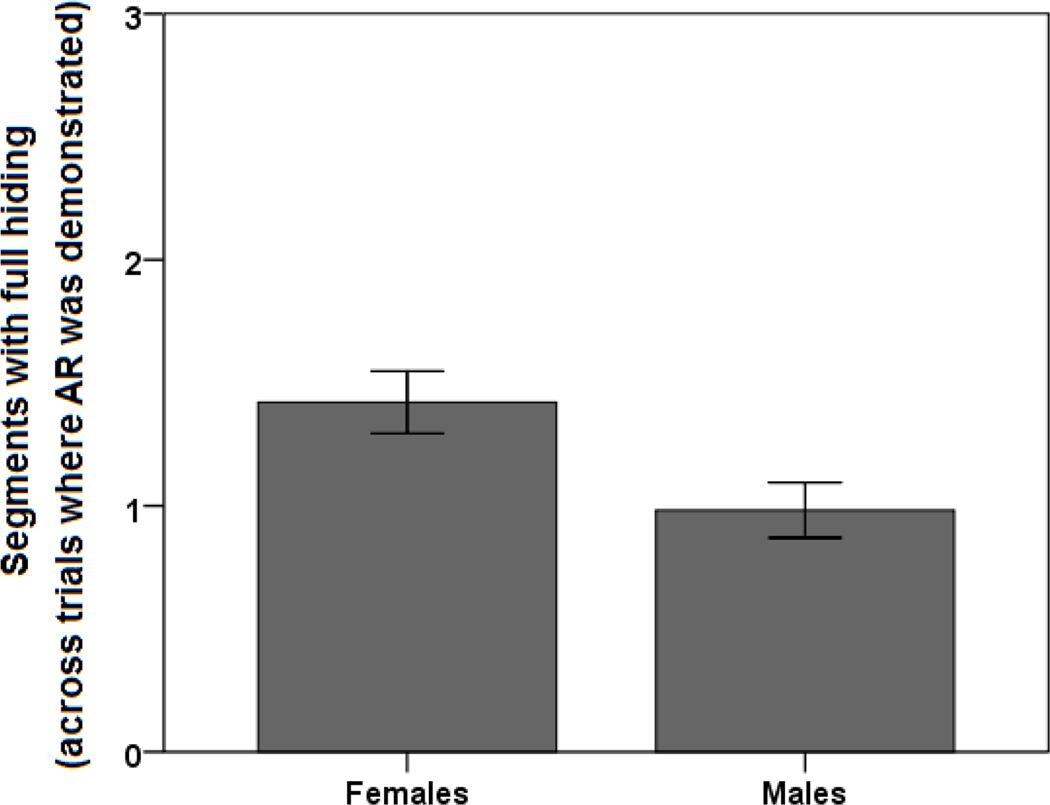
Acquisition and maintenance of avoidance behaviour is a key feature of all human anxiety disorders. Animal models have been useful in understanding how anxiety vulnerability could translate into avoidance learning. For example, behaviourally inhibited temperament and female sex, two vulnerability factors for clinical anxiety, are associated with faster acquisition of avoidance responses in rodents. However, to date, the translation of such empirical data to human populations has been limited since many features of animal avoidance paradigms are not typically captured in human research. Here, using a computer-based task that captures many features of rodent escape-avoidance learning paradigms, we investigated whether avoidance learning would be faster in humans with inhibited temperament and/or female sex and, if so, whether this facilitation would take the same form. Results showed that, as in rats, both vulnerability factors were associated with facilitated acquisition of avoidance behaviour in humans. Specifically, inhibited temperament was associated with higher rate of avoidance responding, while female sex was associated with longer avoidance duration. These findings strengthen the direct link between animal avoidance work and human anxiety vulnerability, further motivating the study of animal models while also providing a simple testbed for a direct human testing.
Keywords: Anxiety disorders; Associative learning; Avoidance learning; Behavioural inhibition; Female sex; Inbred Wistar–Kyoto rats; Translational research.
Copyright © 2014 Elsevier B.V. All rights reserved.
Conflict of interest statement
The authors affirm that they have no relationships that could constitute potential conflict of interest.
Figures
References
-
- American Psychiatric Association. Diagnostic and Statistical Manual of Mental Disorders. 4th ed. Washington, DC: APA; 1994.
-
- Arcediano F, Ortega N, Matute H. A behavioural preparation for the study of human Pavlovian conditioning. Quarterly Journal of Experimental Psychology B. 1996;49:270–283. - PubMed
-
- Avcu P, Jiao X, Beck KD, Myers CE, Pang KCH, Servatius RJ. Avoidance acquisition in Wistar-Kyoto (WKY) and Sprague-Dawley (SD) rats: Shock expectancy or escape from fear?; Society for Neuroscience Annual Meeting; 2012. 703.05/DDD49 [abstract].
-
- Baeken C, De Raedt R, Ramsey N, Van Schuerbeek P, Hermes D, Bossuyt A, Leyman L, Vanderhasselt MA, De Mey J, Luypaert R. Amygdala responses to positively and negatively valenced baby faces in healthy female volunteers: influences of individual differences in harm avoidance. Brain Res. 2009;1296:94–103. - PubMed
Publication types
MeSH terms
Grants and funding
LinkOut - more resources
Full Text Sources
Other Literature Sources
Medical
