


Impact of the hepatopulmonary syndrome MELD exception policy on outcomes of patients after liver transplantation: an analysis of the UNOS database
- PMID: 24412528
- PMCID: PMC3992191
- DOI: 10.1053/j.gastro.2014.01.005
Impact of the hepatopulmonary syndrome MELD exception policy on outcomes of patients after liver transplantation: an analysis of the UNOS database
Abstract
Background & aims: Patients with hepatopulmonary syndrome (HPS) are prioritized for liver transplantation (given exception points) due to their high pre- and post-transplantation mortality. However, few studies have evaluated the outcomes of these patients.
Methods: We performed a retrospective cohort study using data submitted to the United Network for Organ Sharing in a study of the effects of room-air oxygenation on pre- and post-transplantation outcomes of patients with HPS. We identified thresholds associated with post-transplantation survival using cubic spline analysis and compared overall survival times of patients with and without HPS.
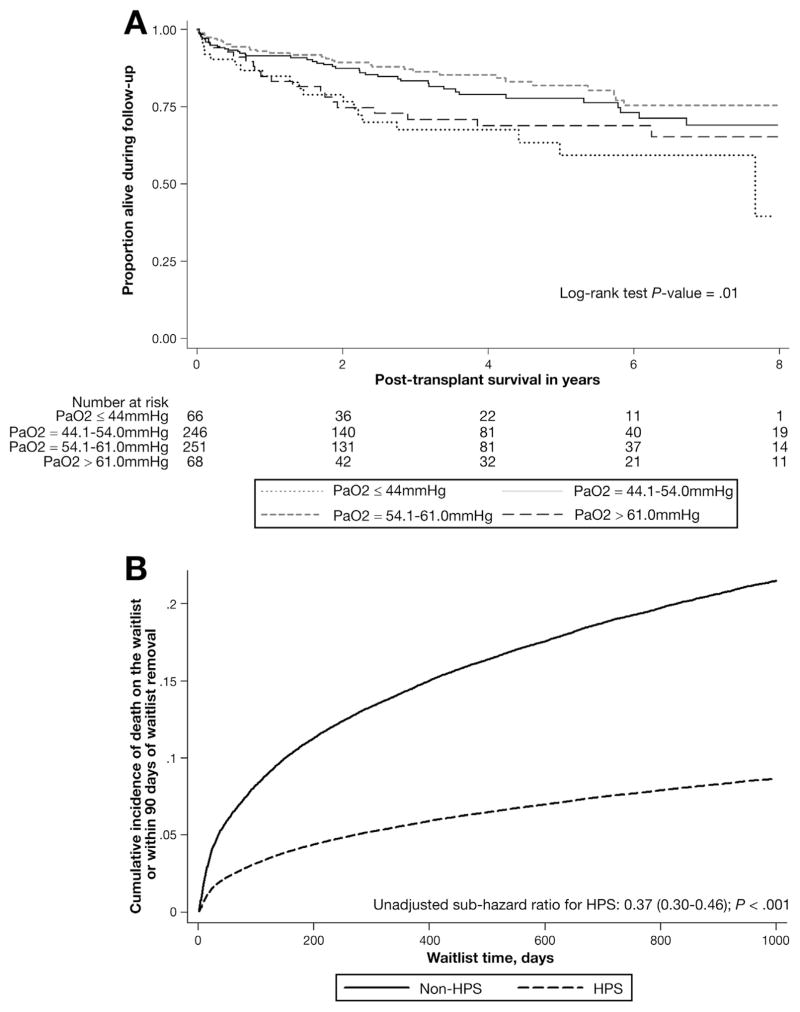
Results: From 2002 through 2012, nine hundred and seventy-three patients on the liver transplant waitlist received HPS exception points. There was no association between oxygenation and waitlist mortality among patients with HPS exception points. Transplant recipients with more severe hypoxemia had increased risk of death after liver transplantation. Rates of 3-year unadjusted post-transplantation survival were 84% for patients with PaO2 of 44.1-54.0 mm Hg vs 68% for those with PaO2 ≤ 44.0 mm Hg. In multivariable Cox models, transplant recipients with an initial room-air PaO2 ≤ 44.0 mm Hg had significant increases in post-transplantation mortality (hazard ratio = 1.58; 95% confidence interval [CI]: 1.15-2.18) compared with those with a PaO2 of 44.1-54.0 mm Hg. Overall mortality was significantly lower among waitlist candidates with HPS exception points than those without (hazard ratio = 0.82; 95% CI: 0.70-0.96), possibly because patients with HPS have a reduced risk of pre-transplantation mortality and similar rate of post-transplantation survival.
Conclusions: Although there was no association between pre-transplantation oxygenation and waitlist survival in patients with HPS Model for End-Stage Liver Disease exception points, a pre-transplantation room-air PaO2 ≤ 44.0 mm Hg was associated with increased post-transplantation mortality. HPS Model for End-Stage Liver Disease exception patients had lower overall mortality compared with others awaiting liver transplantation, suggesting that the appropriateness of the HPS exception policy should be reassessed.
Keywords: Allocation; Gas Exchange; MELD; UNOS.
Copyright © 2014 AGA Institute. Published by Elsevier Inc. All rights reserved.
Conflict of interest statement
The authors disclose no conflicts.
Figures
Comment in
-
Is it time to recalibrate the MELD exception points attributed for hepatopulmonary syndrome?Gastroenterology. 2014 May;146(5):1158-60. doi: 10.1053/j.gastro.2014.03.018. Epub 2014 Mar 26. Gastroenterology. 2014. PMID: 24680966 No abstract available.
-
Hepatopulmonary syndrome: Is it time to redefine the MELD exception score for better organ allocation and outcomes?Ann Hepatol. 2014 Jul-Aug;13(4):468-70. Ann Hepatol. 2014. PMID: 24927621 No abstract available.
References
-
- Krowka MJ, Wiseman GA, Burnett OL, et al. Hepatopulmonary syndrome: a prospective study of relationships between severity of liver disease, PaO(2) response to 100% oxygen, and brain uptake after (99m) Tc MAA lung scanning. Chest. 2000;118:615–624. - PubMed
-
- Swanson KL, Wiesner RH, Krowka MJ. Natural history of hepatopulmonary syndrome: Impact of liver transplantation. Hepatology. 2005;41:1122–1129. - PubMed
-
- Krowka MJ, Fallon MB. Liver transplantation for hepatopulmonary syndrome (HPS): what is the MESSAGE? Am J Transplant. 2008;8:911–912. - PubMed
-
- Krowka MJ, Mandell MS, Ramsay MA, et al. Hepatopulmonary syndrome and portopulmonary hypertension: a report of the multicenter liver transplant database. Liver Transpl. 2004;10:174–182. - PubMed
Publication types
MeSH terms
Grants and funding
LinkOut - more resources
Full Text Sources
Other Literature Sources
Medical
