


Can the relationship between ethnicity and obesity-related behaviours among school-aged children be explained by deprivation? A cross-sectional study
- PMID: 24413346
- PMCID: PMC3902524
- DOI: 10.1136/bmjopen-2013-003949
Can the relationship between ethnicity and obesity-related behaviours among school-aged children be explained by deprivation? A cross-sectional study
Abstract
Objectives: It is unclear whether cultural differences or material disadvantage explain the ethnic patterning of obesogenic behaviours. The aim of this study was to examine ethnicity as a predictor of obesity-related behaviours among children in England, and to assess whether the effects of ethnicity could be explained by deprivation.
Setting: Five primary care trusts in England, 2010-2011.
Participants: Parents of white, black and South Asian children aged 4-5 and 10-11 years participating in the National Child Measurement Programme (n=2773).
Primary outcome measures: Parent-reported measures of child behaviour: low level of physical activity, excessive screen time, unhealthy dietary behaviours and obesogenic lifestyle (combination of all three obesity-related behaviours). Associations between these behaviours and ethnicity were assessed using logistic regression analyses.
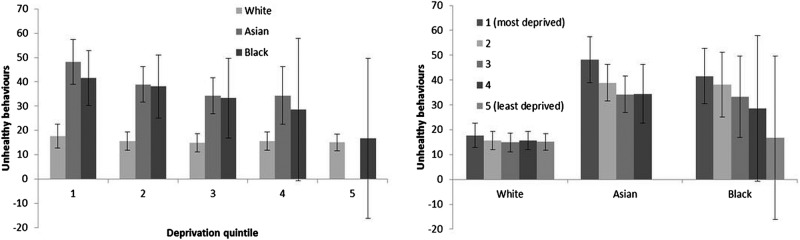
Results: South Asian ethnic groups made up 22% of the sample, black ethnic groups made up 8%. Compared with white children, higher proportions of Asian and black children were overweight or obese (21-27% vs16% of white children), lived in the most deprived areas (24-47% vs 14%) and reported obesity-related behaviours (38% with obesogenic lifestyle vs 16%). After adjusting for deprivation and other sociodemographic characteristics, black and Asian children were three times more likely to have an obesogenic lifestyle than white children (OR 3.0, 95% CI 2.1 to 4.2 for Asian children; OR 3.4, 95% CI 2.7 to 4.3 for black children).
Conclusions: Children from Asian and black ethnic groups are more likely to have obesogenic lifestyles than their white peers. These differences are not explained by deprivation. Culturally specific lifestyle interventions may be required to reduce obesity-related health inequalities.
Keywords: Preventive Medicine; Social Medicine.
Figures
References
-
- Ebbeling CB, Pawlak DB, Ludwig DS. Childhood obesity: public-health crisis, common sense cure. Lancet 2002;360:473–82 - PubMed
-
- Reilly JJ, Kelly J. Long-term impact of overweight and obesity in childhood and adolescence on morbidity and premature mortality in adulthood: systematic review. Int J Obes 2011;35:891–8 - PubMed
-
- Department of Health Cross Government Obesity Unit Healthy weight, healthy lives; a cross-government strategy for England. In: Health, ed London, 2008:56
Publication types
MeSH terms
Grants and funding
LinkOut - more resources
Full Text Sources
Other Literature Sources
Medical
