


The mechanical strength of side-to-side tendon repair with mismatched tendon size and shape
- PMID: 24413573
- PMCID: PMC4366193
- DOI: 10.1177/1753193413517327
The mechanical strength of side-to-side tendon repair with mismatched tendon size and shape
Abstract
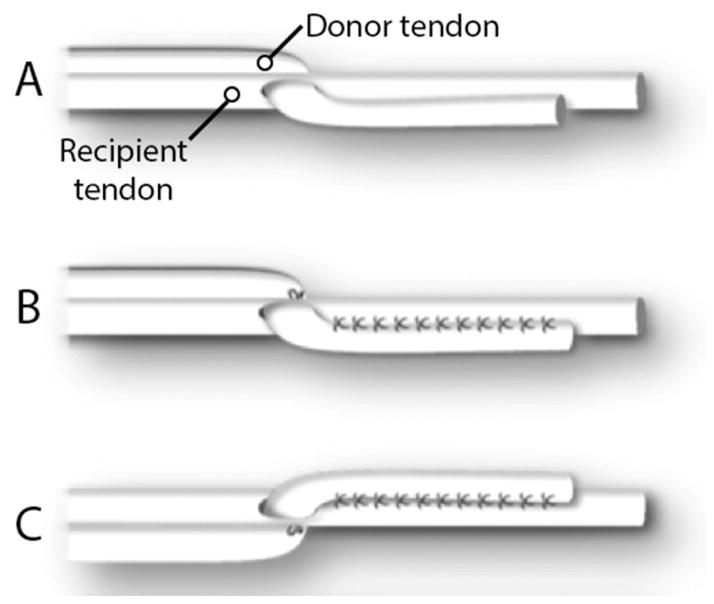
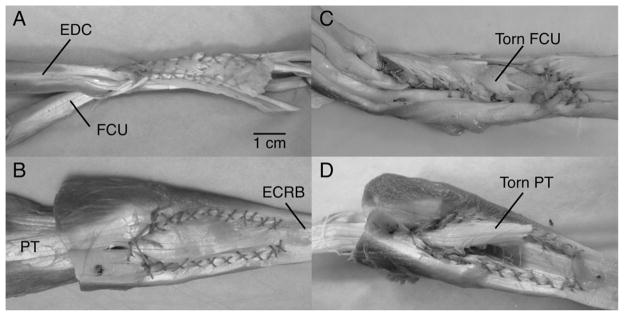
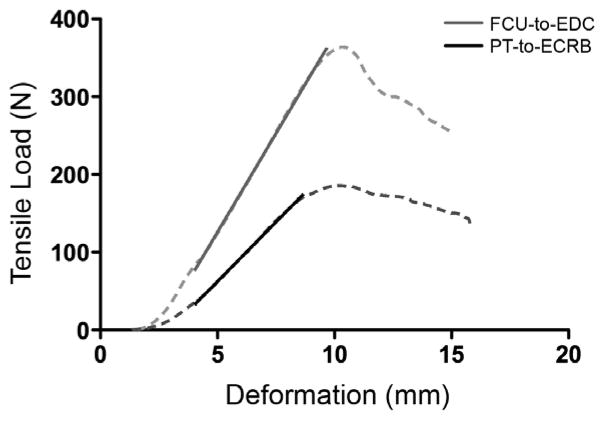
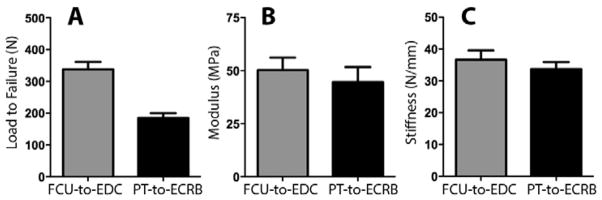
Tendon transfers frequently require coaptation of two mismatched tendons. In this cadaver study, ultimate load, stiffness, and Young's modulus were measured in tendon-to-tendon attachments with mismatched donor and recipient tendons, using pronator teres (PT) to extensor carpi radialis brevis (ECRB) and flexor carpi ulnaris (FCU) to extensor digitorum communis (EDC). FCU-to-EDC attachments failed at higher loads than PT-to-ECRB attachments, but they had similar modulus and stiffness values. Ultimate tensile strength of the tendon attachments exceeded the maximum predicted contraction force of any of the transferred muscles, with safety factors of four-fold for the FCU-to-EDC and two-fold for the PT-to-ECRB transfers. This implies that size and shape mismatches should not be contraindications to tendon attachment in transfers. The strength safety factors suggest that postoperative immobilization of these transfers is unnecessary.
Keywords: Tendon transfer; stiffness; ultimate tensile strength.
© The Author(s) 2014.
Conflict of interest statement
Figures
References
-
- Boyer MI, Goldfarb CA, Gelberman RH. Recent progress in flexor tendon healing. The modulation of tendon healing with rehabilitation variables. J Hand Ther. 2005;18:80–5. quiz 6. - PubMed
-
- Butler DL, Grood ES, Noyes FR, Zernicke RF. Biomechanics of ligaments and tendons. Exerc Sport Sci Rev. 1978;6:125–81. - PubMed
-
- Fridén J, editor. Tendon Transfers in Reconstructive Surgery. 1. Informa Healtcare; 2005.
-
- Fridén J, Reinholdt C. Current concepts in reconstruction of hand function in tetraplegia. Scand J Surg. 2008;97:341–6. - PubMed
Publication types
MeSH terms
Grants and funding
LinkOut - more resources
Full Text Sources
Other Literature Sources
