


Trifluoperazine versus placebo for schizophrenia
- PMID: 24414883
- PMCID: PMC6718209
- DOI: 10.1002/14651858.CD010226.pub2
Trifluoperazine versus placebo for schizophrenia
Abstract
Background: Trifluoperazine is a long-established high potency typical antipsychotic drug used in the treatment of schizophrenia and schizophrenia-like illnesses.
Objectives: To determine absolute effects of trifluoperazine for schizophrenia and schizophrenia-like illnesses compared with placebo.To critically appraise and summarise current evidence on the resource use, cost and economic evaluation of trifluoperazine compared with placebo for schizophrenia.
Search methods: Searches of the Cochrane Schizophrenia Group's register of trials (July 2012), supplemented with handsearching, reference searching, personal communication and contact with industry. Two review authors undertook a search for economic studies using the Cochrane Schizophrenia Group's Health Economic Database (CSzGHED) on the 9th April 2013.
Selection criteria: All available clinical randomised trials involving people with schizophrenia and schizophrenia-like illnesses that compare trifluoperazine with placebo.
Data collection and analysis: Studies for the effects of interventions were reliably selected by a review team and data were doubly independently extracted to reduce bias. We only used dichotomous data, using intention-to-treat analysis when possible. Data were estimated using risk ratio (RR) with 95% confidence intervals (CI). A 'Summary of findings' table was produced, where possible, for each primary outcome using GRADE. Economic studies were searched and reliably selected by review authors (VF and SS) to provide an economic summary of available data. Where no relevant economic studies were eligible for inclusion, the economic review team valued the already-included effectiveness outcome data to provide a rudimentary economic summary.
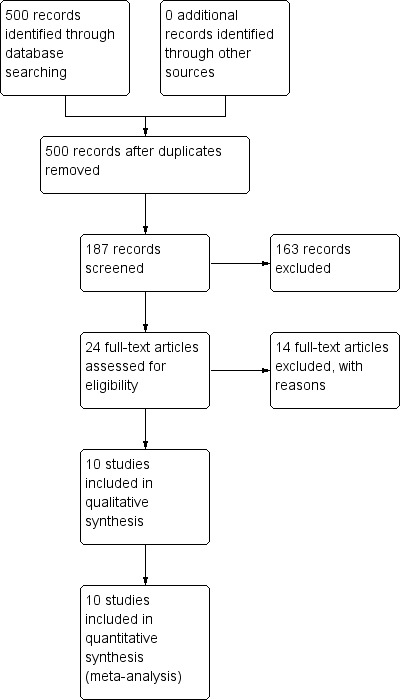
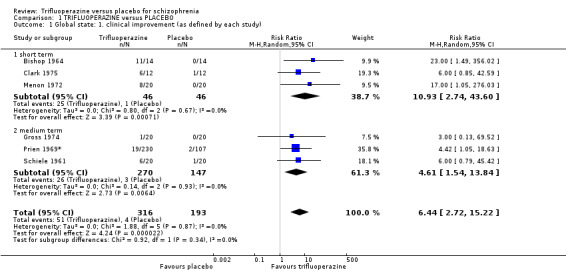
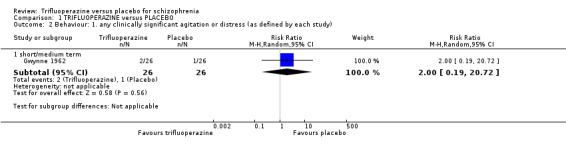
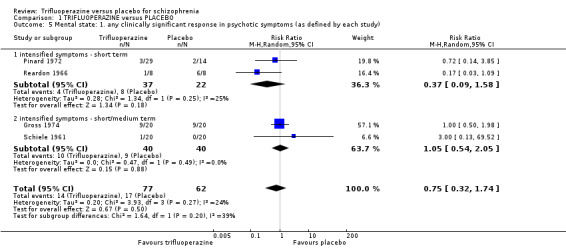
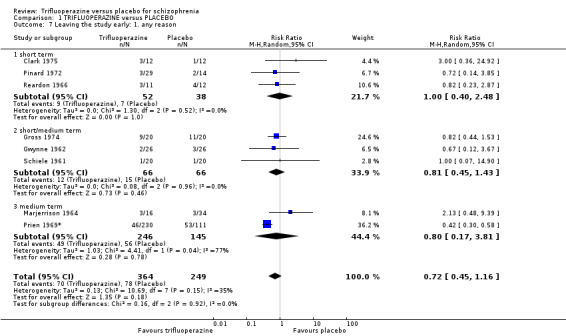
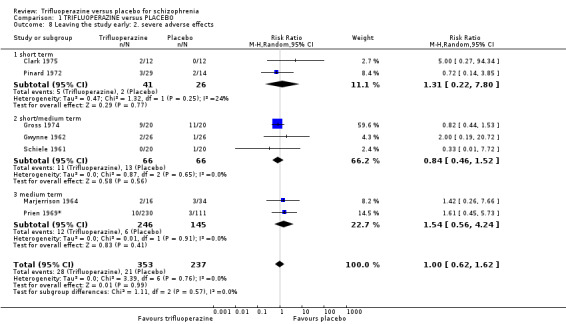
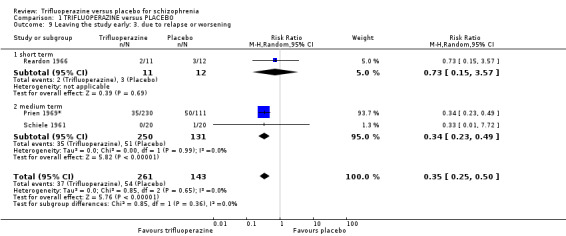
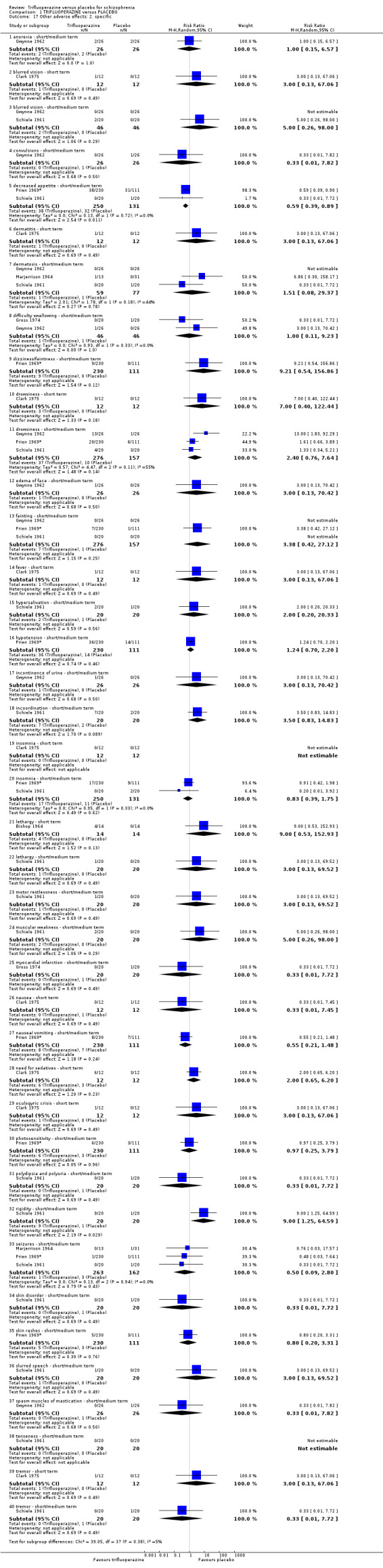
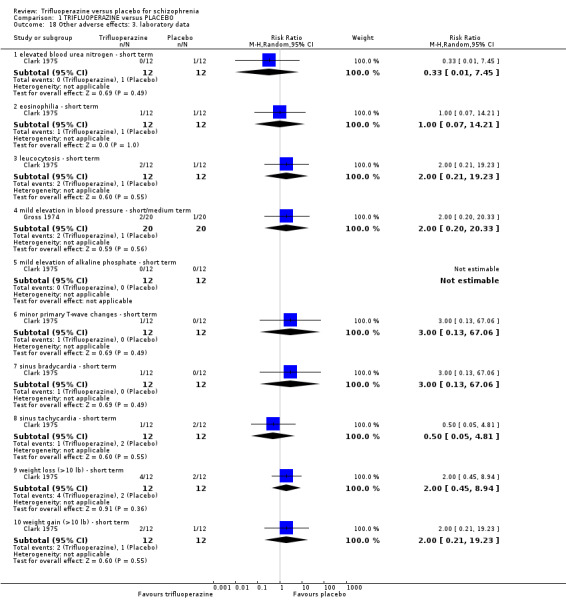
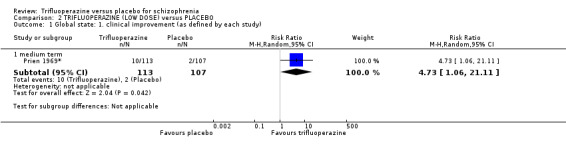
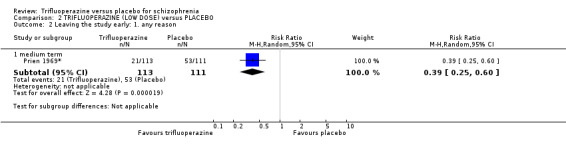
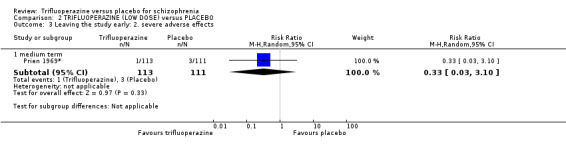
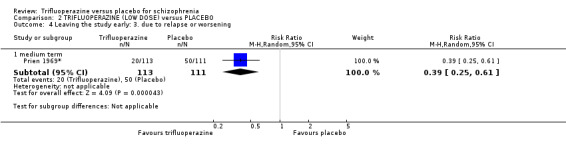
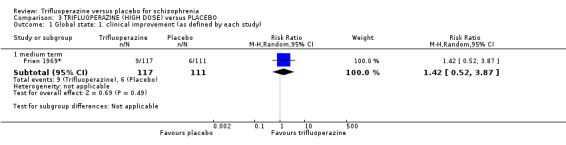
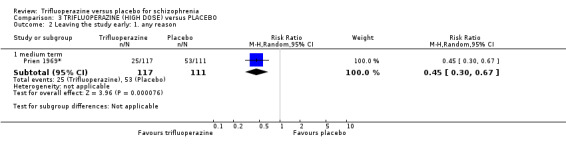
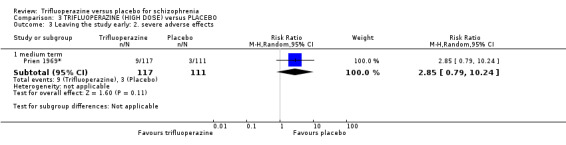
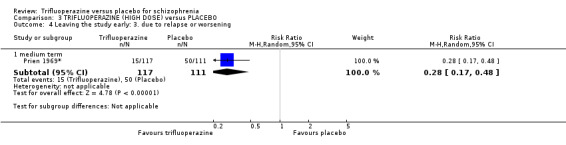
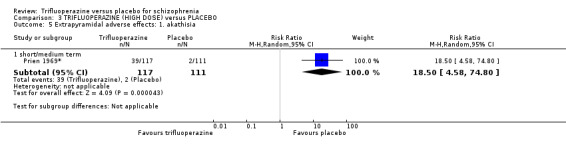
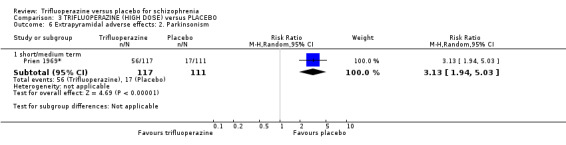
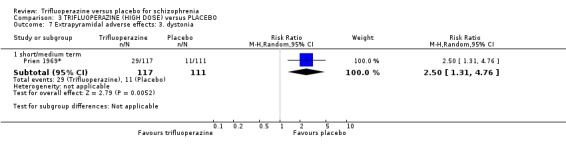
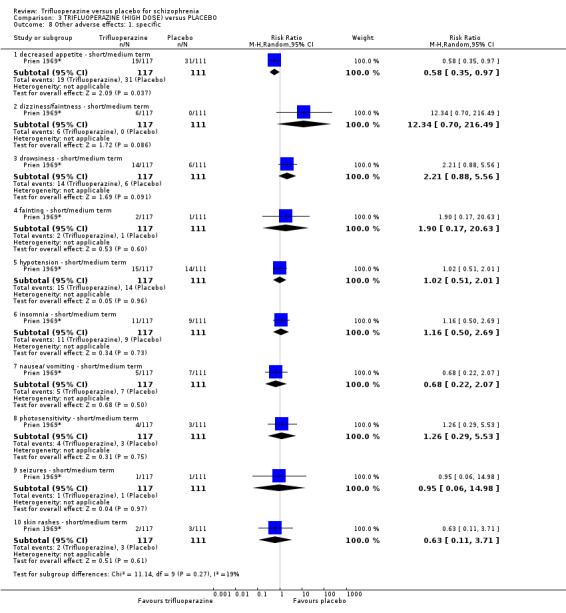
Main results: This review included 10 studies with a total number of 686 participants featuring in 20 different outcomes of interest. Overall, there was significant clinical improvement in clinical global state at medium term amongst people receiving trifluoperazine (3 RCTs, n = 417, RR 4.61, CI 1.54 to 13.84, low quality evidence) and significantly fewer people receiving trifluoperazine left the studies early due to relapse or worsening at medium term (2 RCTs, n = 381, RR 0.34, CI 0.23 to 0.49, low quality evidence). However, results were equivocal for leaving the study early at medium term for any reason (2 RCTs, n = 391, RR 0.80, CI 0.17 to 3.81, very low quality evidence) and due to severe adverse effects (2 RCTs, n = 391, RR 1.54, CI 0.56 to 4.24, very low quality evidence). Equivocal data were also found for intensified symptoms at medium term (2 RCTs, n = 80, RR 1.05, CI 0.54 to 2.05, very low quality evidence) and rates of agitation or distress again at medium term (1 RCT, n = 52, RR 2.00, CI 0.19 to 20.72, very low quality evidence). Comparison between low and high-dose trifluoperazine with placebo from a single study provided equivocal evidence of effects. For economic outcomes, we valued outcomes in GBP terms and presented them in additional tables; there was an estimated saving of £3488.3 in favour of trifluoperazine. However, numerous assumptions were made and these savings need to be interpreted in light of those assumptions.
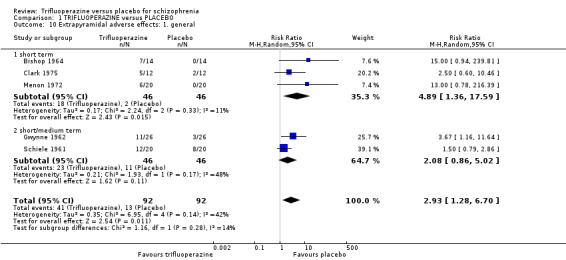
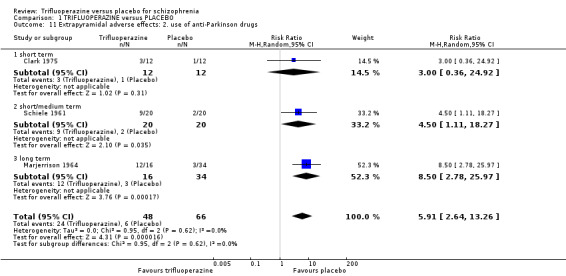
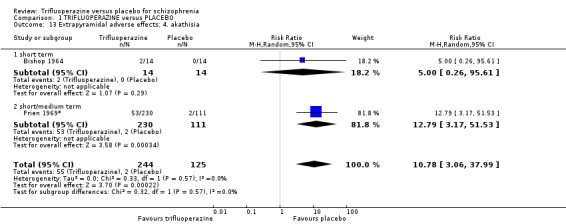
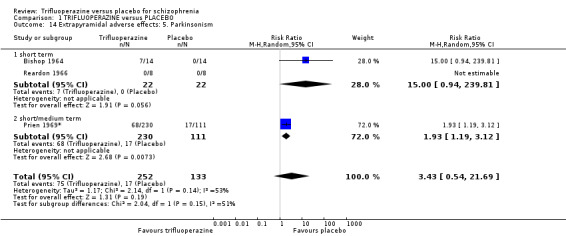
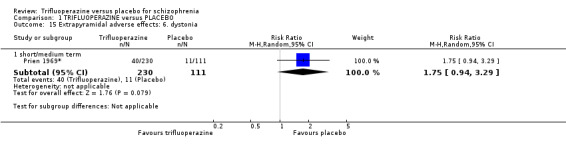
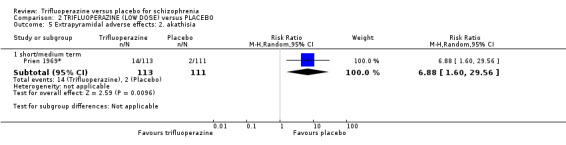
Authors' conclusions: Our results agree with existing evidence that compared to placebo, trifluoperazine is an effective antipsychotic for people with schizophrenia. Furthermore, our review provides supportive evidence that trifluoperazine increases the risk of extrapyramidal adverse effects. Although the effect sizes against placebo are similar to those observed with other agents, they are based on data from many small, pre-CONSORT trials with generally either a low or very low GRADE evidence that has limited implication for clinical practice. Large, independent trials are needed that adhere to the CONSORT statement to compare trifluoperazine with placebo used in the treatment of schizophrenia and schizophrenia-like illnesses.
Conflict of interest statement
Kai Koch ‐ none. Kamel Mansi ‐ none. Euan Haynes ‐ none. Clive E Adams ‐ none. Stephanie Sampson ‐ none. Vivek Furtado ‐ none.
Figures
Update of
References
References to studies included in this review
Bishop 1964 {published data only}
-
- Bishop MP, Gallant DM, Nesselhof W, Sprehe DJ. A controlled evaluation of butaperazine in chronic schizophrenic patients. Diseases of the Nervous System 1964;25:674‐83. - PubMed
Clark 1975 {published data only}
-
- Clark ML, Paredes A, Costiloe JP, Wood F, Barrett A. Loxapine in newly admitted chronic schizophrenic patients. Journal of Clinical Pharmacology 1975;15(4 Pt 1):286‐94. [MEDLINE: ] - PubMed
Gross 1974 {published data only}
-
- Gross HS. A double‐blind comparison of once‐a‐day pimozide, trifluoperazine, and placebo in the maintenance care of chronic schizophrenic outpatients. Current Therapeutic Research, Clinical and Experimental 1974;16(7):696‐705. - PubMed
Gwynne 1962 {published data only}
-
- Gwynne P, Hundziak M, Kavtschitsch J, Lefton M, Pasamanick B. Efficacy of trifluoperazine on withdrawal in chronic schizophrenia. Journal of Nervous and Mental Disease 1962;134:451‐5. [MEDLINE: ] - PubMed
Marjerrison 1964 {published data only}
-
- Marjerrison G, Irvine D, Stewart CN, Williams R, Matheu H, Demay M. Withdrawal of long term phenothiazines from chronically hospitalized psychiatric patients. Canadian Psychiatric Association Journal 1964;60:290‐8. - PubMed
Menon 1972 {published data only}
-
- Menon MS, Ramachandran V. A controlled clinical trial of trifluperidol on a group of chronic schizophrenic patients. Current Therapeutic Research 1972;14(1 January):17‐21. - PubMed
Pinard 1972 {published data only}
-
- Pinard G, Prenoveau Y, Fliesen W, Elie R, Bielmann P, Lamontagne Y, et al. Pimozide and social rehabilitation of chronic schizophrenic patients [Le Pimozide et la reintegration sociale des schizophrenes chroniques]. L'Encephale 1972;61(1):53‐66. [MEDLINE: ] - PubMed
Prien 1969* {published data only}
-
- Prien RF, Levine J, Cole JO. High dose trifluoperazine therapy in chronic schizophrenia. American Journal of Psychiatry 1969;126(3):305‐13. [MEDLINE: ] - PubMed
Reardon 1966 {published data only}
-
- Reardon JD, Abrams S. Acute paranoid schizophrenia (treatment with chlorpromazine, trifluoperazine and placebo). Diseases of the Nervous System 1966;27:265‐70. - PubMed
Schiele 1961 {published data only}
-
- Schiele BC, Vestre ND, Stein KE. A comparison of thioridazine, trifluoperazine, chlorpromazine, and placebo: a double‐blind controlled study on the treatment of chronic hospitalized, schizophrenic patients. Journal of Clinical and Experimental Psychopathology 1961;22(3):151‐62. [MEDLINE: ] - PubMed
References to studies excluded from this review
Abuzzahab 1977 {published data only}
-
- Abuzzahab FS. The treatment of schizophrenia with long‐acting oral neuroleptics: a six‐month double‐blind investigation of penfluridol versus trifluoperazine. Psychopharmacology Bulletin 1977;13(3):26‐7. [MEDLINE: ] - PubMed
Barron 1961 {published data only}
-
- Barron A, Beckering B, Rudy LH, Smith JA. A "double‐blind" study comparing RO 4‐0403, trifluoperazine and a placebo in chronically ill mental patients. American Journal of Psychiatry 1961;118:347‐8.
Cahan 1960 {published data only}
-
- Cahan RB. Efficacy of trifluoperazine in chronic mental illness. American Journal of Psychiatry 1960;116:838. - PubMed
Coons 1962 {published data only}
-
- Coons WH, Boyd BA, White JG. Chlorpromazine, trifluoperazine and placebo with long term mental hospital patients. Canadian Psychiatric Association Journal 1962;7:159‐63. - PubMed
Hamilton 1963 {published data only}
-
- Hamilton M, Hordern A, Waldrop FN, Lofft J. A controlled trial on the value of prochlorperazine, trifluoperazine and intensive group treatment. British Journal of Psychiatry 1963;109:510‐22. - PubMed
Holden 1971 {published data only}
-
- Holden J, Itil T, Gannon P, Keskiner A. The clinical effects of intramuscular thiothixene and trifluoperazine in chronic schizophrenia: a comparative study. Current Therapeutic Research, Clinical and Experimental 1971;13(5):298‐310. [MEDLINE: ] - PubMed
Hunt 1967 {published data only}
-
- Hunt PV. A comparison of the effects of oxypertine and trifluoperazine in withdrawn schizophrenics. British Journal of Psychiatry 1967;113(505):1419‐24. [MEDLINE: ] - PubMed
Leff 1971 {published data only}
Leff 1973 {published data only}
Madgwick 1958 {published data only}
-
- Madgwick JRA, McNeill DLM, Driver M, Preston GC. Stelazine (trifluoperazine). A preliminary report on a clinical trial. Journal of Mental Science 1958;104:1195‐8. - PubMed
Morton 1968 {published data only}
-
- Morton MR. A study of the withdrawal of chlorpromazine or trifluoperazine in chronic schizophrenia. American Journal of Psychiatry 1968;124(11):1585‐8. [MEDLINE: ] - PubMed
Stanley 1961 {published data only}
-
- Stanley WJ, Walton D. Trifluoperazine (stelazine). A controlled clinical trial in chronic schizophrenia. Journal of Mental Science 1961;107:250‐7.
Weckowicz 1960 {published data only}
-
- Weckowicz TE, Ward TF. Clinical trial of 'stelazine' on apathetic chronic schizophrenics. Journal of Mental Science 1960;106:1008‐15. - PubMed
Weston 1961 {published data only}
-
- Weston FK, Loftus AP. A terminal double‐blind trial of tri‐fluoperazine ("stelazine") in chronic schizophrenia. Medical Journal of Australia 1961;48(1):776‐80. [MEDLINE: ] - PubMed
References to studies awaiting assessment
Ortega‐Soto 1996 {published data only}
-
- Ortega‐Soto HA, Brunner E, Apiquian R, Torre MP, Ulloa RE. Typical antipsychotics: the threshold doses strategy. Proceedings of the 20th Collegium Internationale Neuro‐Psychopharmacologicum Congress; 1996 Jun 23‐27; Melbourne, Australia. 1996.
Additional references
Altman 1996
Arana 2000
-
- Arana G, Rosenbaum J. Handbook of Psychiatric Drug Therapy. USA. 4. Philadelphia: Lippincott Williams and Wilkins, 2000.
Bartko 1988
-
- Bartko G, Herczeg I, Zador G. Clinical symptomatology and drug compliance in schizophrenic patients. Acta Psychiatrica Scandinavica 1988;77(1):74‐6. - PubMed
Bazire 2000
-
- Bazire. Psychotropic Drug Directory. USA. New York: Butler and Tanner Limited, 2000.
Bland 1997
BNF 2012
-
- BMJ Group and Pharmaceautical Press. British National Formulary No. 63. Antipsychotic drugs. BNF 2012.
Boissel 1999
-
- Boissel JP, Cucherat M, Li W, Chatellier G, Gueyffier F, Buyse M, et al. The problem of therapeutic efficacy indices. 3. Comparison of the indices and their use [Apercu sur la problematique des indices d'efficacite therapeutique, 3: comparaison des indices et utilisation. Groupe d'Etude des Indices D'efficacite]. Therapie 1999;54(4):405‐11. [PUBMED: 10667106] - PubMed
CEA
-
- Cost‐Effectiveness Analysis Registry (CEA). https://research.tufts‐nemc.org/cear4/ accessed 11/09/13.
Davies 2007
-
- Davies LM, Lewis S, Jones PB, Barnes TR, Gaughran F, Hayhurst K, et al. Cost‐effectiveness of first‐ v. second‐generation antipsychotic drugs: results from a randomised controlled trial in schizophrenia responding poorly to previous therapy. British Journal of Psychiatry 2007;191:14‐22. - PubMed
Deeks 2000
-
- Deeks J. Issues in the selection for meta‐analyses of binary data. Proceedings of the 8th International Cochrane Colloquium; 2000 Oct 25‐28; Cape Town. Cape Town: The Cochrane Collaboration, 2000.
Divine 1992
-
- Divine GW, Brown JT, Frazier LM. The unit of analysis error in studies about physicians' patient care behavior. Journal of General Internal Medicine 1992;7(6):623‐9. - PubMed
Donner 2002
-
- Donner A, Klar N. Issues in the meta‐analysis of cluster randomized trials. Statistics in Medicine 2002;21:2971‐80. - PubMed
Drummond 1996
Egger 1997
Elbourne 2002
-
- Elbourne D, Altman DG, Higgins JPT, Curtina F, Worthingtond HV, Vaile A. Meta‐analyses involving cross‐over trials: methodological issues. International Journal of Epidemiology 2002;31(1):140‐9. - PubMed
Evers 2005
-
- Evers S, Goossens M, Vet H, Tulder M, Ament A. Criteria list for assessment of methodological quality of economic evaluations: Consensus on Health Economic Criteria. International Journal of Technology Assessment in Health Care 2005;21(2 Spring):240‐5. - PubMed
Farina 1957
-
- Farina A, David A, Guskin S. A scale for measuring minimal social behaviour. Journal of Consultant Psychology 1957;21:265‐8. - PubMed
Filippelli 2005
-
- Filippelli E, Biricolti G, Scarano C, Russo F, Luciano L. Treatment of psychotic disorders with olanzapine, risperidone and typical neuroleptics: a comparative cost‐effectiveness evaluation in a local psychiatric setting. Farmeconomia e Percorsi Terapeutici 2005;6(3):161‐8.
Furukawa 2006
-
- Furukawa TA, Barbui C, Cipriani A, Brambilla P, Watanabe N. Imputing missing standard deviations in meta‐analyses can provide accurate results. Journal of Clinical Epidemiology 2006;59(7):7‐10. - PubMed
Galvin 1999
-
- Galvin PM, Knezek LD, Rush AJ, Toprac MG, Johnson B. Clinical and economic impact of newer versus older antipsychotic medications in a community mental health center. Clinical Therapeutics 1999;21(6):1105‐16. - PubMed
Ghaemi 2001
-
- Ghaemi SN, Kirkwood CK, Sambur MR, Ko JY, Howden KL, Duong Q, et al. Economic outcomes of risperidone in comparison to typical neuroleptic agents for treatment‐resistant psychosis: a community‐based study. Journal of Pharmacy Technology 2001;17:273‐8.
Goodrich 1953
-
- Goodrich DW. Quantification of the severity of overt psychotic symptoms. American Journal of Psychiatry 1953;110:334‐41. - PubMed
Gulliford 1999
-
- Gulliford MC. Components of variance and intraclass correlations for the design of community‐based surveys and intervention studies: data from the Health Survey for England 1994. American Journal of Epidemiology 1999;149:876‐83. - PubMed
Guy 1970
-
- Guy W, Bonato RR. Clinical Global Impressions. In: Guy W, Bonato RR editor(s). Manual for the ECDEU Assessment Battery. 2 Rev. National Institute of Mental Health, 1970:12‐1‐12‐6.
Hanrahan 2006
-
- Hanrahan P, Luchins DJ, Fabian R, Tolley G. Cost‐effectiveness of atypical antipsychotic medications versus conventional medication. Expert Opinion in Pharmacotherapy 2006;7(13):1749‐58. - PubMed
Hathaway 1940
-
- Hathaway SR, McKinley JC. A multiphasic personality schedule (Minnesota): I. Construction of the schedule. Journal of Psychology 1940;10:249‐54.
HEED
-
- Health Economic Evaluation Database (HEED). Online ISBN: 9780470510933. [DOI: 10.1002/9780470510933] - DOI
HES 2012
-
- Hospital Episode Statistics, Admitted Patient Care ‐ England 2011‐12: Main Specialties (.xls). http://www.hscic.gov.uk/searchcatalogue?productid=9161&q=title%3a%22... (accessed May 2013) 2011‐12.
Higgins 2003
Higgins 2011
-
- Higgins JPT, Green S (editors). Cochrane Handbook for Systematic Reviews of Interventions Version 5.0.2 [updated September 2011]. The Cochrane Collaboration, 2011. Available from www.cochrane‐handbook.org.
Kaplan 1998
-
- Kaplan H, Sadock B. Pocket Handbook of Clinical Psychiatry. USA. 2. New York: Williams and Wilkins, 1998.
Kay 1986
-
- Kay SR, Opler LA, Fiszbein A. Positive and Negative Syndrome Scale (PANSS) Manual. North Tonawanda, NY: Multi‐Health Systems, 1986.
Knapp 2008
-
- Knapp M, Windmeijer F, Brown J, Kontodimas S, Tzivelekis S, Haro JM, et al. Cost‐utility analysis of treatment with olanzapine compared with other antipsychotic treatments in patients with schizophrenia in the pan‐European SOHO study. PharmacoEconomics 2008;26(4):341‐58. - PubMed
Lankappa 2012
-
- Lankappa S, Gandhi R. Quetiapine versus placebo for schizophrenia. Cochrane Database of Systematic Reviews 2012, Issue 7. [DOI: 10.1002/14651858.CD009935] - DOI
Leucht 2003
-
- Leucht S, Wahlbeck K, Hamann J, Kissling W. New generation antipsychotics versus low‐potency conventional antipsychotics: a systematic review and meta‐analysis. Lancet 2003;361(May 10):1581‐9. - PubMed
Leucht 2005
-
- Leucht S, Kane JM, Kissling W, Hamann J, Etschel E, Engel RR. What does the PANSS mean?. Schizophrenia Research 2005;79(2‐3):231‐8. [PUBMED: 15982856] - PubMed
Leucht 2005a
-
- Leucht S, Kane JM, Kissling W, Hamann J, Etschel E, Engel R. Clinical implications of brief psychiatric rating scale scores. British Journal of Psychiatry 2005;187:366‐71. [PUBMED: 16199797] - PubMed
Leucht 2007
Lewis 1998
-
- Lewis R. Typical and atypical antipsychotics in adolescent schizophrenia: efficacy, tolerability, and differential sensitivity to extrapyramidal symptoms. Canadian Journal of Psychiatry 1998;43(6):596‐604. - PubMed
Lewis 2006
-
- Lewis SW, Davies L, Jones PB, Barnes TRE, Murray RM, Kerwin R, et al. Randomised controlled trials of conventional antipsychotic versus new atypical drugs, and new atypical drugs versus clozapine, in people with schizophrenia responding poorly to, or intolerant of, current drug treatment. Health Technology Assessment 2006;10(17):1‐182. - PubMed
Lorr 1960
-
- Lorr MO, O'Connor JP, Stafford JW. The psychotic reaction profile. Journal of Clinical Psychology 1960;16:241‐5. - PubMed
Mangalore 2007
-
- Mangalore R, Knapp M. Cost of schizophrenia in England. Journal of Mental Health Policy and Economics 2007;10(1):23‐41. - PubMed
Marshall 2000
-
- Marshall M, Lockwood A, Bradley C, Adams C, Joy C, Fenton M. Unpublished rating scales: a major source of bias in randomised controlled trials of treatments for schizophrenia. British Journal of Psychiatry 2000;176:249‐52. - PubMed
Martin 2006
-
- Martin JL, Perez V, Sacristan M, Rodriguez‐Artalejo F, Martinez C, Alvarez E. Meta‐analysis of drop‐out rates in randomised clinical trials, comparing typical and atypical antipsychotics in the treatment of schizophrenia. European Psychiatry 2006;21(1):11‐20. - PubMed
Mendelsohn 1959
-
- Mendelsohn RM, Penman AS, Schiele BC. Massive chlorpromazine therapy: the nature of behavioural changes. Psychiatric Quarterly 1959;33(Jan):1‐22. - PubMed
Mental Health Care
-
- Mental Health Care: reliable and up‐to‐date information about psychosis for family members and friends. http://www.mentalhealthcare.org.uk/pharmacist_answers_september_august_2011 accessed September 2013.
Moher 2001
-
- Moher D, Schulz KF, Altman D. The CONSORT statement: revised recommendations for improving the quality of reports of parallel‐group randomized trials. JAMA 2001;285(12):1987‐91. - PubMed
Mould 2009
-
- Mould QJ, Contreras HI, Verduzco W, Mejia AJM, Garduno EJ. Cost‐effectiveness simulation analysis of schizophrenia at the Instituto Mexicano del Seguro Social: Assessment of typical and atypical antipsychotics. Revista de Psiquiatrí́a y Salud Mental 2009;2(3):108‐18. - PubMed
NICE 2010
-
- NICE. Schizophrenia: Core interventions in the treatment and management in adults in primary and secondary care ‐ National Clinical Guideline Number 82. http://www.nice.org.uk/nicemedia/pdf/CG82FullGuideline.pdf. The British Psychological Society and The Royal College of Psychiatrists, 2010:4‐41.
Overall 1962
-
- Overall JE, Gorham DR. The brief psychiatric rating scale. Psychological Reports 1962;10:799‐812.
PJ Online
-
- PJ Online: Do you accept that medicine shortages have not harmed patients?. http://www.pjonline.com/poll/do_you_accept_that_medicine_shortages_have_... Accessed September 2013.
PSSRU 2012
-
- Compiled by Lesley Curtis. Unit costs of health and social care 2012. http://www.pssru.ac.uk/project‐pages/unit‐costs/2012/ (accessed May 2013) 2012:47.
RCPSYCH 2009
-
- Royal College of Psychiatrists. Antipsychotics. RCPSYCH 2009.
RCPSYCH 2010
-
- Royal College of Psychiatrists. Schizophrenia. RCPSYCH 2010.
RCPSYCH 2011
-
- Royal College of Psychiatrists. Schizophrenia. RCPSYCH 2011.
Saha 2005
Saha 2007
Schünemann 2008
-
- Schünemann HJ, Oxman AD, Vist GE, Higgins JPT, Deeks JJ, Glasziou P, et al. Chapter 12: Interpreting results and drawing conclusions. In: Higgins JPT, Green S editor(s). Cochrane Handbook for Systematic Reviews of Interventions. The Cochrane Collaboration, 2008:359‐83.
Stargardt 2008
-
- Stargardt T, Weinbrenner S, Busse R, Juckel G, Gericke CA. Effectiveness and cost of atypical versus typical antipsychotic treatment for schizophrenia in routine care. Journal of Mental Health Policy and Economics 2008;11(2):89‐97. - PubMed
Suttajit 2009
Tiihonen 2009
-
- Tiihonen J, Lonnqvist J, Wahlbeck K, Klaukka T, Niskanen L, Tanskanen A, et al. 11‐year follow‐up of mortality in patients with schizophrenia: a population‐based cohort study (FIN11 study). Lancet 2009;374(9690):620‐7. - PubMed
Turner 2007
-
- Turner T. Chlorpromazine: unlocking psychosis. BMJ 2007;334(Suppl 1):s7. - PubMed
Ukoumunne 1999
-
- Ukoumunne OC, Gulliford MC, Chinn S, Sterne JAC, Burney PGJ. Methods for evaluating area‐wide and organistation‐based intervention in health and health care: a systematic review. Health Technology Assessment 1999;3(5):1‐75. - PubMed
Williams 1987
-
- Williams, A (editor). Health economics: the cheerful face of dismal science?. Health and economics. London (UK): Macmillan, 1987.
Wing 1961
-
- Wing JK. A simple and reliable subclassification of chronic schizophrenia. Journal of Mental Science 1961;107:862‐75. - PubMed
Xia 2009
-
- Xia J, Adams CE, Bhagat N, Bhagat V, Bhoopathi P, El‐Sayeh H, et al. Loss to outcomes stakeholder survey: the LOSS study. Psychiatric Bulletin 2009;33(7):254‐7.
Publication types
MeSH terms
Substances
Grants and funding
LinkOut - more resources
Full Text Sources
Other Literature Sources
Medical
Research Materials
Miscellaneous
