


Family Sponsorship and Late-Age Immigration in Aging America: Revised and Expanded Estimates of Chained Migration
- PMID: 24415816
- PMCID: PMC3884518
- DOI: 10.1007/s11113-013-9300-y
Family Sponsorship and Late-Age Immigration in Aging America: Revised and Expanded Estimates of Chained Migration
Abstract
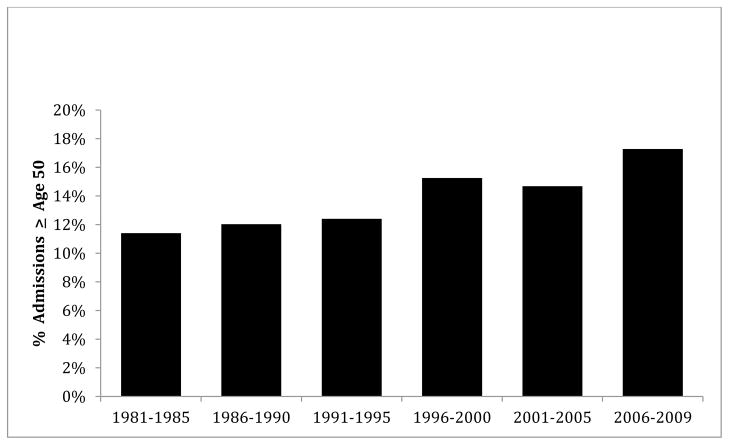
We use the Immigrants Admitted to the United States (micro-data) supplemented with special tabulations from the Department of Homeland Security to examine how family reunification impacts the age composition of new immigrant cohorts since 1980. We develop a family migration multiplier measure for the period 1981 to 2009 that improves on prior studies by including immigrants granted legal status under the 1986 Immigration Reform and Control Act and relaxing unrealistic assumptions required by synthetic cohort measures. Results show that every 100 initiating immigrants admitted between 1981-85 sponsored an average of 260 family members; the comparable figure for initiating immigrants for the 1996-2000 cohort is 345 family members. Furthermore, the number of family migrants ages 50 and over rose from 44 to 74 per 100 initiating migrants. The discussion considers the health and welfare implications of late-age immigration in a climate of growing fiscal restraint and an aging native population.
Keywords: Chain migration; age at admission; family sponsored immigrants; immigration multiplier.
Figures

References
-
- Ambegaokar Sonal, Blazer Jon. Overcoming Barriers Immigrants Face in Accessing Health Care and Benefits. National Immigration Law Center; 2011. Retrieved at http://nilcorg/search.html.
-
- Angel Jacqueline L. Devolution and the Social Welfare of Elderly Immigrants: Who Will Bear the Burden? Public Administration Review. 2003;63(1):79–89.
-
- Angel Ronald J, Angel Jacqueline L, Lee Geum-Yong, Markides Kyriakos S. Age at migration and family dependency among older Mexican immigrants: recent evidence from the Mexican American EPESE. The Gerontologist. 1999;39(1):59–65. - PubMed
-
- Angel Jacqueline L, Angel Ronald J, Markides Kyriakos S. Late-life immigration, changes in living arrangements, and headship status among older Mexican-origin individuals. Social Science Quarterly. 2000;81(1):389–403.
-
- Arnold Fred, Cariño Benjamin V, Fawcett James T, Park Insook Han. Estimating the immigration multiplier: An analysis of recent Korean and Filipino immigration to the United States. International Migration Review. 1989;23(4):813–838. - PubMed
Grants and funding
LinkOut - more resources
Full Text Sources
Other Literature Sources