Review
. 2014 Jan 7;20(1):6-21.
doi: 10.3748/wjg.v20.i1.6.

Immunopathology of inflammatory bowel disease

Affiliations
Review

Immunopathology of inflammatory bowel disease

Kori L Wallace et al. World J Gastroenterol. .

Abstract

Inflammatory bowel disease (IBD) results from a complex series of interactions between susceptibility genes, the environment, and the immune system. The host microbiome, as well as viruses and fungi, play important roles in the development of IBD either by causing inflammation directly or indirectly through an altered immune system. New technologies have allowed researchers to be able to quantify the various components of the microbiome, which will allow for future developments in the etiology of IBD. Various components of the mucosal immune system are implicated in the pathogenesis of IBD and include intestinal epithelial cells, innate lymphoid cells, cells of the innate (macrophages/monocytes, neutrophils, and dendritic cells) and adaptive (T-cells and B-cells) immune system, and their secreted mediators (cytokines and chemokines). Either a mucosal susceptibility or defect in sampling of gut luminal antigen, possibly through the process of autophagy, leads to activation of innate immune response that may be mediated by enhanced toll-like receptor activity. The antigen presenting cells then mediate the differentiation of naïve T-cells into effector T helper (Th) cells, including Th1, Th2, and Th17, which alter gut homeostasis and lead to IBD. In this review, the effects of these components in the immunopathogenesis of IBD will be discussed.

Keywords: Adaptive immune system; Autophagy; Crohn’s disease; Inflammatory bowel disease; Innate immune system; Innate lymphoid cells; Microbiome; T helper 17; TL1A; Ulcerative colitis.


Figures
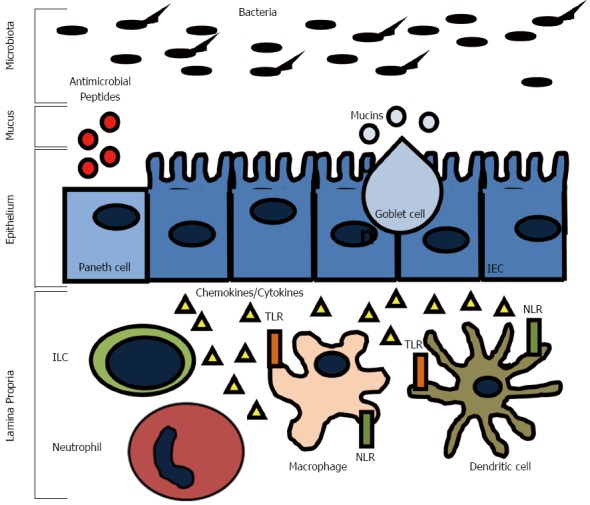
Figure 1
Figure 1
Innate immune system responses in the gut. The intestinal epithelial barrier is equipped with several layers of defense mechanisms to limit luminal antigen translocation. Goblet cells, Paneth cells, and enterocytes secrete mucins and antimicrobial peptides that assemble into a mucus layer. Innate immune system cells, such as macrophages and dendritic cells, can sense invading bacteria through extracellular and intracellular pattern recognition receptors (Toll-like receptors-TRLs and NOD-like receptors-NLRs) and initiate rapid inflammatory reponses mediated by the secretion of cytokines and chemokines. Innate lymphoid cells (ILCs) are also found in the lamina propria where they contribute to cytokine production and inflammatory cell recruitment.
Figure 2
Figure 2
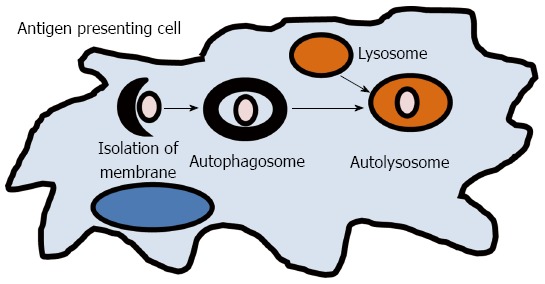
Autophagy. A small volume of cytoplasm is enclosed by the autophagic isolation membrane, which forms the autophagosome. The outer membrane of the autophagosome then fuses with the lysosome where the cytoplasm derived materials are degraded.
Figure 3
Figure 3
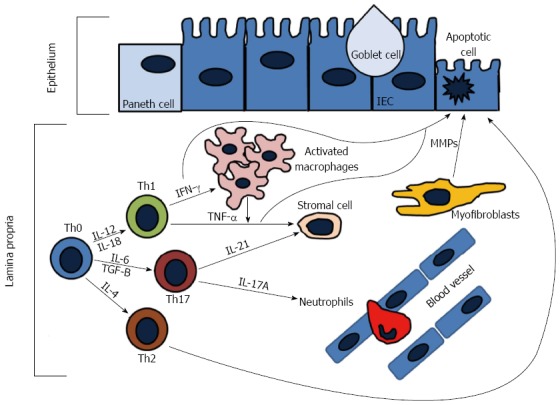
Adaptive immune responses in the gut. During active inflammation, naïve T-cells (Th0) differentiate into T helper cell types (Th1, Th2, Th17) under stimulation of different cytokines. Th1 cells produce interferon (IFN)-γ and tumor necrosis factor (TNF)-α. IFN-γ activated tissue macrophages to produce additional TNF-α, which causes epithelial cell apoptosis and differentiation of stromal cells into myofibroblasts. Activated myofibroblasts produce metalloproteinases (MMPs) that cause tissue degredation. Th2 cells produce interleukin (IL)-13 that can increase intestinal permeability and induce epithelial apoptosis. Th17 cells release IL-17A, which plays a role in recruiting neutrophils to sites of active inflammation, and IL-21 that also induces MMP production that contributes to extracellular matrix degredation.
Figure 4
Figure 4
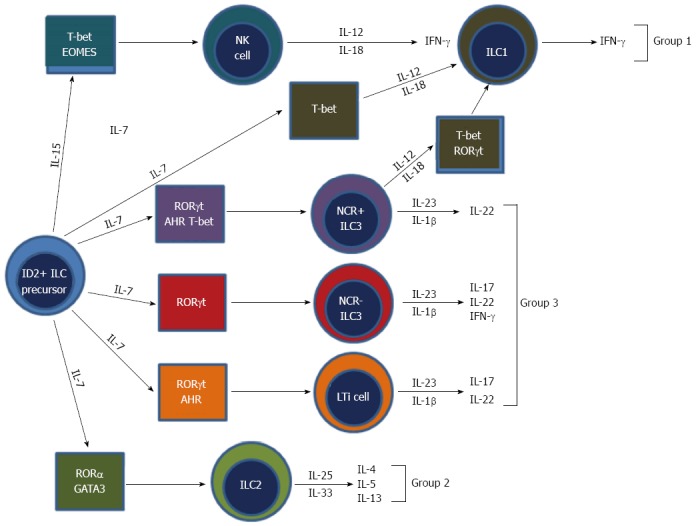
Development and classification of innate lymphoid cells[82]. Innate lymphoid cells (ILCs) all derive from an ID2 positive progenitor cell. Group 1 ILCs make interferon (IFN)-γ. Group 2 ILCs produce IL-5 and interleukin (IL)-13. Group 3 ILCs produce IL-17, IL-22, and IFN-γ. NK require IL-15, whereas all other ILCs require IL-7 for development. Group 2 ILCs depend on transcription factors GATA3 and ROR for development. Group 3 ILCs require RORt for development. Also, subsets of group 3 ILCs require additional transcription factors, such as aryl hydrocarbon receptor (AHR) for development. NK cells, which are group 1 ILCs, require both T-bet and eomesodermin (EOMES). The mechanisms of ILC1 development are not fully elucidated, however are known to require transcription factor T-bet for development.

References

    1. Lakatos PL. Recent trends in the epidemiology of inflammatory bowel diseases: up or down? World J Gastroenterol. 2006;12:6102–6108. - PMC - PubMed
    1. Lichtenstein GR, Hanauer SB, Sandborn WJ. Management of Crohn’s disease in adults. Am J Gastroenterol. 2009;104:465–83; quiz 464, 484. - PubMed
    1. Satsangi J, Silverberg MS, Vermeire S, Colombel JF. The Montreal classification of inflammatory bowel disease: controversies, consensus, and implications. Gut. 2006;55:749–753. - PMC - PubMed
    1. Kornbluth A, Sachar DB. Ulcerative colitis practice guidelines in adults. American College of Gastroenterology, Practice Parameters Committee. Am J Gastroenterol. 1997;92:204–211. - PubMed
    1. Bernstein CN, Wajda A, Blanchard JF. The clustering of other chronic inflammatory diseases in inflammatory bowel disease: a population-based study. Gastroenterology. 2005;129:827–836. - PubMed

Publication types

MeSH terms

Substances