. 2014 Jan 9;8(1):e2642.
doi: 10.1371/journal.pntd.0002642. eCollection 2014.

Predicting the impact of vaccination on the transmission dynamics of typhoid in South Asia: a mathematical modeling study

Affiliations

Predicting the impact of vaccination on the transmission dynamics of typhoid in South Asia: a mathematical modeling study

Virginia E Pitzer et al. PLoS Negl Trop Dis. .

Abstract

Background: Modeling of the transmission dynamics of typhoid allows for an evaluation of the potential direct and indirect effects of vaccination; however, relevant typhoid models rooted in data have rarely been deployed.

Methodology/principal findings: We developed a parsimonious age-structured model describing the natural history and immunity to typhoid infection. The model was fit to data on culture-confirmed cases of typhoid fever presenting to Christian Medical College hospital in Vellore, India from 2000-2012. The model was then used to evaluate the potential impact of school-based vaccination strategies using live oral, Vi-polysaccharide, and Vi-conjugate vaccines. The model was able to reproduce the incidence and age distribution of typhoid cases in Vellore. The basic reproductive number (R 0) of typhoid was estimated to be 2.8 in this setting. Vaccination was predicted to confer substantial indirect protection leading to a decrease in the incidence of typhoid in the short term, but (intuitively) typhoid incidence was predicted to rebound 5-15 years following a one-time campaign.

Conclusions/significance: We found that model predictions for the overall and indirect effects of vaccination depend strongly on the role of chronic carriers in transmission. Carrier transmissibility was tentatively estimated to be low, consistent with recent studies, but was identified as a pivotal area for future research. It is unlikely that typhoid can be eliminated from endemic settings through vaccination alone.


Conflict of interest statement

The authors have declared that no competing interests exist.

Figures
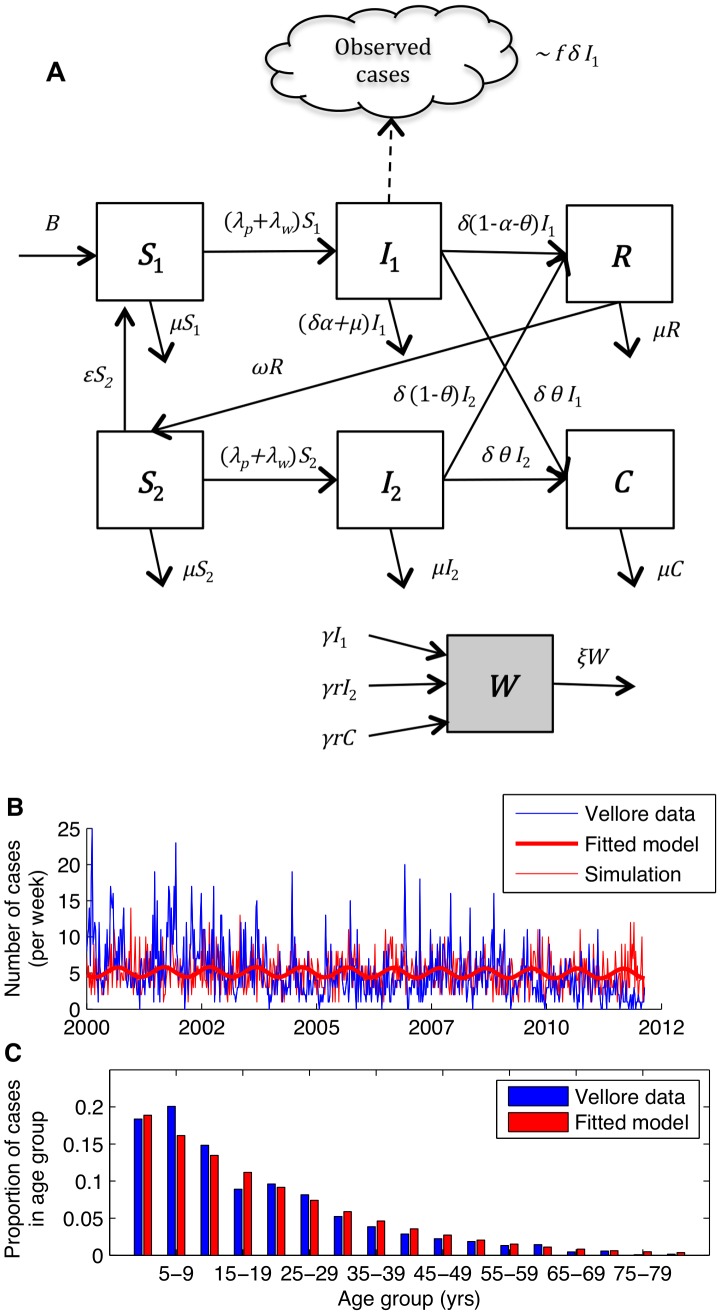
Figure 1
Figure 1. Model for the transmission dynamics of typhoid.
(A) Diagram of model structure. Model parameters are defined in Table 1. (B) Weekly incidence of observed (blue line) and model-predicted (thick red line) typhoid inpatients at Christian Medical College hospital in Vellore, India. The thin red line represents a simulated incidence time-series for the best-fit model assuming the number of cases each week is Poisson distributed with a mean equal to the model-predicted incidence. (C) Age distribution of observed (blue) and model-predicted (red) typhoid cases.
Figure 2
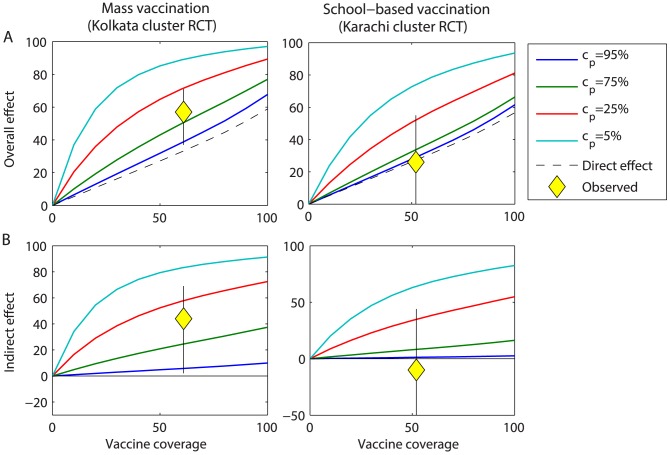
Figure 2. Relationship between the relative infectiousness of chronic carriers and the model-predicted overall and indirect effects of vaccination.
(A) Overall effect and (B) indirect effect of ViPS over two years following vaccine introduction at coverage levels varying from 0 to 100%. The model-predicted vaccine effects over 2 years of follow-up for cp = 5 to 95% are represented by the thick coloured lines, while the population direct effect is represented by the dotted black line. Mass vaccination consisted of a one-time campaign among all individuals ≥2 years of age, while school-based vaccination consisted of a one-time campaign among 2–15 year olds. The overall and indirect effects observed during cluster randomized trials conducted in Kolkata, India and Karachi, Pakistan are plotted in yellow, with the thin black line corresponding to the 95% confidence interval , .
Figure 3
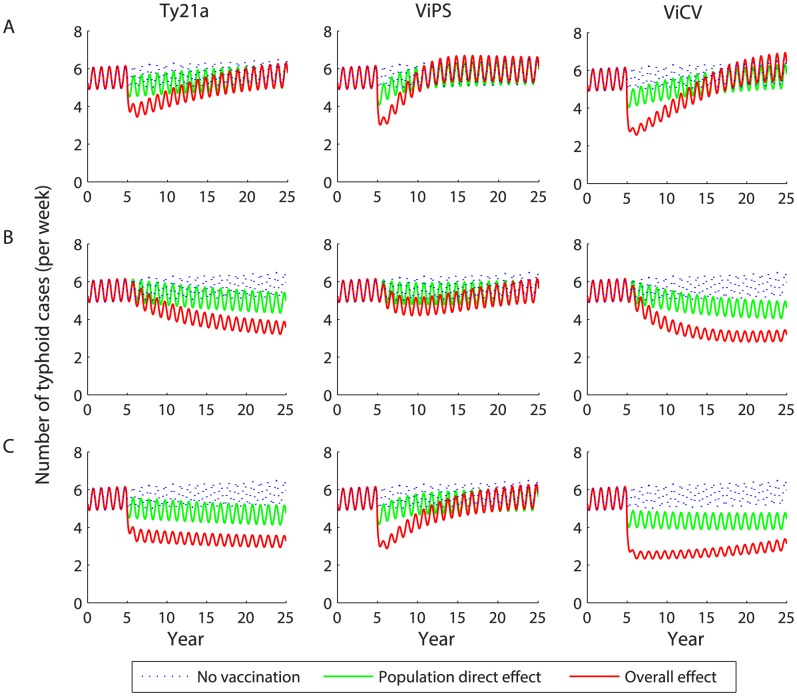
Figure 3. Predicted impact of vaccination on the weekly incidence of typhoid.
Vaccination is introduced in year 5 with 80% coverage as (A) a one-time campaign among 6–15 year olds, (B) routine vaccination of 6 year olds, or (C) routine vaccination of 6 year olds plus a one-time catch-up campaign among 6–15 year olds. The red line represents the model-predicted overall effect of vaccination, while the green line represents the population direct effect of vaccination and the dotted blue line is the projected typhoid incidence in the absence of vaccination.
Figure 4
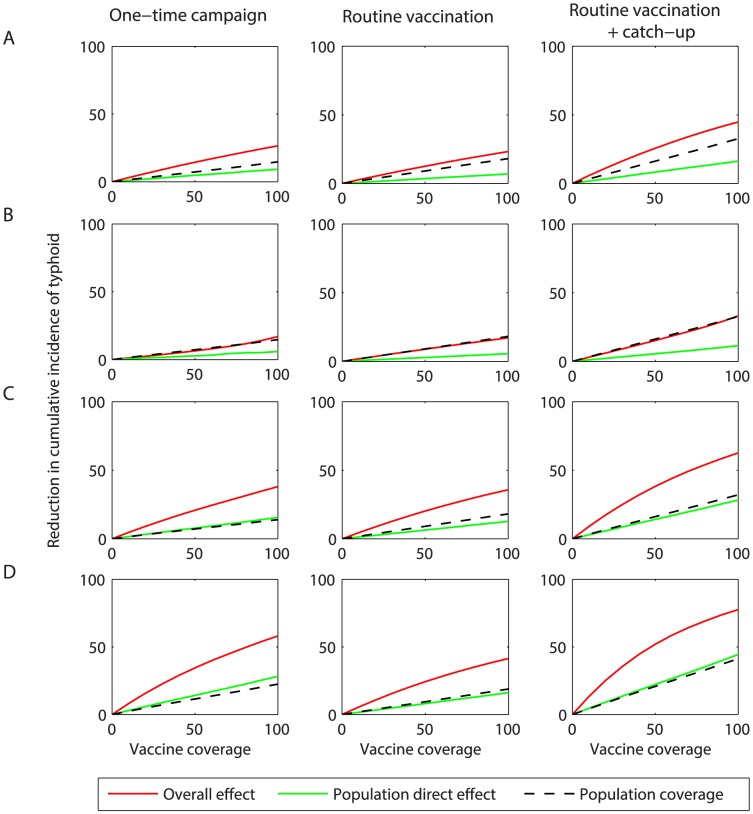
Figure 4. Overall effect of vaccination on the projected incidence of typhoid over the first 10 years following vaccine introduction.
The model-predicted reduction in the cumulative incidence of typhoid at coverage levels ranging from 0 to 100% is plotted for vaccine-induced immunity and efficacy assumptions corresponding to (A) the Ty21a live oral vaccine, (B) the Vi-polysaccharide (ViPS) vaccine, and (C) the Vi-conjugate (ViCV) vaccine administered at 6 years of age or (D) 9 months of age. The red line represents the model-predicted overall effect of vaccination, while the green line represents the population direct effect of vaccination. The dotted black line represents the population coverage (i.e. the proportion of the population ever vaccinated).
Figure 5
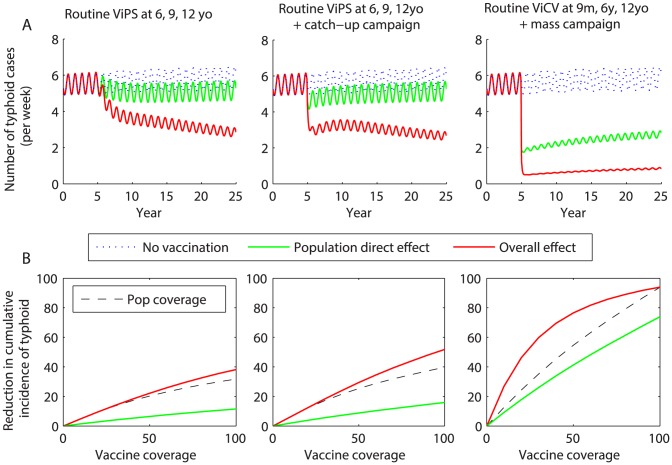
Figure 5. Impact and effectiveness of revaccination with Vi-based vaccines.
Revaccination strategies include routine vaccination with ViPS at 6, 9, and 12 years of age; routine vaccination with ViPS of 6, 9, and 12 year olds plus a one-time catch-up campaign among 6–15 year olds; and routine vaccination with ViCV at 9 months, 6 years, and 12 years of age with a one-time mass vaccination campaign. (A) Impact of vaccination on the projected weekly incidence of typhoid. Vaccination is introduced in year 5 with 80% coverage. The red line represents the model-predicted overall effect of vaccination, while the green line represents the direct effect of vaccination and the dotted blue line is the projected typhoid incidence in the absence of vaccination. (B) The model-predicted reduction in the cumulative incidence of typhoid due to the overall (red line) and population direct (green line) effects of vaccination at coverage levels ranging from 0 to 100%, and the population coverage (black dotted line).
Figure 6
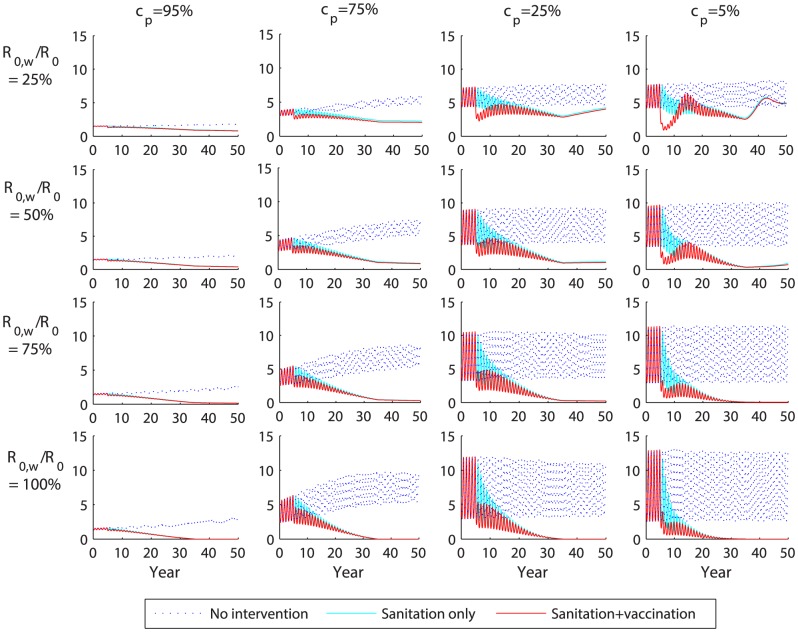
Figure 6. Combined impact of sanitation and vaccination on the projected weekly incidence of typhoid.
The model-predicted weekly number of typhoid cases in Vellore is plotted for values of the proportion of transmission due to chronic carriers (cp) from 5% to 95% and the percent of transmission that is water-borne (R 0,w/R 0) from 25% to 100%. Improved sanitation is modeled as a reduction in water-borne transmission (R 0,w) from baseline levels to zero over a 30-year period beginning in year 5. Vaccination is introduced in year 5 with 80% coverage as routine vaccination of 6 year olds plus a one-time catch-up campaign among 6–15 year olds using ViPS vaccines. The red line represents the overall effect of sanitation plus vaccination, while the light blue line represents the effect of improved sanitation only and the dotted blue line is the projected typhoid incidence in the absence of any intervention.

References

    1. Crump JA, Luby SP, Mintz ED (2004) The global burden of typhoid fever. Bull World Health Organ 82: 346–353. - PMC - PubMed
    1. Buckle G, Walker C, Black R (2012) Typhoid fever and paratyphoid fever: Systematic review to estimate global morbidity and mortality for 2010. J Glob Health 2: 1–9. - PMC - PubMed
    1. Lozano R, Naghavi M, Foreman K, Lim S, Shibuya K, et al. (2012) Global and regional mortality from 235 causes of death for 20 age groups in 1990 and 2010: a systematic analysis for the Global Burden of Disease Study 2010. Lancet 380: 2095–2128 doi:10.1016/S0140-6736(12)61728-0 - DOI - PMC - PubMed
    1. Ochiai RL, Acosta CJ, Danovaro-Holliday MC, Baiqing D, Bhattacharya SK, et al. (2008) A study of typhoid fever in five Asian countries: disease burden and implications for controls. Bull World Health Organ 86: 260–268 doi:10.2471/BLT.06.039818 - DOI - PMC - PubMed
    1. Roumagnac P, Weill F-X, Dolecek C, Baker S, Brisse S, et al. (2006) Evolutionary history of Salmonella typhi. Science (80-) 314: 1301–1304 doi:10.1126/science.1134933 - DOI - PMC - PubMed

Publication types

MeSH terms

Substances