


A Scoping Review of Health Game Research: Past, Present, and Future
- PMID: 24416638
- PMCID: PMC3884078
- DOI: 10.1089/g4h.2012.0011
A Scoping Review of Health Game Research: Past, Present, and Future
Abstract
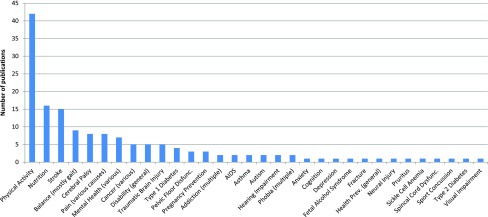
Health game research has flourished over the last decade. The number of peer-reviewed scientific publications has surged as the clinical application of health games has diversified. In response to this growth, several past literature reviews have assessed the effectiveness of health games in specific clinical subdomains. The past literature reviews, however, have not provided a general scope of health games independent of clinical context. The present systematic review identified 149 publications. All sources were published before 2011 in a peer-reviewed venue. To be included in this review, publications were required (1) to be an original research, (2) to focus on health, (3) to utilize a sound research design, (4) to report quantitative health outcomes, and (5) to target healthcare receivers. Initial findings showed certain trends in health game publications: Focus on younger male demographics, relatively low number of study participants, increased number of controlled trials, short duration of intervention periods, short duration and frequency of user-game interaction, dominance of exercise and rehab games, lack of underlying theoretical frameworks, and concentration on clinical contexts such as physical activity and nutrition. The review concludes that future research should (1) widen the demographics to include females and elderly, (2) increase the number of participants in controlled trials, (3) lengthen both the intervention period and user-game interaction duration, and (4) expand the application of health games in new clinical contexts.
Figures
References
-
- Higgins J, editor; Green S, editor. Cochrane Handbook for Systematic Reviews of Interventions. 2011. www.cochrane-handbook.org. [Mar;2011 ]. www.cochrane-handbook.org Version 5.1.0 [updated March 21, 2011] The Cochrane Collaboration.
-
- Laver K. George S. Ratcliffe J. Crotty M. Virtual reality stroke rehabilitation—hype or hope? Aust Occup Ther J. 2011;58:215–219. - PubMed
-
- Bartolomé NA. Zorrilla AM. Zapirain BG. Can game-based therapies be trusted? Is game-based education effective? A systematic review of the serious games for health and education. 16th International Conference on Computer Games (CGAMES); Louisville, KY. 2011. [Mar;2012 ].
-
- Peng W. Lin JH. Crouse J. Is playing exergames really exercising? A meta-analysis of energy expenditure in active video games. Cyberpsychol Behav Soc Netw. 2011;14:681–688. - PubMed
Publication types
Grants and funding
LinkOut - more resources
Full Text Sources
Miscellaneous
